

Anyone emigrating or living permanently abroad tends to think first of the will when it comes to legal precautions. Yet the advance power of attorney (Vorsorgevollmacht) concerns a quite different – and often more urgent – situation: what happens if an accident, a stroke, or a serious illness leaves you temporarily or permanently unable to make your own decisions? Unlike a will, which only takes effect on death, an advance power of attorney takes effect during your lifetime – and this is precisely what makes it a distinct, often underestimated issue when you live abroad. Anyone living far from Germany should ask in good time whether an advance power of attorney drawn up in Germany will actually be effective in the place where it is needed in an emergency.
Advance power of attorney is not a will: the distinction matters especially abroad
A will and the law of succession govern what happens to assets after death. An advance power of attorney, a custodianship directive (Betreuungsverfügung), and a living will/healthcare directive (Patientenverfügung), by contrast, take effect during your lifetime: they determine who may act on your behalf if you yourself – temporarily or permanently – lack legal capacity. This distinction is not an academic nicety. It has practical consequences: an accident or sudden illness can strike anyone, regardless of age, and someone living abroad is often physically far removed from family in Germany – while, at the same time, an unfamiliar legal and healthcare system decides on the next steps.
Anyone who has only a will but no valid advance power of attorney is unprotected in the event of sudden incapacity. For the period during a person’s lifetime, a will is of no help – what matters here is solely whether a robust advance-planning arrangement is in place.
The core purpose of the advance power of attorney: avoiding court-ordered guardianship – even across the border
What happens without an advance power of attorney?
Under German law, a court-appointed guardian (Betreuer) is, in principle, only appointed where necessary. The necessity principle enshrined in the reformed guardianship law (Section 1814(3) of the German Civil Code (Bürgerliches Gesetzbuch, BGB)) expressly provides that no guardianship is ordered where the affairs of an adult can be looked after equally well by an authorised representative. That is precisely the core purpose of the advance power of attorney: it replaces court-ordered guardianship with a self-determined arrangement made in advance – the person you trust acts, instead of a court appointing a stranger as guardian.
Residence abroad increases the risk of a dual structure
Living abroad adds a further layer: if the emergency occurs abroad, a local court or authority may, in principle, also become involved there under the relevant national law and order its own protective measure – such as a local guardianship or custodianship. Whether, and to what extent, a German advance power of attorney prevents this depends crucially on whether and how the target country recognises such a power of attorney. If no valid power of attorney accepted abroad exists, there is a risk, in the worst case, of parallel or conflicting jurisdictions – with the result that relatives in Germany are effectively unable to act, even though an advance power of attorney exists.
Is a German advance power of attorney recognised abroad at all?
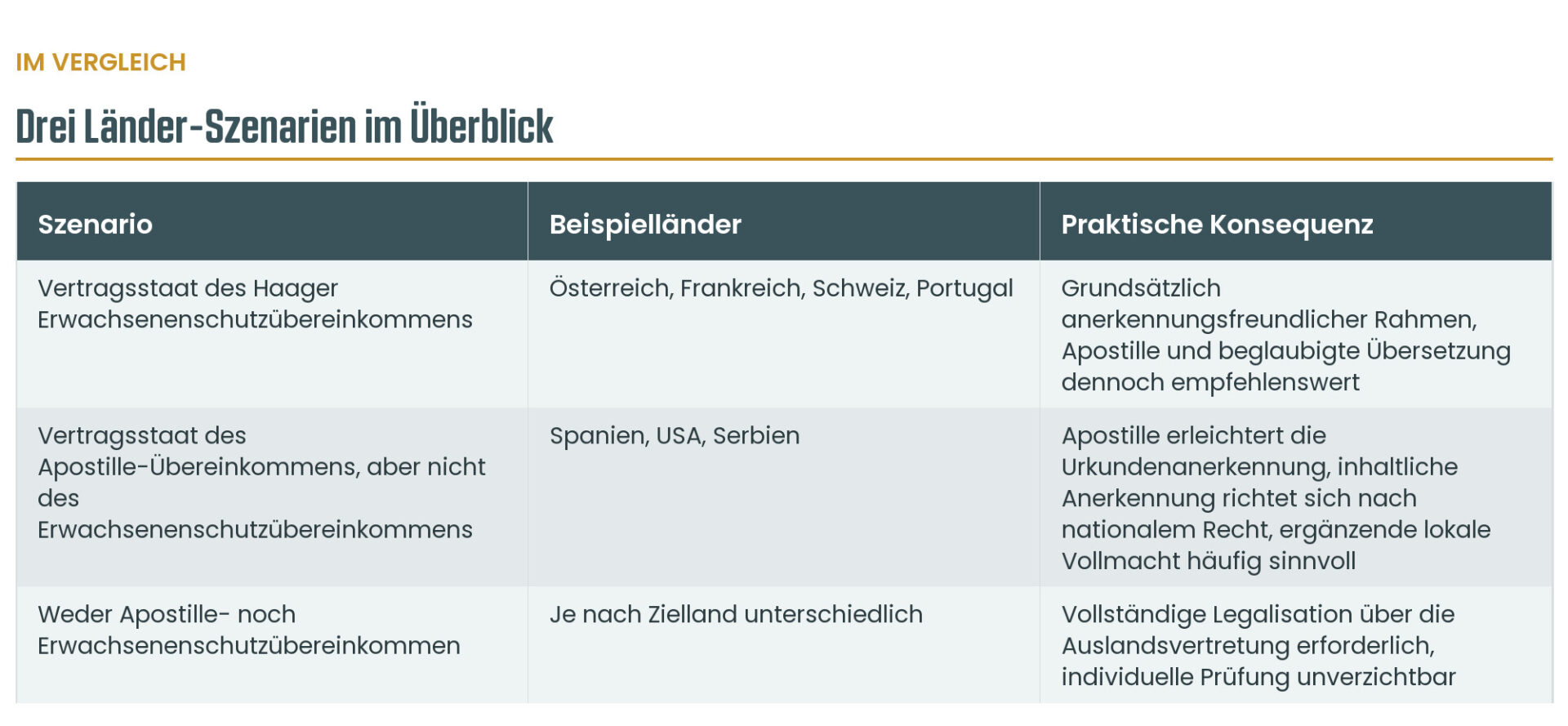
There is no blanket answer. Whether an advance power of attorney drawn up in Germany is accepted abroad depends essentially on which law applies in the target country and on whether a relevant international agreement exists between Germany and that state. In essence, three scenarios can be distinguished:
- The target country is a party to the Hague Convention on the International Protection of Adults – in which case this Convention provides a framework favourable to recognition.
- The target country is a party to the 1961 Hague Apostille Convention but not to the Convention on the International Protection of Adults – here, the apostille helps with recognition of the document itself, without automatically securing the substantive validity of the power of attorney.
- The target country is party to neither convention – in which case full legalisation via the competent diplomatic or consular mission is generally required, and substantive recognition is governed solely by the local rules of private international law.
These three scenarios form the common thread running through all the practical steps that follow.
The Hague Convention on the International Protection of Adults: scope and limits
The Hague Convention of 13 January 2000 on the International Protection of Adults (Erwachsenenschutzübereinkommen, ErwSÜ) is intended to facilitate the cross-border recognition of protective measures for adults – including advance powers of attorney for future incapacity. For Germany, the Convention has been in force since 1 January 2009. Crucially, however, it applies only in relation to states that have actually acceded to it – and so far, that is a comparatively small number.
The overview below also includes each contracting state’s organ donation rule – a point closely connected to the advance power of attorney, because, absent an express living will or objection, an opt-out system may automatically apply depending on the country.
← Tabelle nach links wischen, um weitere Spalten zu sehen
| Contracting state | In force since (selection) | Organ donation rule |
|---|---|---|
| Germany | 1 January 2009 | Opt-in (explicit consent required) |
| France | 1 January 2009 | Opt-out |
| Switzerland | 1 July 2009 | Currently still opt-in – a switch to opt-out has been decided but is not yet in force |
| Finland | 1 March 2011 | Extended opt-out |
| Estonia | 1 November 2011 | Extended opt-out |
| Czech Republic | 1 August 2012 | Opt-out |
| Austria | 1 February 2014 | Opt-out |
| Monaco | 1 July 2016 | Opt-in |
| Latvia | 1 March 2018 | Extended opt-out |
| Portugal | 1 July 2018 | Opt-out |
| Cyprus | 1 November 2018 | Opt-in (registration system) |
| Belgium | 1 January 2021 | Opt-out |
| Greece | 1 November 2022 | Opt-in |
| Malta | 1 July 2023 | Opt-in (reform to opt-out under consultation, not yet adopted) |
| Ireland | 1 September 2024 | Opt-out (since June 2025) |
| United Kingdom (Scotland only) | 1 January 2009 | Opt-out (since March 2021) |
This overview does not claim to be up to date on any given day; before moving abroad, it is always advisable to check the current position – both as to contracting-state status and as to the organ donation rule, which, as the example of Switzerland shows, can change at short notice. On the organ donation column, a second look is also worthwhile: Monaco, Cyprus, Greece, and Malta are, in some overviews, mistakenly listed as opt-out countries but, according to the national sources relied on here, are (still) opt-in countries. Regarding contracting-state status, it is striking at first glance that numerous destinations popular with German emigrants are not contracting states – including Spain, Turkey, and the USA. Even outside the EU, for example in the Balkans, not all states are parties either: Serbia, for example, has not so far acceded to the Convention on the International Protection of Adults, though it has – as discussed further below – acceded to the older Hague Apostille Convention. For all states outside the Convention on the International Protection of Adults, the position is: recognition of the German advance power of attorney is governed by the respective national law, not by a uniform mechanism under international law.
Signed but not yet in force: mere signatory states
In addition to the contracting states listed above, further countries have signed the Convention on the International Protection of Adults but have not so far ratified it – meaning the Convention has not yet entered into force for them. A mere signature does not yet have legal effect; what matters is ratification.
← Tabelle nach links wischen, um weitere Spalten zu sehen
| Signatory state | Signed on | Status |
|---|---|---|
| Netherlands | 13 January 2000 | Signatory, not ratified |
| Poland | 18 September 2008 | Signatory, not ratified |
| Luxembourg | 18 September 2008 | Signatory, not ratified |
| Italy | 31 October 2008 | Signatory, not ratified |
| Romania | 29 August 2024 | Signatory, not ratified |
Italy in particular is easily and mistakenly assumed in practice to be a contracting state because the country has signed – but what matters is solely the ratification that is, so far, still missing.
Apostille and legalisation: making the power of attorney document valid abroad
Regardless of whether the Convention on the International Protection of Adults applies, the power of attorney document itself should be drafted so that foreign authorities, banks, or clinics can readily verify its authenticity. Three steps are relevant in practice here:
- Notarisation or certification. A notarised power of attorney, or at least one bearing a publicly certified signature, enjoys significantly higher acceptance abroad than a purely private document.
- Apostille or legalisation. If the target country is a party to the 1961 Hague Apostille Convention, an apostille suffices as a simplified form of authentication. For states outside that Convention, full legalisation via the competent diplomatic or consular mission is required instead – a process that generally takes considerably longer.
- Certified translation by a translator authorised in the target country. Especially for practical use with local banks, clinics, or authorities, a certified translation into the relevant local language is advisable, even where not strictly required by law. What matters here is not just any translation, but one prepared by a translator authorised or sworn in the target country – only such a version is regularly accepted without further ado by local authorities and banks.
- Multiple language versions for multiple destinations or transit. Anyone who does not simply live permanently in one country, but travels through several countries on the way there or commutes between several countries, should keep more than one language version on hand. For example: someone travelling from Germany via Italy by ferry from Bari to Montenegro may need an Italian version en route in an emergency, as well as one for the actual destination – a single translation tailored only to the final destination falls short in such a scenario.
One point that is often given too little attention in general guides is important here: the apostille and the Convention on the International Protection of Adults solve different problems. The apostille merely confirms the authenticity of the document and the signature – it says nothing about whether the authority approached abroad will recognise the power of attorney as substantively valid. Keeping the two levels clearly separate avoids a false sense of security.
Is the German power of attorney enough – or is an additional local power of attorney needed?
Even where a German advance power of attorney is formally recognised, a further question often arises in practice: is it worth having an additional power of attorney drawn up under the law and in the language of the target country? Several reasons favour a supplementary local power of attorney:
- Local banks, land registries, or clinics are familiar with standard local power-of-attorney forms and often accept these without further enquiry, whereas a translated German document can trigger additional checks.
- For assets located in the target country – such as a local bank account or a property – a local power of attorney can considerably speed up practical handling.
- In countries without the Convention on the International Protection of Adults, an additional local power of attorney offers a degree of protection in case the German document is not recognised on its merits.
Against an uncoordinated dual structure, however, is the fact that two separately drawn-up powers of attorney can, in case of doubt, create contradictions – for example, if different people are authorised, or different scopes of authority are defined. Whether an additional local power of attorney is advisable, and how it should be coordinated in substance with the German one, can only be assessed on the basis of the individual situation – the target country, the asset position, and the family circumstances.
The attorney-in-fact: keep availability and remuneration in mind
An advance power of attorney is only worth as much as the willingness and ability of the appointed person to actually act in an emergency – and where residence is abroad, this can mean travelling in person, communicating with an authority in a foreign language, or providing support over an extended period. Anyone drawing up a power of attorney should therefore not merely formally name a trusted person, but clarify in advance whether that person is practically able and willing to take on this task abroad. This should also include an open discussion of remuneration: whether the attorney-in-fact acts without payment, receives remuneration, or at least receives reimbursement of expenses for travel costs and time, should ideally be discussed and recorded in writing at the time the power of attorney is drawn up.
In addition to the advance power of attorney, a travel assistance policy (Schutzbrief) and international health insurance are often advisable: they do not replace the power of attorney, but cover practical aspects such as repatriation, emergency treatment, or organisational support locally in an emergency, which a power of attorney alone does not address.
Figures on advance powers of attorney in Germany
More than 7 million advance directives are now registered in the Central Register of Advance Directives (Zentrales Vorsorgeregister) maintained by the Bundesnotarkammer (the Federal Chamber of Notaries) (Bundesnotarkammer press release of 6 May 2026). The register covers advance powers of attorney, custodianship directives, living wills, and objections to the spousal emergency representation right (Ehegattennotvertretungsrecht), and has been maintained since 2004.
This figure shows how widespread the advance power of attorney has become as a tool for avoiding court-ordered guardianship in Germany. No separate survey exists on how many of these powers of attorney are designed for use abroad, or how many Germans living overseas even hold one – an indication that the cross-border dimension of the advance power of attorney still plays a secondary role in public awareness, even though it is of particular practical importance for this group.
An illustrative example
The following example is entirely fictitious and serves illustrative purposes only; it does not describe any real case or real person. Suppose a retired German couple permanently relocates their habitual residence to Portugal, a contracting state to the Convention on the International Protection of Adults. Before moving, both draw up a notarised advance power of attorney with a choice-of-law clause in favour of German law and have the document apostilled. If, years later, one spouse suffers a stroke in Portugal, the appointed spouse can, in principle, rely on the German power of attorney – in practice, however, dealings with the Portuguese bank or clinic often run more smoothly where an additional Portuguese-language, notarised local power of attorney, coordinated in substance with the German one, is also in place.
Three country scenarios at a glance
The following overview illustrates the three scenarios described above once again with concrete example countries:
Practical recommendations for people living abroad
Draw up or review an advance power of attorney before moving abroad. Anyone who already has a power of attorney should have it checked before moving to see whether it contains a choice-of-law clause and expressly also covers legal transactions abroad.
Plan for notarisation and an apostille. Notarisation followed by an apostille (or legalisation, if the target country is not a party to the Apostille Convention) considerably increases practical acceptance.
Check the target country specifically. Whether the target country is a party to the Convention on the International Protection of Adults should be clarified individually before moving – the legal position can change as new states accede.
Consider a supplementary local power of attorney. Particularly where assets are located in the target country, or in states without the Convention on the International Protection of Adults, an additional, locally drawn-up power of attorney can ease practical handling in an emergency – coordinated with the German power of attorney, not as an isolated, standalone measure.
Factor in a custodianship directive and a living will. The advance power of attorney should be considered together with a custodianship directive (Betreuungsverfügung) (in case a court-ordered guardianship is imposed despite the power of attorney) and a living will/healthcare directive (Patientenverfügung).
Keep several originals. Several originals or certified copies of the advance power of attorney should exist – one for home, one for the attorney-in-fact, and one to carry when travelling – so that, in an emergency, a single document does not determine your capacity to act.
Conclusion: advance planning that also holds up abroad
Unlike a will, the advance power of attorney is an instrument for use during your lifetime, and it deserves particular attention when you live abroad. Whether and how a German advance power of attorney is recognised in the target country depends essentially on whether that country is a party to the Hague Convention on the International Protection of Adults, and – independently of that – on whether the document is formally structured to hold up abroad, that is, notarised and provided with an apostille or legalisation. In many cases, it is also worth having a local power of attorney in the target country, coordinated with the German one. Clarifying these questions early secures the actual purpose of the advance power of attorney – avoiding court-ordered guardianship – across the German border as well.
The Fiala law firm has published extensively on international advance-planning and asset law and supports clients in aligning their advance power of attorney with a residence abroad in a legally sound way – from the choice-of-law clause, through the apostille, to coordination with a supplementary local power of attorney. Please feel free to contact the firm on a no-obligation basis to discuss your individual situation in an initial consultation.


