

Company acquisitions, corporate restructurings, shareholder disputes: mandates of this kind present attorneys with particular challenges – and mistakes can prove costly for businesses. Unlike many private matters, business cases often involve substantial asset values, several interlocking areas of law, and complex contractual structures. If a mistake is made that a diligent attorney would not have made, this can give rise to a claim for damages on the grounds of attorney liability.
This article explains the special duties of care that apply to attorneys in corporate mandates, the typical scenarios in which liability cases arise, and how both businesses and law firms can protect themselves.
High Standards in Complex Corporate Mandates
Business and corporate law mandates – ranging from company formation to M&A transactions (mergers and acquisitions) and group restructurings – are often legally multi-layered. In such cases, attorneys are expected to provide particularly thorough, cross-disciplinary advice. The Bundesgerichtshof (BGH), Germany’s Federal Court of Justice, sets high standards for an attorney’s knowledge and competence: an attorney who takes on a complex business case must either already possess the necessary expertise or take steps to acquire it – for instance, by involving colleagues with the relevant area of experience. Failing to do so can render the attorney liable for negligent advice.
Special Features of Corporate Mandates
Corporate mandates differ from conventional individual mandates in several respects:
Interdisciplinary aspects: Business cases frequently touch on several areas of law at once – for example corporate law, tax law, employment law, and in some cases international law as well. An attorney must keep these aspects in view. Where the attorney lacks sufficient experience in a particular area, they are obliged either to bring in colleagues with the relevant experience or, at the very least, to advise the client that additional expert input is required. If the attorney fails to do so and, for example, overlooks a tax pitfall in a restructuring, they are liable for the resulting damage.
High asset values: Corporate matters often involve substantial sums. A single mistake can quickly cause significant damage – whether in the form of lost profits, a tax back-payment, a contractual penalty, or losses in share value. For this reason, the principle of the safest course of action applies to attorneys here with particular force: where the legal position is unclear, the safest available course of action must be chosen in order to avoid a possible loss of claims or other damage. Put differently, especially on difficult questions, attorneys should err on the side of caution in order to rule out risk.
Teamwork and coordination: Large business cases are often handled by several attorneys within a firm, who divide tasks such as due diligence, drafting contracts, or liaising with authorities. In such cases, the firm must ensure smooth internal coordination. Clients are entitled to expect that nothing falls through the cracks between areas of responsibility. If, for example, the attorney in charge fails to adequately supervise the work of supporting colleagues and, as a result, a deadline or a piece of information is lost, this can constitute an organizational fault for which the firm, or the responsible attorney, is liable.
Typical Liability Risks in Business Cases
Below are some typical scenarios in which attorneys handling corporate mandates can incur liability.
1. Errors in M&A Transactions (Company Acquisitions)
In company acquisitions, attorneys support the due diligence process (the legal review of the target company), draft contracts – such as purchase and transfer agreements as well as shareholder agreements – and advise on approvals and risks, for example vis-à-vis the Federal Cartel Office (Kartellamt) or in structuring the catalogue of warranties. Liability cases arise here, for example, through:
Incomplete due diligence: If the advisory team overlooks a material circumstance – such as a pending patent lawsuit against the target company or concealed liabilities – and a diligent attorney should have discovered it, the resulting damage may have to be compensated. In practice, buyers in such cases frequently argue that, had they been correctly informed, they would have paid a lower purchase price or would not have proceeded with the acquisition at all.
Defective contract clauses: M&A agreements contain complex mechanisms such as purchase price adjustments, so-called earn-out clauses (under which part of the purchase price depends on the company’s future performance), as well as warranty and indemnity provisions. An attorney can be held liable if, for example, they draft a warranty too weakly and the client consequently loses claims at a later stage. A hypothetical example with no connection to any actual mandate: a buyer wishes to protect itself against certain environmental legacy liabilities, but the contract clause drafted by the attorney does not cover the scenario that actually occurs. The seller is consequently not liable – and the attorney may have to answer for this gap in coverage.
Missed deadlines or formal requirements: Company acquisitions often involve deadlines that must be observed, for example in connection with commercial register filings, employee stock option rights, or a takeover offer under German securities acquisition and takeover law (Wertpapiererwerbs- und Übernahmegesetz, WpÜG). If the attorney or their team misses such a deadline, legal disadvantages such as fines or the loss of rights may result. Attorney liability applies here in principle just as with any other missed deadline – with the difference that the financial consequences in business cases can be particularly severe.
2. Corporate Law Advice and Restructurings
In corporate law matters, attorneys handle matters such as the formation of GmbHs (German limited liability companies), shareholder disputes, capital measures, and corporate reorganizations such as mergers and demergers. Errors relevant to liability here can include, in particular:
Breach of capital maintenance rules: If an attorney clears a distribution or withdrawal from company assets without adequate review, and it later transpires that this was impermissible – for instance in violation of Sections 30 and 31 of the German Limited Liability Companies Act (GmbHG), which protect a GmbH’s registered share capital – claims for damages may arise on the part of the company or an insolvency administrator. Where the flawed advice was causative, the attorney shares in the liability.
Disregard of co-determination and employment law: In restructurings such as a transfer of business or a merger, employee rights must be taken into account. If the attorney overlooks the information duties under Section 613a of the German Civil Code (BGB), which governs the transfer of employment relationships, or fails to arrange a necessary reconciliation of interests with the works council, this can lead to costly delays or severance payments. The company affected could hold the attorney responsible for such additional costs where the attorney is answerable for the breach of duty.
Incorrect recommendation on legal form: If an attorney recommends a particular legal structure without pointing out its tax or liability consequences, this can amount to a breach of the duty to advise. A hypothetical example: a company spins off a business division into a GmbH & Co. KG (a hybrid limited partnership structure) in order to limit liability – but the attorney fails to point out the complex trade tax treatment of this structure. If a tax loss results, the attorney may be liable in recourse. An attorney does not owe comprehensive tax advice in every case – but where tax issues are obvious, the attorney must at least point out that a tax advisor should be brought in, or research the essentials themselves.
3. International and Regulatory Environment
Corporate mandates frequently have a cross-border dimension or concern regulated industries.
Foreign law dimension: Where a project touches on foreign law – for example a joint venture based in another country – the German attorney must advise the client that local law needs to be reviewed. If the attorney fails to do so and it later transpires that, for instance, certain contracts are unenforceable abroad or a required regulatory approval is missing, the attorney can be held liable. A hypothetical example with no connection to any actual mandate: a company acquires a subsidiary in the United States. The German attorney handles the purchase agreement under German law but overlooks the fact that, under US law, the additional consent of a local regulatory authority would have been required. Closing is delayed, and losses result. In such a case, the attorney should have flagged the open US legal question or brought in US colleagues in good time.
Compliance and regulatory matters: Industries such as financial services, pharmaceuticals, or energy are subject to specific statutory requirements. Attorneys advising such clients must be familiar with these special rules or, at the very least, make clear within the mandate that additional specialist support is required. A liability case could arise, for example, where a firm provides legal support for a securities prospectus and, in doing so, violates the EU Prospectus Regulation or requirements of BaFin (Germany’s Federal Financial Supervisory Authority), resulting in a defective prospectus. If investors subsequently bring claims for prospectus liability, the advising firm can be held in recourse where the company must pay damages due to an attorney’s oversight.
Overview: Typical Risk Areas in Business Mandates
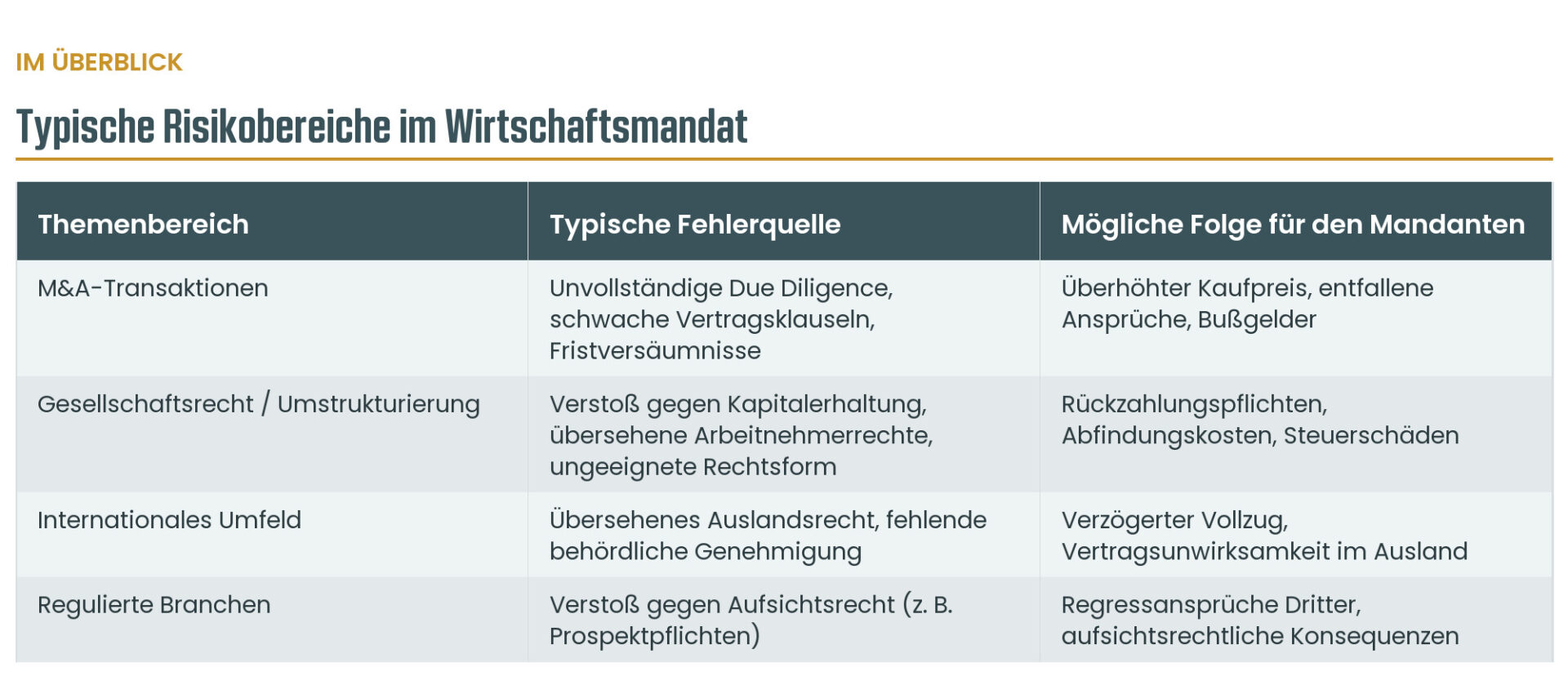
The table does not replace a review of the individual legal case, but it illustrates how varied the possible starting points for attorney liability in business mandates can be.
Protection and Prevention for Clients
There is a good deal that businesses can do to protect both themselves and the attorney they engage from liability cases:
A precise engagement agreement: Set out in writing exactly what scope of services the attorney owes. Where certain areas are not covered – such as tax or patent law advice – this should be stated transparently in the engagement letter. This allows you to know where you may need separate advisors. At the same time, a clear delineation prevents misunderstandings about precisely what the attorney will review.
Communicating all the facts: Keep your attorney fully informed about the facts of the matter. In complex cases, the client often knows their own business best. The more the attorney learns about risks and objectives, the better the advice they can provide. If a client inadvertently withholds an important piece of information, it becomes considerably harder, in hindsight, to assess whether the attorney actually gave incorrect advice. Openness benefits both sides.
The four-eyes principle and interim results: Request regular updates and ask to have interim results explained to you. Ask whether, in the event of uncertainty, additional expert opinions should be obtained – for example from a tax advisor on a particular sub-issue. Many losses arise because a complex matter was handled by a single person when an additional expert perspective would have been advisable. An experienced attorney will usually suggest this themselves; if this does not happen, clients can proactively ask for it.
A Second Opinion During an Ongoing Mandate – Permissible, Sensible, and Often Advisable
In complex business matters, it is entirely legitimate – and in many cases even advisable – to obtain a second opinion, even while the original mandate is still ongoing. The case law recognizes that businesses have a legitimate interest in having an attorney’s work to date reviewed for risks, omissions, or opportunities for improvement. There are several reasons for this:
High asset values and risks: Even minor advisory errors can have significant financial consequences. An independent review serves to minimize risk and is not disloyal toward the previous advisor.
Complex, cross-disciplinary subject matter: M&A projects, restructurings, or international matters frequently require sound expertise across several areas of law. A second opinion can clarify whether all relevant areas have been fully taken into account.
Early detection of errors: Many liability losses occur because clients only discover late that a deadline was missed, a risk was overlooked, or a structure was not adequately secured. An interim review can prevent this.
The role of the original attorney: An experienced advisor will generally not regard an additional expert review as an attack, but rather as sensible quality control ahead of important strategic decisions.
For clients, this means the following: you are entitled – and well advised – to have the attorney’s work to date reviewed at an early stage to confirm that it is legally sound, complete, and strategically viable. In ongoing projects in particular, this is not only permissible but can prevent costly damage claims later on. If a second opinion of this kind reveals significant shortcomings, claims for recourse against the original attorney may exist – regardless of whether that attorney remains engaged on the matter or has already been replaced.
Prevention Measures Within the Firm
On the attorney’s side too, there are measures available to reduce liability risks in business mandates. Firms frequently protect themselves internally through quality controls – for example a four-eyes principle for important documents, due diligence checklists, and regular training. The general professional duty under Section 43 of the German Federal Code for the Legal Profession (Bundesrechtsanwaltsordnung, BRAO) already requires conscientious conduct of the profession; larger firms accordingly sometimes maintain dedicated risk management functions to identify and minimize liability risks at an early stage.
Nevertheless, mistakes happen. The professional indemnity insurance carried by larger firms is typically structured with high coverage limits to cover any resulting damage. Clients can therefore generally expect that legitimate claims will in fact be settled financially.
Conclusion
Complex business cases demand particular diligence, broad expertise, and a strategy of risk provisioning from attorneys. The BGH has made clear that, especially where the legal position is unclear, attorneys must take the safest course of action and take all foreseeable risks into account. Where this standard is not met and your company suffers loss as a result, attorney liability may come into consideration. As an injured client, you need not hesitate to have your claims reviewed – the case law grants no free pass for negligence in this area.
If you suspect that errors in legal advice have occurred within your company – for instance in connection with an acquisition, a restructuring, or an international project – the law firm of attorney Johannes Fiala can support you in assessing your case. We review your documentation, advise you on possible recourse claims against your previous advisor, and show you how to structure future mandates so that you can make business decisions with confidence. Contact us to discuss your individual situation.


