

A settlement is meant to bring a dispute to a final end – for many clients, this initially feels like a relief. Yet this is precisely where the risk lies: anyone who agrees to a settlement generally waives, irrevocably, any further claims, even if it later emerges that the actual damage was considerably higher. Whether a settlement turns out to be advantageous or disadvantageous for the client depends largely on how thoroughly the advising attorney explained the opportunities, risks, and final effect of the settlement beforehand.
This article explains the duties an attorney owes when concluding a settlement, when attorney liability for errors in advice may arise, and what rights clients have if they later have doubts about the advice they received.
Settlement Agreements: What Does This Mean for Clients?
A settlement under Section 779 of the German Civil Code (Bürgerliches Gesetzbuch, BGB) is a consensual resolution of a dispute in which both parties make mutual concessions and reach binding arrangements. Often, this finally settles all reciprocal claims arising from the underlying facts – including claims whose actual extent was not yet foreseeable at the time the settlement was concluded.
Within the scope of the engagement, attorneys are obligated to advise their clients comprehensively before concluding a settlement and to protect them from avoidable disadvantages. For clients, this means: before you agree to a settlement, your attorney must have informed you in such a way that you can independently assess the advantages and disadvantages. The attorney’s typical duties in connection with a settlement include, in particular:
- Explaining opportunities and risks: The attorney must explain how a settlement compares to a court decision – for example, whether the client would receive significantly less through the settlement than could have been expected in the event of a successful lawsuit.
- Explaining the effect of clauses: If the settlement contains a full and final settlement clause (Abgeltungsklausel) excluding all further claims, the attorney must make clear that no additional claims can be asserted once the agreement is signed.
- Advising against the settlement where necessary: If a proposed settlement is recognizably disadvantageous, the attorney must actively advise against it. If the attorney fails to do so and the client suffers financial harm as a result, liability may arise.
- Respecting the client’s decision: No settlement may be concluded without the client’s prior consent. If the attorney concludes a settlement on their own authority, this can trigger not only civil liability but, in particularly serious cases, may also constitute the criminal offense of breach of a party’s trust (Parteiverrat) under Section 356 of the German Criminal Code (Strafgesetzbuch, StGB).
When Is the Attorney Liable in Connection with a Settlement?
The attorney is liable if they breach a contractual duty arising from the engagement and the client suffers damage as a result. In settlement cases, the most common allegation is that the attorney failed to adequately explain an unfavorable settlement. A typical scenario: the attorney advises the client to accept a settlement that is significantly below the actual value of the claim, without informing the client of this discrepancy or of the final, binding effect of the full and final settlement clause. If it later emerges that the actual damage was considerably higher, the client can hold the attorney liable for damages in the amount of the difference.
The Federal Court of Justice (Bundesgerichtshof, BGH) confirmed these strict standards in its judgment of April 20, 2023 (case no. IX ZR 209/21): as a general rule, an attorney must explain the advantages and disadvantages of a settlement to the client in such a way that the client understands the material consequences and can make an independent decision. Only in the exceptional case where a client is already fully informed – which, in the BGH’s assessment, is rare in practice – may the attorney dispense with separate advice on the point. In a dispute, the attorney then bears the burden of proving that the client genuinely had no remaining need for information. This case law illustrates how demanding the requirements for attorney advice are, designed to protect clients from unknowingly disadvantageous settlements.
Typical Errors in Settlements and Their Consequences
Case law and legal practice reveal several recurring patterns of error in connection with settlement agreements:
- Inadequate risk disclosure: The attorney fails to explain that the settlement amount may not cover the actual costs of the damage or its remediation. This was precisely the subject of the BGH judgment of April 20, 2023, mentioned above: a client had concluded a settlement of EUR 55,000 following moisture damage to his house, even though the actual cost of remedying the defects was considerably higher. He was unaware of the full implications of the full and final settlement clause contained in the agreement. The BGH made clear that a comprehensive duty to advise had existed in this case.
- Waiver of claims without express notice: If the settlement contains wording stating that all claims are thereby settled, and the attorney does not expressly point out the implications of this, an error in advice is likely. Clients may lose rights as a result without even noticing.
- Undue haste or pressure: If an attorney pushes for a quick settlement – for example, to bring the engagement to a swift conclusion – without giving the client time to consider the matter or pointing out alternatives such as continuing the litigation, this violates the attorney’s duties to advise.
- Settlement against the client’s will: If an attorney concludes a settlement on their own authority – whether by mistake or deliberately – this constitutes a serious breach of duty. Depending on the circumstances, the client may be able to rescind the settlement and hold the attorney liable for the resulting disadvantages.
The legal consequences of such errors are referred to as attorney liability, or recourse (Regress) against the attorney. If the client has suffered financial harm as a result of the settlement – for example, receiving a lower amount than a court judgment would have awarded, or losing further claims – the attorney must, as a general rule, compensate this damage. In practice, a hypothetical outcome of the litigation is often used as the basis for assessment: what would the client most likely have received without the settlement? The difference between that hypothetical amount and the lower amount actually achieved through the settlement can form the basis of the damages claim. What matters is the perspective at the time the settlement was concluded: should a careful attorney, at that time, have advised against the settlement or reserved certain claims in order to cover the client’s future risks? If this question is to be answered in the affirmative and such advice was not given, liability is likely.
Client Rights: What to Do If You Suspect an Error in Advice
As a client, you have the right to proper advice. If you later have doubts as to whether your attorney informed you correctly before you agreed to a settlement, the following approach may be advisable:
- Review the documents: Obtain all documents relating to the settlement – the settlement agreement itself, correspondence with the attorney, and court records – and check whether the risks or waiver clauses were documented.
- Obtain a second opinion: An attorney experienced in the field of attorney liability can assess whether duties to advise were breached. An error in advice often only becomes apparent once an independent lawyer reviews the case.
- Determine the damage: Establish what damage you have suffered. As an illustration: if you would most likely have received EUR 100,000 without the settlement, but received only EUR 50,000 through the settlement, the potential damage – subject to any litigation costs saved – is around EUR 50,000.
- Involve the attorney’s professional indemnity insurance: Attorneys are required to maintain professional indemnity insurance (Berufshaftpflichtversicherung). If the allegation is well-founded, the attorney will generally report the matter to their insurer, and the claim will typically be pursued through the attorney or their insurer. A client bringing a claim directly against the insurer is only possible in exceptional cases, such as the insolvency of the law firm.
- Observe the limitation period: Claims arising from attorney errors generally become time-barred after three years from the date the client became aware of the error, or from the date the client should have become aware of it (Section 195 BGB in conjunction with Section 199 BGB). Anyone who hesitates too long risks that the claim has already become time-barred.
Note on the limitation period for settlement-related errors
The limitation period frequently does not begin with the conclusion of the settlement itself, but only once the client realizes, or should realize, that the settlement was disadvantageous or that the advice received was inadequate. Typical triggers for this awareness include: the client discovers that the settlement does not cover the actual costs; a later professional review reveals that claims were unnecessarily given up; or a new attorney points out deficiencies in the advice previously given. Because the question of limitation is often decisive in attorney liability cases, it is advisable to determine early on whether a period has already begun running – or whether it has not yet started at all, for lack of awareness.
Caution regarding assessments by third parties
When evaluating a settlement, clients should not rely on assessments from persons or bodies who are not authorized to provide legal advice – such as intermediaries, general online guides, or foreign providers without German admission to practice law. Legal assessments generated by generative AI systems should be viewed with similar caution: even though their answers may sound plausible, they can be professionally incomplete or simply incorrect. A reliable assessment of one’s own situation should therefore always be carried out by a qualified attorney.
Second opinion during ongoing proceedings
It is permissible – and, particularly where a settlement is imminent, often advisable – to obtain an independent second opinion while an engagement with another attorney is still ongoing. Such a review can help identify possible errors in advice at an early stage, realistically assess alternatives, and avoid a premature or disadvantageous settlement.
Do Not Underestimate the Client’s Contributory Negligence
Attorney liability is not a one-way street: depending on the circumstances, the client may bear substantial contributory negligence – in extreme cases, up to 100 percent. This includes, in particular, informing the attorney fully and truthfully, involving necessary experts in good time, and actively working toward professional clarification in complex matters. Which experts are advisable or necessary in a given case depends heavily on the nature of the dispute:
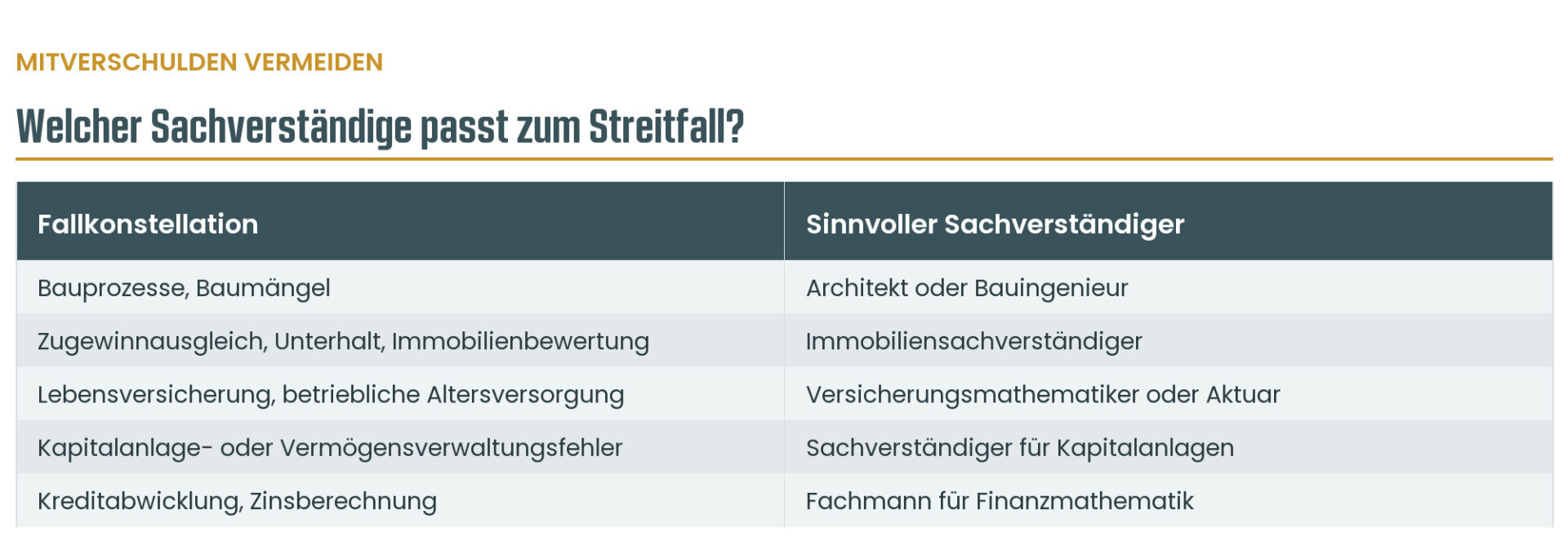
Contributory negligence is particularly likely where even an average layperson, in the specific situation, would clearly have needed to obtain expert support – comparable to the common practice of engaging an expert to assess the damage after a traffic accident.
FAQ – Frequently Asked Questions About Attorney Liability in Settlement Agreements
When is an attorney liable for a poor settlement?
An attorney is liable if they breach their duties – for example, by failing to adequately explain the risks, alternatives, or the final, binding nature of a settlement – and the client suffers financial harm as a result. The standard applied is how a careful attorney would have had to act at the relevant time.
May my attorney conclude a settlement without my consent?
No. As a general rule, an attorney must never conclude a settlement on their own authority. If they do so nonetheless, the settlement is often voidable, and the attorney is generally liable to recourse. In particularly serious cases, even the allegation of breach of a party’s trust (Parteiverrat) may arise.
Can I undo a settlement if I was given incorrect advice?
This depends on the specific circumstances. Under certain conditions, a settlement can be voided on the grounds of mistake, deception, or lack of consent. Independently of this, a claim for damages against the attorney may generally exist, even if the settlement itself remains valid.
When does the limitation period begin for errors in advice concerning a settlement?
The standard limitation period is three years, but it frequently does not begin until the client becomes aware, or should have become aware, that the advice was defective. This point in time is often significantly later than the actual conclusion of the settlement – which is why having the individual case reviewed by an attorney is worthwhile.
Is it permissible to obtain a second opinion during ongoing proceedings?
Yes, without restriction. It is not only permissible but, particularly where a settlement offer is pending, often advisable to obtain an independent second opinion in order to uncover errors in advice and avoid a premature or disadvantageous settlement.
Conclusion
When concluding a settlement, clients often have a great deal at stake – typically, the final resolution of the entire claim. Attorneys must therefore advise their clients comprehensively before such far-reaching decisions are made. If risks are concealed or the attorney acts to the client’s disadvantage, a claim for recourse against the attorney may exist. Anyone who suspects they were given incorrect advice in connection with a settlement should have that suspicion legally reviewed rather than letting the matter rest.
The Fiala law firm, with a focus on attorney liability law, advises clients who wish to have a settlement already concluded, or an upcoming settlement decision, assessed from a legal perspective. Please get in touch to discuss your individual situation in an initial consultation.


