

Few European tax systems have generated as much legal uncertainty in recent years as the Dutch “Box 3” regime – the taxation of savings, securities, and other capital assets. Ever since the Hoge Raad, the Supreme Court of the Netherlands, declared the system incompatible with European law in its so-called Kerstarrest (Christmas ruling), Box 3 taxation has been undergoing a multi-year overhaul that remains unfinished to this day. For Germans living in the Netherlands, this is far more than a footnote: anyone holding savings, a securities portfolio, or a second property is directly affected. And for anyone generally considering a move abroad, the Dutch case offers a vivid illustration of how quickly wealth taxation in Europe can shift through politics and litigation alike – a topic that, against the backdrop of the revived German wealth tax debate, is also gaining relevance on this side of the border.
What Is Box 3? An Overview of the Dutch Tax System
Dutch income tax is divided into three “boxes”: Box 1 covers income from employment and owner-occupied housing, Box 2 covers income from substantial shareholdings in companies, and Box 3 covers income from savings and investments – that is, bank deposits, shares, funds, and also additional real estate that is not the taxpayer’s own main residence.
Legally speaking, Box 3 is therefore not a classic net wealth tax levied on assets themselves, as existed in Germany before 1997, but formally an income tax: what is taxed is not the wealth itself, but the return generated from it. The decisive point of contention in recent years, however, was how that return was determined. Until recently, the tax authorities applied flat-rate, deemed (fictitious) rates of return – regardless of whether a saver actually achieved such a return. Anyone who kept their money in a low-interest savings account was taxed as though they had earned a considerably higher return on the capital markets. This mechanism – taxing a deemed rather than an actual return – is precisely the core of what is commonly understood as the “Box 3 model” and is often referred to, somewhat simplistically, in public debate as the Dutch “wealth tax.”
Currently (as of 2026), the Box 3 tax rate is a flat 36 percent on the calculated return. A tax-free allowance – the so-called heffingsvrij vermogen – exempts a base amount of capital from taxation; for 2026, this stands at approximately €59,357 for single taxpayers and approximately €118,714 for tax partners (i.e., spouses or registered partners filing jointly). Only the assets above this threshold are subject to the return calculation.
The Kerstarrest: How the Hoge Raad Struck Down the System in 2021
On 24 December 2021, the Hoge Raad handed down a landmark ruling – since known as the Kerstarrest (literally: “Christmas ruling”) – holding that taxation based on a deemed, flat-rate return violates the right to property under Article 1 of the First Protocol to the European Convention on Human Rights (ECHR), as well as the prohibition of discrimination under Article 14 ECHR – at least where the deemed return significantly exceeds the return actually achieved. The court made clear that, as a matter of principle, taxpayers may only be taxed on their actual return on capital, not on a return merely attributed to them.
The consequences of this ruling continue to occupy the Dutch tax administration and politics to this day. Initially, around 60,000 taxpayers who had filed a timely and properly formulated objection against their Box 3 assessment for the years 2017 to 2020 automatically received a recalculation under the so-called “Rechtsherstel” (legal redress) scheme. For everyone else, it long remained unclear whether, and to what extent, they were also entitled to a correction. It was not until June 2026 that the Hoge Raad provided further clarity on this point, ruling that taxpayers who had not filed a timely objection against their already final assessments for the years 2017 to 2020 cannot, as a general rule, derive a retrospective refund claim from the Kerstarrest.
The Current State of Play: Transitional Rules, the Counter-Evidence Scheme, and the Reform from 2028
Since 19 July 2025, the Netherlands has applied the so-called “Wet tegenbewijsregeling box 3” (Counter-Evidence Regulation Act for Box 3) – a scheme that allows taxpayers to use the “Opgaaf Werkelijk Rendement” (Declaration of Actual Return) form to demonstrate that their actual return was lower than the flat-rate deemed amount, and accordingly to be taxed only on the lower, actual figure. This scheme applies retroactively to tax years from 2017 onward and simultaneously serves as a bridge to a fundamentally new system.
On 12 February 2026, the Tweede Kamer, the lower house of the Dutch parliament, passed the bill “Wet werkelijk rendement box 3” (Actual Return Box 3 Act), with 93 of its 150 members voting in favor. At the core of this bill is a definitive change of system: going forward, Box 3 is to be redesigned, in principle, as an accrual-based capital gains tax, under which actual returns as well as positive and negative changes in the value of assets are recorded and taxed on an ongoing basis – meaning the deemed return would finally be abolished as the basis of assessment. Until the new system takes effect, the transitional scheme with the counter-evidence option remains in force.
Formally, the reform remains subject to approval by the Eerste Kamer, the Dutch Senate, as well as royal assent. The government is aiming for the new law to take effect on 1 January 2028. This timeline is politically ambitious but not set in stone: should the Senate fail to pass the bill in time, delayed budgetary effects alone would, according to the responsible state secretary, create an estimated funding gap of around €2.4 billion per year from 2028 onward. Anyone dealing with the Box 3 issue should therefore bear in mind that the state of the reform remains in flux, and that individual details – such as the specific transitional deadlines or the final design of the accrual-based capital gains tax – may still change before parliamentary approval is finalized.
Figures on the Box 3 Rechtsherstel: According to the Dutch State Secretary for Taxation, Eelco Eerenberg, the government has set aside a total of €16.6 billion for the corrections and refunds under the Box 3 Rechtsherstel (legal redress) scheme – a figure that vividly illustrates the financial scale of remedying a single flaw in a tax system.
What Does This Mean for Germans Living in the Netherlands?
Germany and the Netherlands have a double taxation treaty (DTT), which in its current version has been in force since 2016. It governs which state may tax which types of income and is intended, as a general rule, to prevent the same investment returns from being taxed twice. This does not mean, however, that German nationals resident in the Netherlands are exempt from Box 3 – quite the opposite: anyone who is tax-resident there is, as a rule, subject to Dutch Box 3 taxation on their worldwide capital assets, while Germany, as the country of departure, typically loses its right to tax those assets accordingly.
Three points are of particular practical relevance:
- Savings and securities accounts count too. Even a securities portfolio or savings balance held in Germany can be included in the Box 3 assessment base if the taxpayer’s tax residence is in the Netherlands – regardless of which country the account or portfolio is held in.
- A second property is a classic Box 3 case. Anyone who owns an additional property besides their own main residence – for example, a rented apartment or a holiday home – must generally pay tax on its value under Box 3, which can result in a noticeable tax burden, particularly where the property is valuable.
- The counter-evidence option needs to be actively used. Anyone who can demonstrably show that they achieved a lower return in past years than the one deemed by the tax authorities should check whether the counter-evidence scheme can still be invoked within the applicable deadline – otherwise, as the June 2026 ruling shows, the right to a correction may be permanently lost.
Hypothetical example for illustration (not a real client situation): A German national relocates their residence to the Netherlands and retains a German securities portfolio as well as a rented-out apartment in Germany. Under Dutch law, both assets can, in principle, be included in the Box 3 assessment base, while Germany, as the country of departure, generally loses its right to tax them. Whether, and to what extent, this also triggers so-called exit taxation (Wegzugsbesteuerung) under German law depends on the circumstances of the individual case and requires separate legal review before the move.
Germany vs. the Netherlands: Where Does the German Wealth Tax Debate Stand?
Germany has not levied a wealth tax since 1997. In 1995, the Federal Constitutional Court (Bundesverfassungsgericht) had declared the then-existing structure unconstitutional due to the unequal valuation of real estate and capital assets; since then, the Wealth Tax Act (Vermögensteuergesetz) has not formally been repealed but is no longer applied in practice. Unlike in the Netherlands, the German debate concerns a classic net wealth tax that attaches directly to the stock of assets held – a legally and constitutionally different approach from the Dutch Box 3 model, which is formally an income tax on (deemed or actual) returns on capital.
The political debate about reintroducing such a tax has, however, flared up again: on 6 March 2026, the Bundestag debated motions on wealth taxation from the Die Linke and Bündnis 90/Die Grünen parliamentary groups for the first time. Die Linke is calling for a rate of one percent on private wealth above the first million euros, rising on a linear scale to five percent above €50 million and twelve percent above €1 billion. The Greens are focusing instead on reforming inheritance tax, from which they see additional revenue potential of around €20 billion for the German federal states (Länder). The SPD parliamentary group has likewise put forward its own inheritance tax reform proposals under the concept “FairErben.” A concrete legislative implementation of a new German wealth tax is therefore not currently in sight – yet the comparison with the Netherlands shows how quickly an issue considered politically dead for years can return to the agenda once majorities shift and public pressure builds.
Wealth Taxation in EU Comparison (Rough Overview)
The following overview places the Dutch Box 3 model in context compared with selected other European countries:
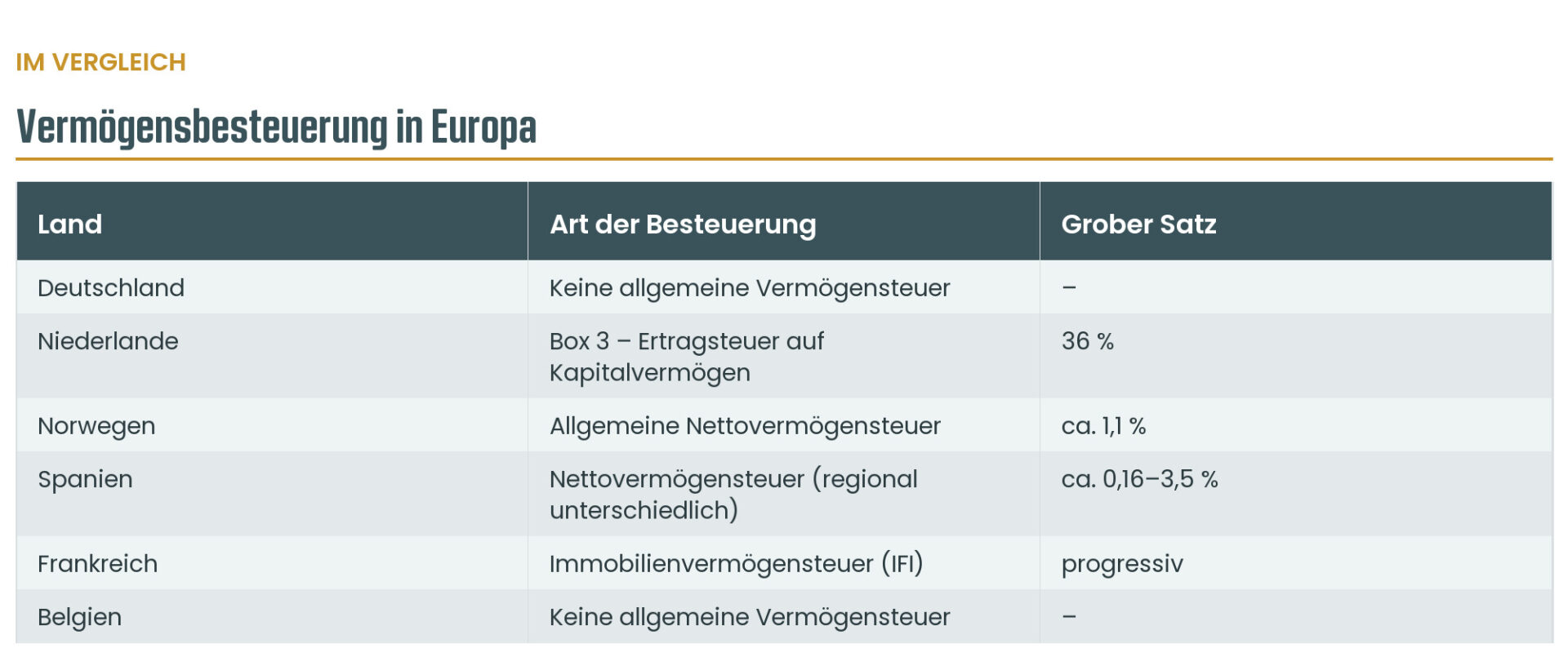
*Note: The figures provide a rough, simplified overview only. Rates, allowances, and regional particulars change regularly and should be verified for their current status in each individual case.*
What Emigrants Should Generally Keep in Mind Regarding Wealth Taxation
The Dutch case illustrates, by way of example, what matters when assessing wealth taxation abroad in Europe – regardless of whether the Netherlands is specifically involved:
- Tax systems are not a static condition. Within a few years, Box 3 evolved from an established, largely unquestioned model into a transitional system repeatedly corrected by the courts. Anyone basing their emigration or wealth planning solely on the current state of the law should factor in that it may change.
- The legal form of taxation matters, not just the rate. Whether a levy is structured as an income tax on investment returns or as a net wealth tax on the stock of assets has significant practical and constitutional consequences – as the Kerstarrest shows, it is precisely this distinction that can provide the basis for a successful legal challenge.
- Double taxation treaties determine allocation, not amount. A DTT governs which state is entitled to tax – it does not protect against that state actually exercising its taxing right, and doing so in full.
- A change of residence is not an isolated tax decision. Exit taxation, inheritance law, registration obligations, and social security issues are all interconnected and should be reviewed together before a move.
Anyone wishing to permanently avoid such developments sometimes also looks toward states outside the EU that have no general wealth taxation at all – for example in the Western Balkans, where Serbia, for instance, does not levy a general wealth tax. Such a step, however, is far more than a purely tax-driven decision and should be examined in its full legal scope before it is treated as a supposedly simple solution.
When Is Legal Advice Worthwhile?
The development of the Dutch Box 3 regime makes clear that wealth taxation abroad in Europe is rarely a rigid, permanently reliable framework, but instead changes continuously through the interplay of legislation, case law, and political debate. Anyone living in the Netherlands, holding assets there, or planning to move there should have their own situation reviewed in good time in light of the current legal position – and its foreseeable further development – rather than relying on information that is several years old.
Johannes Fiala is a German lawyer (Rechtsanwalt) with experience in international tax and wealth law matters relating to emigration, relocation, and cross-border wealth structures. The firm, which focuses on international tax law, helps clients accurately assess their personal situation with regard to foreign wealth taxation – such as in the case of the Dutch Box 3 regime – and structure it in a legally sound manner.
Do you live in the Netherlands, are you planning a move there, or would you like your cross-border wealth structure reviewed from a legal standpoint? Contact the Fiala law firm to have your individual situation assessed before the next stage of reform affects your tax burden.


