

Anyone who has obtained a judgment, a default payment order (Vollstreckungsbescheid), or a court settlement in Germany will, in many cases, want to be able to enforce that title even if the debtor has moved abroad or holds assets there. Conversely, many people planning to emigrate themselves ask: can a German judgment follow me to my new home, or does relocating actually offer some protection against creditors? There is no blanket answer – it depends significantly on which country is involved and on what legal basis enforcement is even possible there. This article provides an overview of the key mechanisms and typical country scenarios.
Civil-law titles only: what this article does not cover
The following discussion concerns exclusively the recognition and enforcement of *civil-law* titles – such as judgments, default payment orders, or enforceable settlements. Tax enforcement measures by German authorities, as well as criminal extradition and search proceedings, follow their own rules under international law and are not covered here.
Three routes to recognition: EU law, bilateral treaties, national law
There is no automatic, worldwide enforceability of German judgments. Whether a German title can be enforced abroad depends essentially on one of three possible legal bases:
- European law: Within the EU, cross-border enforcement is considerably simplified by EU regulations; a German judgment can generally be enforced in other Member States without a new court proceeding. The same broadly applies in relation to Switzerland, Norway, and Iceland under the Lugano Convention – Liechtenstein, despite being an EFTA member, is not a party to this Convention.
- The Hague Judgments Convention (HCCH 2019): Since 1 September 2023, the EU Member States (with the exception of Denmark) are additionally bound by the HCCH Convention of 2 July 2019 on the Recognition and Enforcement of Foreign Judgments in Civil or Commercial Matters. For the first time, it creates a multilateral framework for mutual recognition of judgments that is not limited to the EU. Alongside the EU, Ukraine, Uruguay (since 1 October 2024), and the United Kingdom (since 1 July 2025) have since acceded, with further states expected to follow. Because the list of contracting states keeps changing, it is worth checking the current status table maintained by the Hague Conference (HCCH) before relying on any fixed list. As between EU Member States, the Brussels Ia Regulation continues to take precedence over the HCCH Convention.
- Bilateral treaties: Germany has concluded its own bilateral recognition and enforcement treaties with certain states outside the EU/EFTA. These provide for mutual recognition of judgments, provided certain conditions are met.
- National law and reciprocity: Where EU law, the HCCH Convention, and a bilateral treaty are all absent, recognition is governed by the law of the state concerned. Many countries require reciprocity – meaning they will only enforce foreign judgments if the other state would do the same in reverse. Absent a specific legal basis, a separate court recognition procedure in the enforcing country is usually required, often referred to as “exequatur proceedings”.
In practice, this means: whether a German title is enforceable abroad depends largely on which of these legal bases applies in the target state. In states with close legal ties to Germany (EU/EFTA, HCCH contracting states, countries with a bilateral treaty), enforcement is comparatively straightforward for creditors. In countries without any such legal basis, by contrast, it can be considerably more difficult – up to the point of being practically unenforceable. Anyone living abroad or planning to move should be aware of these differences as information about their own legal position – not as a guide to deliberately frustrating legitimate claims; the latter can trigger its own legal risks, as explained further below.
Enforcement within the EU and the EEA/Lugano area
EU Member States recognise court decisions from other EU countries comparatively straightforwardly, on the basis of shared rules. Thanks to the Brussels Ia Regulation (Regulation (EU) No. 1215/2012), no separate recognition procedure has generally been required since 2015: a German civil judgment is, for example, directly enforceable in France or Italy once certain formalities have been completed – in particular, the production of a certificate from the German court under Article 53 of the Brussels Ia Regulation. For undisputed claims, there is additionally the European Enforcement Order, which can likewise be obtained via a court certificate and allows enforcement in any EU state without further review.
Certain areas are excluded from the scope of the Regulation, such as certain family-law decisions or insolvency proceedings, which follow their own rules. Enforcement may also be refused where it would be contrary to the public policy (ordre public) of the enforcing state – a very rare exception in practice, for example where the debtor was denied the right to be heard.
Example: Spain and Austria
In Spain, the creditor applies to the German court that issued the judgment for a certificate under Article 53 of the Brussels Ia Regulation and can then, together with the judgment, apply directly to the competent Spanish court to initiate enforcement; the debtor can raise objections only in narrow exceptional cases. In Austria, as a neighbouring EU state, enforcement of German titles is likewise very effective – a German creditor can, for example, apply for a garnishment order at the district court (Bezirksgericht) with jurisdiction over the debtor’s place of residence.
For emigrants within the EU/EEA, the upshot is: relocating offers little protection against German creditors. A German title for, say, EUR 50,000 can typically be enforced in Spain or Sweden without a fresh trial.
Enforcement of German judgments in third countries
Outside the EU and EFTA, the picture becomes more nuanced. Here, it is always worth looking closely at the specific target country.
Special case Liechtenstein: no treaty of its own, but routes via Switzerland and Austria
Liechtenstein is an EFTA member, but – unlike Switzerland, Norway, and Iceland – is not a party to the Lugano Convention, nor is there a bilateral treaty with Germany. A German title is therefore not automatically recognised there. What always remains open in this case, however, is the route of bringing an entirely new, independent action before the Liechtenstein courts – with corresponding costs and the need to instruct a Liechtenstein lawyer; the German judgment can at most serve as evidence, not as an enforceable title in its own right. Because Liechtenstein, conversely, maintains its own recognition agreements with Austria and Switzerland, it can be worth checking, depending on the case, whether proceedings could instead be brought first in Austria or Switzerland – for example where a court has jurisdiction there in its own right – with the resulting judgment then enforced against Liechtenstein via the relevant agreement, rather than litigating afresh directly in Liechtenstein.
Countries with a bilateral treaty
Germany has historically concluded its own recognition and enforcement treaties with individual states, for example with Israel and Tunisia; separate treaty arrangements also exist with the United Kingdom. Within the EU and the EFTA area, older bilateral treaties (for example with Austria, Belgium, or the Netherlands) have now largely been superseded by EU law or – in the case of Norway as a Lugano state – by the Lugano Convention, and are of little practical relevance today. In the remaining third countries with a genuine bilateral treaty, a local court recognition procedure is usually still required, but one that follows clearly defined, treaty-agreed criteria.
Countries without a treaty, but with a functioning judiciary
For states such as the USA, Canada, or Australia, whether and how a German judgment is recognised is determined solely by national law. The United States has no federal statute on the recognition of judgments; most states, however, have their own broadly similar laws under which foreign money judgments are generally recognised, provided the originating court had jurisdiction and the proceedings were fair. In practice, the creditor must bring a separate recognition action in the relevant state – an additional proceeding, but one that is usually limited to recognition and does not reopen the merits of the case from scratch. Once recognition has been granted, enforcement can proceed as if from a domestic judgment. Canada and Australia broadly follow a similar approach. Important in practice: such proceedings take time, generate additional costs, and require instructing local lawyers.
Emerging markets and offshore jurisdictions without a treaty
Some states, as a matter of principle, do not recognise foreign titles without a fresh proceeding of their own. In Thailand, for example, a German judgment must be relitigated there from scratch; it can at most serve as evidence, but the decisive factor is the independent assessment by the Thai court. In the offshore jurisdiction of St Kitts and Nevis, there are no bilateral treaties with Germany; owing to the Commonwealth tradition, some recognition rules exist there for British judgments, but a German creditor would generally have to relitigate. In Serbia and Montenegro, national civil procedure law likewise applies: absent a treaty under international law – which does not exist with Germany – the outcome turns essentially on the principle of reciprocity, which is often difficult to establish in an individual case. In practice, enforcing a German title there is often difficult to the point of being practically ineffective.
Country overview at a glance
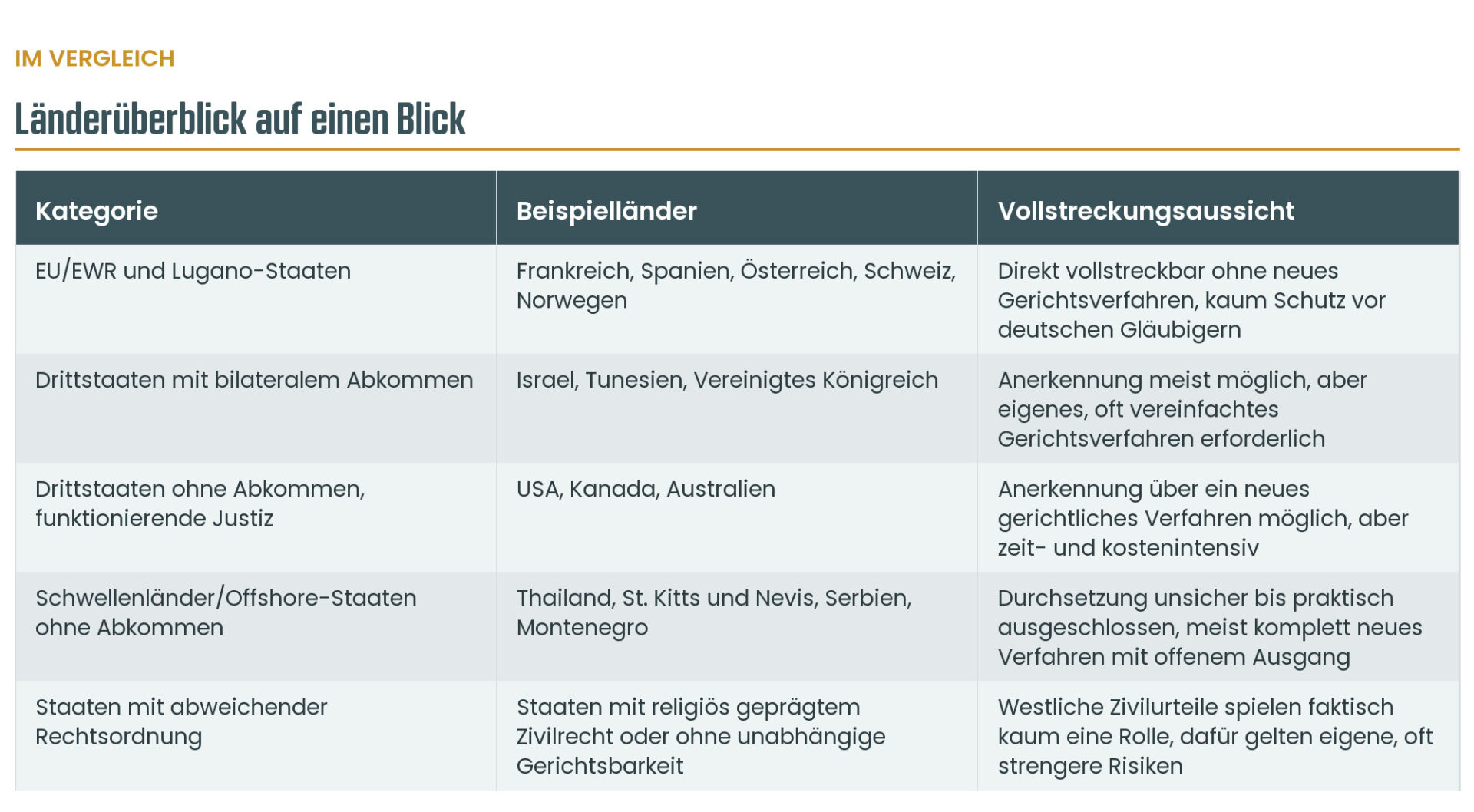
This overview does not replace a case-by-case assessment: there are differences within each category, and details such as the type of title, the date of service, or local assets can shift the outcome in an individual case.
Special case: emigrating for debt discharge
Beyond the enforcement of existing titles, there is another, often-discussed aspect: conducting insolvency proceedings abroad, formerly sometimes referred to as “insolvency tourism”. For years, Germans were able to go through insolvency proceedings in several EU states with, in some cases, considerably shorter discharge periods than in Germany. Following the EU Insolvency Regulation and the reform of German residual debt discharge (Restschuldbefreiung), which now generally provides for a three-year period, this incentive has diminished noticeably. In addition, a discharge abroad always requires a genuine centre of main interest (COMI) in the state concerned – a purely sham emigration will not be recognised by the courts.
What those affected abroad should know
Check the legal position in the target country in advance. Within Europe, there is hardly any escape from German titles; outside Europe, the position varies considerably from country to country. Relying solely on the non-recognition of a judgment is risky – creditors may, in certain circumstances, also sue directly in the new state of residence, and some banks cooperate internationally on account garnishment.
Seek legal advice early. Advice from someone familiar with international enforcement law helps to realistically assess what legal consequences an existing German title actually has in the relevant state of residence.
Know the limits of legitimate asset planning. Measures taken solely or predominantly for the purpose of frustrating existing or foreseeably impending claims can be reversed under the German Avoidance Act (Anfechtungsgesetz, AnfG) and may, in individual cases, even carry criminal liability (Section 288 of the German Criminal Code (Strafgesetzbuch, StGB), frustrating compulsory enforcement). Legally sound asset and succession planning pursued for legitimate purposes is something fundamentally different from a deliberate attempt to leave existing creditors empty-handed – what matters is always the temporal and substantive connection with the specific claim.
A typical misconception, by way of illustration: anyone who assumes that moving to, say, Spain or Portugal automatically puts a German judgment out of reach is, as a rule, mistaken – within the EU, a German title can in practice generally be enforced thanks to the Brussels Ia Regulation just as it could domestically.
Practical pointers for creditors
Don’t give up too quickly. Even without a treaty, it is often worth examining the enforcement options locally, for example with the support of local lawyers. In some cases, debtors pay voluntarily once faced with a recognition action, in order to avoid the additional costs involved.
Secure the title EU-wide while you still can. If the debtor still has assets in the EU, instruments such as the European Order for Payment or the European Account Preservation Order can help before assets are moved elsewhere.
Plan the choice of forum ahead of time for new contracts. For contracts with an international dimension, it is advisable to agree arbitration clauses or a choice-of-court agreement under the Hague Convention on Choice of Court Agreements (HCCH 2005), whose contracting states now include, alongside the EU, countries such as Mexico, Singapore, and the United Kingdom. Arbitral awards can also be enforced comparatively reliably in a large number of states worldwide via the New York Convention – in some respects more reliably than state-court judgments.
Conclusion
Enforcing German judgments abroad is not an area for blanket answers. For creditors, the position is: a German title is not automatically worth something worldwide – what is required is either an international legal basis such as EU law and the HCCH Convention, or an additional court proceeding locally. Anyone affected personally should conversely bear in mind: simply moving away generally does not provide protection from German creditors – almost never within Europe, and even outside Europe the outcome remains dependent on the individual case and the creditors’ conduct, not on any blanket formula.
Rechtsanwalt Johannes Fiala and the firm have published extensively on international enforcement law and asset protection, and support both creditors seeking to enforce claims abroad and emigrants who want a realistic assessment of how far creditor access reaches in their chosen destination country. Please feel free to contact the firm on a no-obligation basis to discuss your individual situation in an initial consultation.


