

Anyone wishing to relocate a GmbH – the German private limited liability company (Gesellschaft mit beschränkter Haftung) – abroad quickly faces a range of critical decisions: Is it sufficient to relocate only the company’s management abroad, or must the company change its registered seat and, with it, its legal form? What tax consequences does relocating a GmbH abroad trigger – for the company itself and for the shareholders personally? And what risks arise if the move is carried out without proper legal preparation? This article outlines the key concepts, the relevant case law, and the fundamental tax principles, and shows what matters most in practical implementation.
What Does It Mean to Relocate a GmbH Abroad? An Overview of the Administrative Seat and the Statutory Seat
In everyday usage, the term “seat” of a GmbH is often imprecise. From a legal perspective, two distinct levels must be distinguished:
- Statutory seat (Satzungssitz): the seat specified in the company’s articles of association and entered in the commercial register.
- Administrative seat (Verwaltungssitz): the place where the management actually operates – in other words, where the company’s fundamental business decisions are made.
The two need not coincide. In practice, they frequently diverge – for example, where a shareholder-managing director relocates abroad personally and thereafter conducts the company’s business from there, while the statutory seat formally remains in Germany. This is precisely where the legal complexity begins, because merely shifting the administrative seat is a different matter from formally relocating the statutory seat together with a change of the applicable legal system.
The Real Seat Theory and the Incorporation Theory in International Company Law
Whether a company continues to be recognized as a GmbH after relocating abroad depends on which company-law connecting principle the country in question follows:
- Under the real seat theory (Sitztheorie), a company is governed by the law of the state in which its actual administrative seat is located. If a GmbH relocates its administrative seat to a state that likewise follows the real seat theory, this can result in the company no longer being treated there as a corporate entity with limited liability, but at best as a partnership – with the shareholders facing personal liability.
- Under the incorporation theory (Gründungstheorie), a company remains subject to the law of the state in which it was incorporated, regardless of where its actual management later relocates. This principle is followed, among others, by numerous jurisdictions of Anglo-American legal tradition.
Within the European Union, this distinction has lost much of its practical edge as a result of the case law of the European Court of Justice (EuGH), because freedom of establishment now largely secures an identity-preserving relocation of seat within the EU. Vis-à-vis third countries outside the EU, however, the distinction between the real seat theory and the incorporation theory remains practically significant.
The Key EuGH Rulings: Daily Mail, Cartesio, Polbud
Three decisions of the EuGH continue to shape the legal assessment of cross-border seat relocations within the EU to this day:
In Daily Mail, the EuGH held that companies are “creatures of national law” and exist only within their respective national legal system – accordingly, at the time, the state of origin was still permitted to significantly restrict a company’s departure.
In Cartesio, the EuGH confirmed, as a matter of principle, the right of Member States to regulate the departure of a company incorporated under their law. At the same time, however, the Court made clear that a Member State may not deny a company the possibility of an identity-preserving cross-border conversion where the law of the destination state provides for such a conversion.
The Polbud decision went even further: the EuGH recognized that freedom of establishment also covers the mere relocation of the statutory seat combined with a simultaneous change of the applicable legal system – even where the actual economic activity continues to be carried out in the country of origin. A destination state may not categorically refuse to recognize such a conversion if it permits equivalent conversions for its own domestic companies.
This line of case law has paved the way for a distinct, EU-wide harmonized procedure: the cross-border conversion.
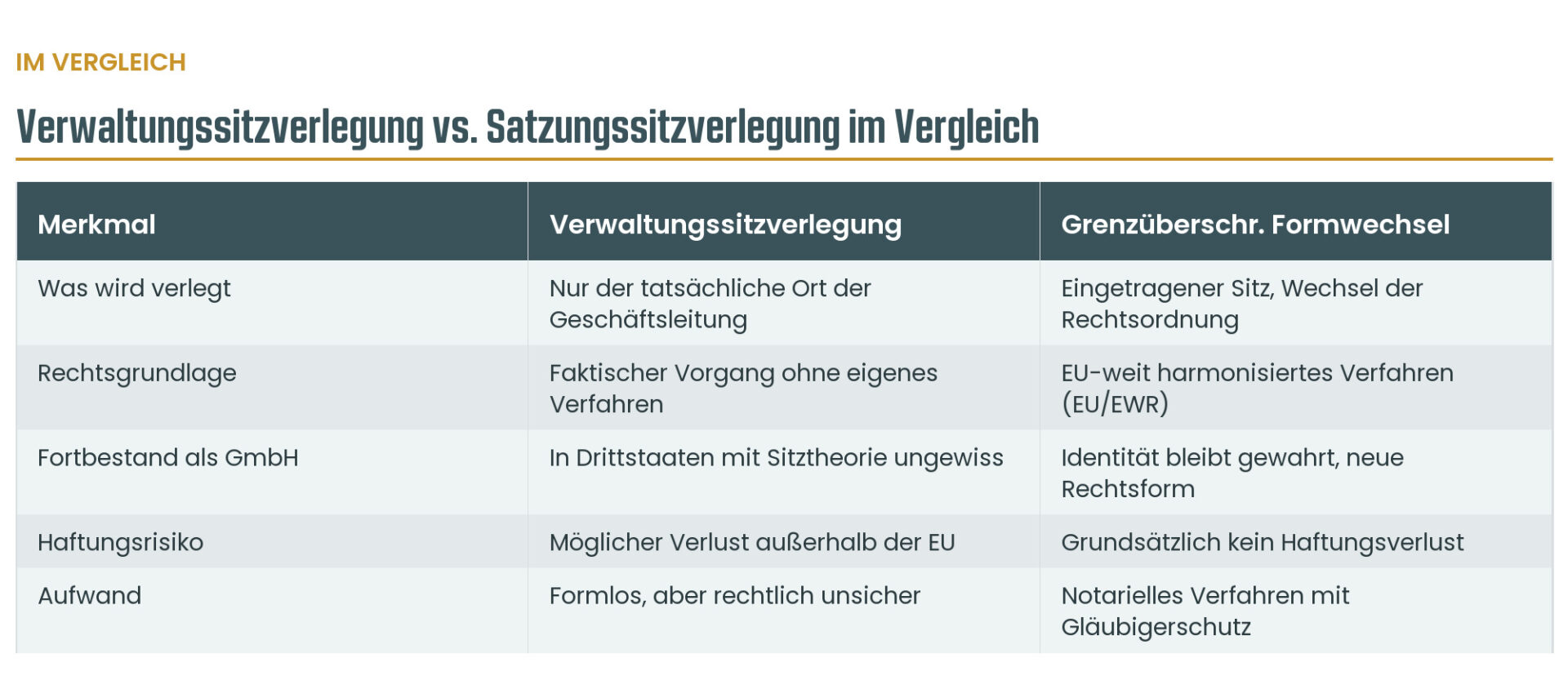
Relocating the Administrative Seat vs. Relocating the Statutory Seat: A Comparison
The following overview shows the key differences between the two approaches:
Relocating a GmbH Abroad Without a Conversion: These Risks Arise
Anyone who relocates the administrative seat of their GmbH abroad without formally converting the company takes on considerable risks.
Double Taxation Through Dual Residence
Many states do not base a corporate entity’s tax residence on the place of its registration, but on the place of its actual management. If the statutory seat formally remains in Germany while management is factually exercised abroad, the company can become subject to unlimited tax liability in two states at once. An existing double taxation treaty can mitigate such conflicts, but it does not always prevent them entirely – particularly where no treaty exists, or where the “tie-breaker” rules do not produce a clear result in the individual case.
Loss of Limited Liability
If a GmbH relocates its administrative seat to a state that follows the classic real seat theory, its recognition there as a corporate entity with limited liability may be called into question if the local incorporation requirements have not been met. In the worst case, the company is treated as a partnership – with the result that the shareholders become personally and unlimitedly liable for its obligations. Within the EU, this risk has been largely contained as a result of the EuGH case law described above; vis-à-vis third countries, it remains real and depends substantially on the destination state’s international company law.
Cross-Border Conversion: A Legally Secure Way to Relocate a GmbH Abroad Within the EU
For shareholders wishing to relocate within the European Union, the EU Mobility Directive offers a decisive advantage: it has created a distinct, EU-wide harmonized framework for the cross-border conversion, which has been implemented in Germany through corresponding provisions of the Transformation Act (Umwandlungsgesetz – UmwG). Unlike a merely factual relocation of the administrative seat, the company’s legal identity is preserved in a cross-border conversion: provided the procedure is properly followed, the German GmbH becomes a comparable corporate entity of the destination state, without any need for liquidation and re-incorporation.
The procedure is formally more demanding than a mere relocation of the administrative seat: among other things, it requires a conversion plan, a report to the shareholders, protective mechanisms for creditors and minority shareholders, and the involvement of a notary and the registry court. In return, however, the company gains legal certainty over the entire process – a significant difference from a purely factual relocation, whose legal assessment in a dispute often remains uncertain.
EU or Non-EU Destination: A Comparison of Target Countries
Whether a cross-border conversion is available at all depends decisively on the destination country:
← Tabelle nach links wischen, um weitere Spalten zu sehen
| Aspect | EU/EEA Country | Non-EU Country (Third Country) |
|---|---|---|
| Freedom of establishment | Applies; a cross-border conversion is possible | Does not apply; no EU-law entitlement to an identity-preserving departure |
| Applicable company statute | Largely secured by EuGH case law | Depends on the destination state’s private international law; in some cases a strict real seat theory applies |
| Risk of loss of status | Low, provided the conversion is carried out properly | Real, particularly without local re-incorporation or recognition |
| Procedure | Regulated, formal conversion under the UmwG | Typically only possible via liquidation in Germany and re-incorporation in the destination state |
| Practical lead time | Plannable, but multi-stage and time-consuming | Usually even more extensive, since two separate procedures are required |
Tax Consequences: Exit Taxation of the Company and the Shareholders
Regardless of whether a GmbH formally relocates its seat or merely shifts its administrative seat, the departure regularly triggers tax consequences – on two separate levels.
Corporate Exit Taxation (Entstrickungsbesteuerung) at the Level of the GmbH
If Germany loses its right to tax the hidden reserves of a corporate entity as a result of its departure – for example, because the company is no longer subject to unlimited tax liability in Germany and no domestic nexus, such as a permanent establishment, remains – this generally triggers what is known as corporate exit taxation (Entstrickungsbesteuerung). The hidden reserves embedded in the company’s business assets are then treated as if they had been disposed of at fair market value, even though no actual sale takes place. In economic terms, this can result in a substantial tax liability that falls due immediately, without any corresponding liquid funds flowing to the company.
Exit Taxation of the Shareholders (Wegzugsbesteuerung)
On a second level, what is known as exit taxation (Wegzugsbesteuerung) affects the shareholders personally. If a natural person holding a substantial interest in a corporate entity relocates their residence abroad, and unlimited tax liability in Germany consequently ends, this is treated for tax purposes as though that person had disposed of their shares at fair market value – even though no sale has taken place. The resulting tax can amount to substantial sums, particularly where hidden reserves have built up since the company was founded. Under certain conditions, the legislator provides for the possibility of deferring the tax liability; the precise terms of such deferral – for example, as to duration, interest, and security – vary depending on the destination country and the applicable statutory framework, and should be examined on a case-by-case basis.
These two levels of taxation – the company and the shareholders – are legally independent of one another and can both apply simultaneously when a GmbH relocates abroad. Anyone who fails to consider both levels frequently underestimates the true overall tax burden of a relocation abroad.
Practical Recommendation: Structuring Advice Before Implementation
A typical example from our advisory practice illustrates the problem: suppose a shareholder-managing director relocates abroad within Europe together with their family and henceforth conducts the business of their GmbH from there, without adjusting the company’s statutory seat or its tax structure. After a few years, it emerges that both the new state of residence and Germany are asserting tax claims against the company, while at the same time exit taxation looms over the personally held shares – a consequence that was not considered at the time of the move. Such a scenario can, as a rule, be avoided through early planning.
It is therefore essential to clarify the legal and tax structure before the actual move – not only afterwards. This includes, in particular:
- deciding whether a mere relocation of the administrative seat is sufficient, or whether a cross-border conversion should be pursued,
- examining whether the destination country follows the real seat theory or the incorporation theory, and how it treats cross-border conversions,
- coordinating at an early stage with the applicable double taxation treaty in order to avoid dual residence,
- calculating the anticipated corporate and shareholder exit taxation in order to avoid liquidity shortfalls,
- coordinating closely between German and foreign legal and tax advisors as well as the responsible notary.
Relocating a GmbH abroad without prior structuring advice therefore carries a significantly higher risk than a carefully planned departure in which company-law and tax-law questions are considered together from the outset.
Conclusion and Next Steps
Relocating a GmbH abroad is legally and fiscally demanding, but – particularly within the EU – it has, with the cross-border conversion, become a process that can now be properly planned. Anyone who hastily relocates only the administrative seat risks double taxation and, in the worst case, the loss of limited liability. By contrast, anyone who selects the appropriate structure early on and calculates the tax consequences at both the corporate and the shareholder level can structure the departure in a legally secure manner.
Attorney Johannes Fiala and his Munich-based law firm, with a focus on international company and tax law, provide support in planning the relocation of a GmbH abroad – from selecting the appropriate procedure to coordinating with foreign advisors. Contact the firm without obligation to discuss your plans in an initial consultation.


