

Many managing directors of a German GmbH (the German equivalent of a limited liability company) dream of relocating their centre of life abroad while the company continues to operate in Germany. What is frequently underestimated is that managing director liability after relocating abroad is not a marginal tax issue, but goes to the core of personal responsibility. A managing director’s corporate office does not end at the national border – the power of representation, the duty of care, and the duty to file for insolvency continue to apply regardless of where the managing director actually resides. Anyone who underestimates this continued applicability risks personal liability, additional tax assessments, and, in the worst case, criminal consequences.
This article explains which duties remain in place after relocating abroad, where the biggest practical pitfalls lie, and how managing directors can protect themselves legally before moving.
Why Relocating Abroad Does Not End a Managing Director’s Corporate Duties
Appointment as managing director of a GmbH is not tied to a domestic residence. Under Section 35 of the German Limited Liability Companies Act (Gesetz betreffend die Gesellschaften mit beschränkter Haftung, GmbHG), the power to represent the company continues to apply even after the managing director relocates their centre of life abroad. There is no automatic resignation from office simply by moving abroad, and the company continues to be validly represented externally – with all the rights, but also all the duties, that follow from this.
In practice, this means that the duty of care, the duty of loyalty, the duty to maintain proper accounting and organise the business, and all statutory filing and notification obligations continue unchanged. A residence abroad is legally no free pass – if anything, it raises the practical bar for organisation and availability, since physical presence on the ground is missing.
Managing Director Liability After Relocating Abroad at a Glance: What Stays the Same, What Changes
The following table shows which key duties remain unchanged and where a residence abroad creates practical or legal particularities.
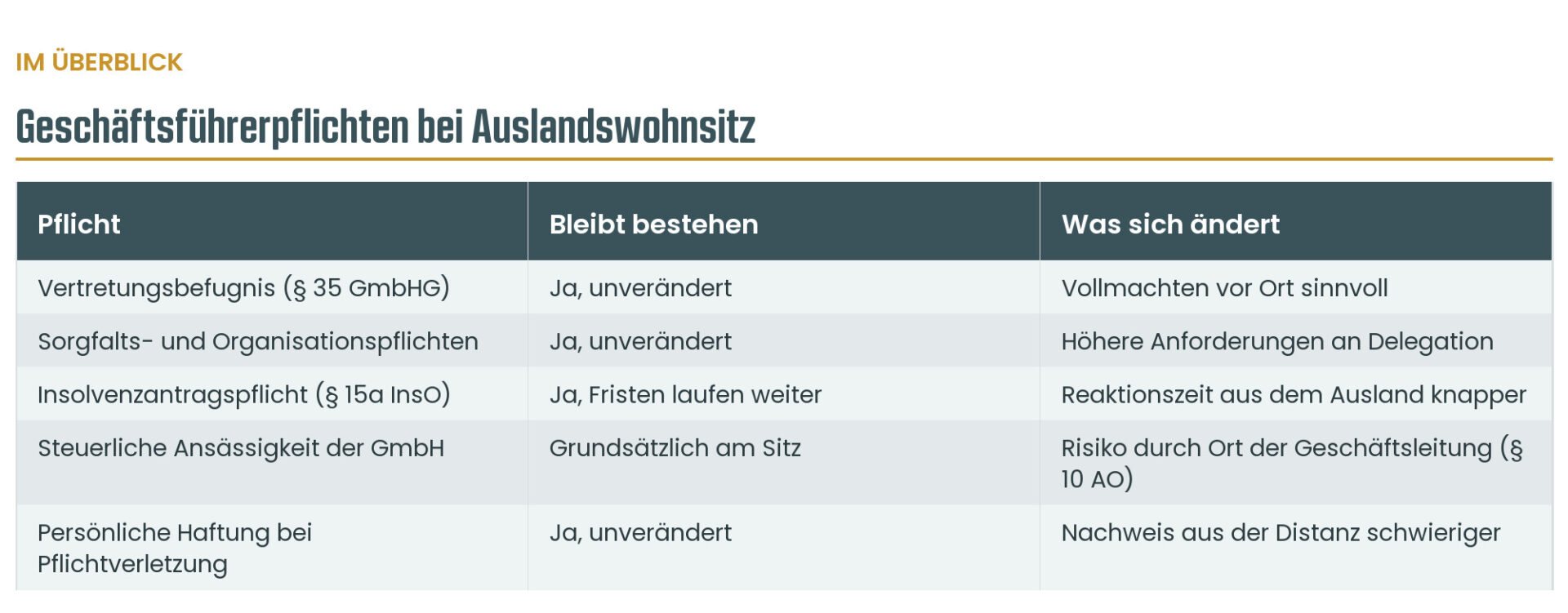
The table makes one thing clear: legally, almost nothing changes about the duties themselves – but a great deal changes in terms of how realistic it is to fulfil them on time from a distance.
The Underestimated Risk: The Place of Management Moves With You
One aspect that is frequently given too little attention when planning a relocation abroad is the tax risk surrounding the so-called place of management (Ort der Geschäftsleitung). Under Section 10 of the German Fiscal Code (Abgabenordnung, AO), this refers to the place where the decisive will for the day-to-day management of the business is actually formed – not the place registered as the company’s seat in the articles of association. In addition, under Section 12 AO, a fixed place of business abroad – for example, a permanently used home office from which the business is actually managed – can already constitute a permanent establishment.
In practical terms, this means that if a managing director, after relocating, actually and permanently makes the essential business decisions from their new place of residence – signing contracts, making strategic decisions, organising day-to-day management from there – the GmbH’s tax nexus can unintentionally shift along with them. The company would formally remain registered at its German seat, but could become additionally taxable in the destination country, for example on profits earned or attributable there. Whether and to what extent this actually leads to double taxation depends heavily on the individual case and the applicable double taxation treaty – blanket statements cannot seriously be made here.
An illustrative example, purely hypothetical and unrelated to any actual case: A managing director permanently relocates their residence abroad but continues to make all of the GmbH’s operational decisions from there by video conference and email. If they travel to Germany only rarely, for individual appointments, the question may arise as to whether the actual place of management has, in effect, moved along with them. Precisely such situations should be thought through legally and from a tax perspective before relocating, rather than dealt with retrospectively.
The Duty to File for Insolvency From Abroad: Section 15a InsO Knows No Foreign Exception
The issue of managing director liability after relocating abroad becomes particularly acute when it comes to the duty to file for insolvency. Under Section 15a of the German Insolvency Code (Insolvenzordnung, InsO), an insolvency petition must be filed without undue delay, and at the latest within the statutory deadline, once the company is unable to pay its debts or is over-indebted. This duty is tied to the corporate office, not to the place of residence. A managing director abroad must therefore recognise a crisis just as reliably, and respond just as promptly, as a managing director based in Germany.
Time zone differences, limited availability of the tax advisor or accounting department, delayed postal delivery, or simply the greater distance from day-to-day operations are, from a legal standpoint, no excuse. If the deadline is missed, personal liability towards creditors and the company is at risk, and – in the case of intentional or grossly negligent delay – criminal consequences for delaying insolvency proceedings (Insolvenzverschleppung) may follow. Anyone managing a company from abroad should therefore place even greater emphasis on robust, ongoing monitoring of the company’s financial situation.
Service of Documents and Availability as a Liability Trap
Another practical pitfall: official correspondence, court service of documents, and important deadlines are based on the address recorded in the commercial register (Handelsregister) and on actual availability. If a managing director moves abroad without arranging for reliable mail handling and forwarding, delayed responses to reminders, deadline notices, or official inquiries can result. Service of documents abroad also typically takes longer, which can further shorten deadlines that are already tight.
A delayed response – for example, to a court letter or a tax deadline notice – can quickly develop into an independent liability risk, regardless of whether there was originally any breach of duty at all. A managing director’s de facto duty of organisation therefore also includes arranging their own affairs so that important information reaches them reliably and in good time, even across national borders.
Practical Safeguards When Relocating Abroad
Managing directors planning to relocate abroad should consider a number of organisational and legal measures at an early stage:
- Clear rules on representation and powers of attorney: Who is authorised to make which decisions in day-to-day business when the managing director is not immediately available?
- A second managing director resident in Germany: In many situations, this is advisable to ensure ongoing operational management and local availability, and to reduce the risk of the place of management shifting abroad.
- An agent authorised to receive service, or a reliable mail-handling arrangement: So that deadlines are not missed simply due to postal transit times.
- A documented organisational structure: Who makes which decision, where, and how is this recorded in a verifiable way – particularly with a view to the question of where the company is actually managed from.
- D&O insurance: Directors’ and officers’ liability insurance (Vermögensschaden-Haftpflichtversicherung für Organe) is, in practice, a common instrument for economically cushioning the risk of personal liability. However, it does not replace careful legal and tax planning of the relocation – it supplements it.
- Early legal and tax review of the individual case: Whether and to what extent the place of management actually shifts, which double taxation treaty applies, and how the GmbH’s representation structure can most sensibly be adapted can only be assessed on the basis of the specific circumstances.
On D&O insurance specifically: Having a policy in place alone is not yet a reliable safeguard. In practice, D&O contracts frequently contain coverage gaps and exclusions that are rarely identified when the policy is arranged through a broker or intermediary – whereas the claims handler on the insurer’s side knows them very precisely when a claim arises. If such a gap only becomes apparent once a liability case has already occurred, the supposed protection can turn out to be worthless, while the premiums paid over the years are economically lost. Anyone who genuinely wants to know whether their D&O policy will hold up in connection with a relocation abroad should have the specific terms reviewed by an independent party before making a final decision – separate from the intermediary through whom the policy was originally arranged.
Another, often overlooked point: where the GmbH or AG (German stock corporation) itself holds the policy as policyholder, the insured manager generally has no independent influence over claims handling once they no longer hold a power of representation – for example, after relocating abroad or being removed from office. Under Sections 44 and 45 of the German Insurance Contract Act (Versicherungsvertragsgesetz, VVG), the right of disposal over the insurance generally rests with the company as policyholder, not with the individual insured officer. For officers who have left the company or moved abroad, this can mean being dependent, in the event of a claim, on decisions they no longer have direct access to. This can certainly be structured differently – for example, through separate notification and consent rights for former officers, or a so-called run-off clause that secures cover for past periods even after leaving office – but this point should already be considered when planning the relocation, not only once a claim arises.
Not yet conclusively resolved from a tax perspective, and therefore deliberately noted here only as an open question: whether the company’s assumption of the premium for a separate deductible insurance (Selbstbehaltsversicherung) is to be treated as taxable employment income is assessed inconsistently – the statutory deductible is specifically intended to influence the officer’s personal conduct, which could argue against a predominantly business-related interest on the part of the company. A clear, directly applicable ruling by the Federal Fiscal Court (Bundesfinanzhof, BFH) on this specific constellation could not be identified; anyone wishing to take out or be reimbursed for such deductible insurance through the company should have the tax treatment clarified in advance for the specific case, rather than relying on a blanket assessment.
Conclusion
A managing director’s relocation abroad is legally possible, but it does not change their fundamental responsibility as a corporate officer. The power of representation, the duty of care, and the duty to file for insolvency continue to apply unchanged, while at the same time the practical demands on organisation, availability, and tax classification increase. In practice, the risk that the GmbH’s place of management unintentionally shifts abroad for tax purposes is often considered too late. Anyone who plans early – organisationally, under company law, and from a tax perspective – can significantly reduce their liability risk.
If you are a managing director planning to relocate abroad, or already living abroad, and would like to secure your position legally: the law firm of Rechtsanwalt Johannes Fiala advises on company law and tax matters relating to managing directors’ duties when resident abroad. Please get in touch to discuss your individual situation.


