

Anyone who has paid into a Riester pension contract for years and then permanently moves abroad sooner or later asks an uncomfortable question: do the state subsidies and tax benefits remain intact – or must everything eventually be repaid? The answer depends decisively on where the move leads and when it takes place. Within the EU and the EEA, the subsidy is now largely unproblematic. For a move to a state outside the EU and the EEA – for example Serbia, Switzerland, the United Kingdom, or overseas – a fundamentally different legal position generally applies, one that changed noticeably under the 2022 Annual Tax Act (Jahressteuergesetz 2022); an important grandfathering rule applies for the United Kingdom, addressed further below. Anyone planning to emigrate should understand this distinction before making the contract paid-up, terminating it, or simply “forgetting” about it. This article sets out the current legal position and shows the practical options available before emigrating.
What Must Actually Be Repaid in the Event of “Detrimental Use”
A Riester contract is a contract certified under the German Old-Age Pension Contracts Certification Act (Altersvorsorgeverträge-Zertifizierungsgesetz, AltZertG), intended exclusively to serve subsidised retirement provision. In return, the saver receives state subsidies during the accumulation phase and, where income is sufficiently high, an additional special-expenses deduction under Section 10a of the German Income Tax Act (Einkommensteuergesetz, EStG) – § 10a EStG. If the accumulated capital is later not paid out as intended – as an old-age pension or in one of the legally permitted special forms – the law refers to “detrimental use” (schädliche Verwendung, § 93 EStG). The consequence: all credited subsidies and the separately assessed tax benefit must be repaid, and the returns generated within the contract are taxed retroactively (§ 94 EStG).
Emigration abroad is regulated by statute as its own special case of repayment, § 95 EStG. This provision declares §§ 93 and 94 EStG “correspondingly” applicable where the person entitled to the subsidy has their residence or habitual abode outside the EU and the EEA. What matters is not the move as such, but a very specific point in time – and this is precisely where many guides become imprecise.
The Decisive Point in Time: Residence at the Start of the Payout Phase
Since the revision brought about by the 2022 Annual Tax Act, in force since 1 January 2023, the repayment obligation under § 95 EStG depends solely on where the person entitled to the subsidy has their residence or habitual abode “as from the start of the payout phase” – that is, at the start of the pension. A move to a non-EU/EEA state during the accumulation phase – that is, during the active working years – no longer, by itself, triggers an automatic repayment obligation. Before 2023 the position was different: back then, the mere fact of emigrating during the accumulation phase could already be treated as detrimental use – a rule that many older online guides still reproduce unchanged, even though it is now outdated.
In practical terms, this means that anyone who lives outside the EU/EEA temporarily or permanently during their working life need not necessarily react immediately. The position only becomes critical if, at the start of pension payments – the beginning of the payout phase – the residence remains outside the EU and the EEA. § 95 EStG also captures a constellation that is easily overlooked: someone who formally still has a residence in an EU/EEA state, but who is treated as resident in a third state under a double taxation agreement with that state, is likewise treated for the purposes of this provision as having emigrated to the third state.
Emigration to the EU/EEA: The Subsidy Generally Remains Intact
The background to today’s comparatively saver-friendly rule for moves within the EU/EEA is a judgment of the European Court of Justice of 10 September 2009 (Case C-269/07, Commission v Germany). The ECJ objected to the German practice then in force, under which Riester savers could lose their subsidy on moving to another EU country, as a breach of the freedom of movement for workers and as indirect discrimination. The German legislature subsequently had to amend the rules; the Act Implementing EU Tax Requirements (Gesetz zur Umsetzung steuerlicher EU-Vorgaben), promulgated on 8 April 2010 (Federal Law Gazette, Bundesgesetzblatt, BGBl. I p. 386), established that a move within the EU or to an EEA contracting state no longer constitutes detrimental use.
For Riester savers who move permanently to France, Spain, Austria, or another EU/EEA state, this means that subsidies and tax benefits generally remain intact, the contract continues unchanged, and even at the start of the pension an EU/EEA residence does not trigger repayment. What is not automatically resolved by this, however, is the question of where the later Riester pension will be taxed. In Germany, the payout is generally subject to deferred taxation under Section 22 No. 5 of the German Income Tax Act (Einkommensteuergesetz, EStG) – § 22 Nr. 5 EStG; whether, and to what extent, Germany as the source state or the new state of residence as the state of residence actually exercises the right to tax is governed by the applicable double taxation agreement and must be examined on a case-by-case basis.
Special Case United Kingdom: Grandfathering after Brexit
Since Brexit, the United Kingdom is no longer an EU or EEA state, which at first glance suggests that residence there at the start of the pension always triggers the repayment obligation under § 95 EStG. For an important group of people, however, this is not the case: § 95 EStG provides for grandfathering for persons entitled to the subsidy who have had their uninterrupted residence or habitual abode in the United Kingdom since 22 June 2016 – that is, since before the Brexit referendum. For this group, the more favourable EU/EEA treatment continues to apply, even though the United Kingdom itself is now treated as a third state. Anyone who moved to the United Kingdom only after that cut-off date, or who moves there in future, cannot rely on this grandfathering and is subject to the stricter third-state rule.
Emigration to a State Outside the EU/EEA – for Example Serbia
The position is different where the move leads to a state outside the EU and the EEA. Serbia is an illustrative example: as a non-EU and non-EEA state, a move there is generally subject – unlike a move within the EU – to the stricter rule under § 95 EStG. If the residence or habitual abode of the person entitled to the subsidy is in Serbia or another third state at the start of the payout phase, §§ 93 and 94 EStG apply correspondingly: all subsidies granted over the term of the contract and the tax benefit under § 10a EStG must be repaid, and the returns are taxed retroactively.
To prevent this from becoming an immediate, often existentially threatening lump-sum payment, § 95(2) EStG, in the version in force until 31 December 2022, provided for its own deferral option: on application to the Central Allowance Office for Retirement Assets (Zentrale Zulagenstelle für Altersvermögen, ZfA), the repayment amount was deferred until the start of the payout of the retirement assets, accrued interest, and was then repaid progressively by withholding 15 percent of the ongoing Riester pension each month. For cases in which the payout phase had already begun before 1 January 2023, this rule continues to apply unchanged under the transitional provision in Section 52(51a), first sentence, EStG – § 52 Abs. 51a Satz 1 EStG. For cases already deferred under the old rules by that cut-off date, where the payout phase began after 31 December 2022, § 52(51a), second sentence, EStG additionally directs that the deferral interest accrued up to that point is waived – this is the narrowly defined transitional case from which the widespread but overly sweeping claim originates that the deferral has been “interest-free since the 2022 Annual Tax Act”. For new repayment cases only now arising – with the payout phase beginning in 2023 or later – the current version of § 95 EStG, by contrast, no longer contains its own deferral rule with 15 percent repayment; a deferral is here only possible under the general rules of the German Fiscal Code (Abgabenordnung, AO) (§ 222 AO), and this is, as a rule, subject to interest (§ 234(1) AO) – a waiver of interest is only available exceptionally, on grounds of equity (§ 234(2) AO).
Riester Consequences on Emigration: EU/EEA Compared with Third States
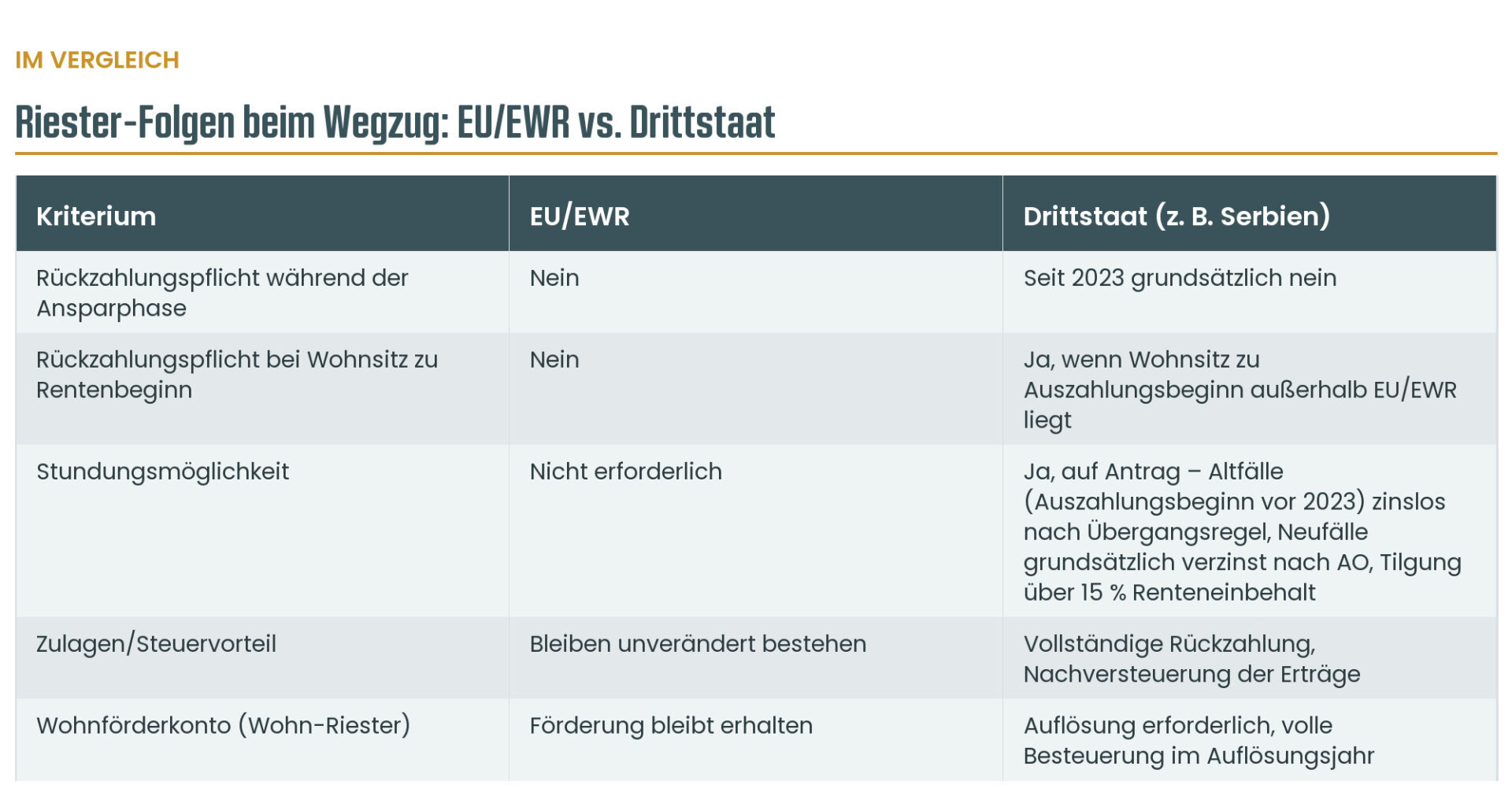
*Legal basis EU/EEA: § 95 EStG in conjunction with ECJ judgment C-269/07 (2009) and the 2010 implementing act. Legal basis third state: § 95 EStG in conjunction with §§ 93, 94 EStG (detrimental use). Taxation of the later payout: for EU/EEA, deferred taxation under § 22 No. 5 EStG, with the allocation of the taxing right under the applicable DBA to be assessed case by case; if the subsidy is repaid, the basis for the originally planned deferred taxation of the subsidy portions ceases to that extent.*
Special Case Home-Ownership Riester: The Home Ownership Subsidy Account
A further special feature applies to the so-called home-ownership pension (Wohn-Riester). The subsidy is tied, under § 92a EStG, to the permanent use of the subsidised property by the owner for residential purposes, and that property must generally be located within the territory of the EU or the EEA. The so-called home ownership subsidy account (Wohnförderkonto) notionally carries forward the subsidies used, repayment instalments made, and an annual notional interest amount, until the entire account balance is taxed at the start of the payout phase.
If the owner permanently ceases to occupy the property themselves, or permanently relocates their residence to a state outside the EU/EEA, an early winding-up of the home ownership subsidy account is generally required. The entire carried-forward amount is then taxed in a single year as other income – for a home ownership subsidy account built up over many years, this can result in a considerable one-off tax burden, noticeably heavier than the instalment-based repayment applicable to a conventional savings plan or fund contract. Anyone who owns a subsidised property and intends to emigrate permanently should factor this in at an early stage.
Options Before Emigrating
Anyone planning to emigrate to a state outside the EU/EEA and still holding Riester contracts essentially has four ways of dealing with this starting position.
Make the Contract Paid-Up (Let It Rest)
The contract continues to exist, but no further personal contributions are paid in, so no new subsidies accrue either. Subsidies already credited are not lost as a result, and ongoing administrative costs must be weighed against the advantage that the contract can be reactivated at any time – for instance, if a later return to the EU before the start of the pension seems realistic. Letting the contract rest does not, by itself, trigger repayment, but it does not change the fact that, at the start of the pension, the residence at the relevant point in time remains decisive.
Terminate the Contract Early
Termination with full payout of the capital counts as detrimental use and immediately triggers repayment of all subsidies and tax benefits, together with retroactive taxation of the returns, regardless of the future residence. This route creates clarity and immediate access to the capital, but is usually the most expensive option economically and should only be considered after a comparative calculation against the alternatives.
Voluntarily Repay the Subsidy
Rather than handling repayment only at the start of the pension, via a deferral with instalment repayment from the ongoing pension, it can in individual cases make sense to settle the repayment amount voluntarily at a self-chosen point in time. This creates planning certainty and avoids a lifelong reduction of the later Riester pension, but ties up liquidity now that would otherwise remain in the contract and continue working until the start of the pension.
Wait and Apply for a Deferral
Anyone who does not yet wish to commit definitively to whether, and for how long, their residence will remain outside the EU/EEA can leave the decision open: only at the start of the payout phase is it examined where the residence actually lies. If a repayment obligation then exists, a deferral can be obtained on application under the general rules of the Fiscal Code, with subsequent repayment via a deduction from the ongoing pension; unlike some older cases still running under the previous law, this deferral is, as a rule, subject to interest, with a waiver of interest remaining the exception. This route is particularly suited to anyone who considers a return to the EU before retirement possible, or whose period abroad is not yet definitively planned – the actual interest burden can only be clarified case by case with the competent tax office.
Which of these options is preferable in economic and legal terms in a given case depends on the type of contract, the amount of subsidy already received, the planned destination country, and the time horizon until the start of the pension, and can only be assessed on the basis of the specific documentation.
Hypothetical example for illustration (not an actual client matter): A Riester saver plans to spend retirement permanently in a country outside the EU, but still has more than twenty years until the planned start of the pension. If they move there now, this does not, under the current legal position, yet trigger repayment – what matters is only the residence shortly before the start of the pension. If, by contrast, they move permanently shortly before the start of the pension and remain resident there until the start of the payout phase, the repayment obligation under § 95 EStG applies, unless they apply for a deferral in good time or opt for voluntary repayment.
Figures Box: Germany’s Riester Portfolio Continues to Shrink
According to figures from the Federal Ministry of Labour and Social Affairs (Bundesministerium für Arbeit und Soziales, BMAS), the number of state-subsidised Riester contracts in Germany fell net by around 318,000 in 2025 to 14.663 million contracts – the eighth consecutive decline, albeit less pronounced than the drop of more than half a million contracts in the previous year.
The figure shows that, despite the shrinking portfolio, Riester contracts remain a retirement product used by millions of people in Germany – and that questions about continuing, terminating, or dealing with emigration abroad correspondingly affect a large number of savers.
When Is Legal Advice Worthwhile?
The rules on the repayment obligation on emigration were noticeably relaxed in 2023, but remain complex in their concrete application: the decisive point in time is not the move itself but the residence at the start of the payout phase, the treatment of EU/EEA and third states differs fundamentally, and for home-ownership Riester the home ownership subsidy account adds a further layer. Anyone planning to emigrate and still holding Riester contracts should clarify the sequence of steps – making the contract paid-up, terminating it, voluntary repayment, or waiting with a deferral application – in good time before emigrating, not only afterwards.
Johannes Fiala is a lawyer with experience in questions of private and state-subsidised retirement provision, as well as in international tax and social security law relating to emigration. The firm has published extensively on this subject area and supports clients in assessing existing Riester and home-ownership Riester contracts in light of a planned move abroad, and in weighing up the available options against one another.
Are you planning to permanently move abroad and are unsure what will happen to your Riester contract? Contact the Fiala law firm to have your individual situation assessed from a legal perspective.


