

“As long as I stay under 183 days, I am safe from a tax perspective” – this line comes up in forums, in guidebooks, and unfortunately also in some advisory conversations, shortly before it turns out to be simply wrong in this form. The reason: behind the label “183-day rule” hide, in reality, two entirely different legal concepts. One version of the 183-day rule appears in double taxation agreements (Doppelbesteuerungsabkommen, DBA) and determines which state is entitled to tax an employee’s salary. The other time limit – the six-month presumption under § 9 of the German Fiscal Code (Abgabenordnung, AO) – decides something entirely different: whether a person has a habitual abode in Germany at all, and therefore unlimited tax liability. Both rules have to do with “roughly half a year,” and both are cited in the context of periods of stay abroad – which is exactly why they are constantly mixed up in practice. This article cleanly separates the two concepts, shows the differences using a comparison table, and uses a practical example involving employer secondment and working from home abroad to illustrate why confusing the two can become expensive.
The Misconception: “Under 183 Days, I Am Safe from a Tax Perspective”
The rule of thumb “183 days, then I am tax-free” is usually cited in connection with a stay abroad – whether for a fixed-term assignment for an employer abroad, an extended period of working from home, digital nomads moving between several countries, or the supposedly most unremarkable case of all: the employed cross-border commuter who travels to work in a neighbouring country daily or weekly while keeping their domicile in Germany. It sounds like a single, clear-cut limit – and it is precisely the cross-border commuter case that is often overlooked in a legal review, because at first glance it appears unremarkable and is not usually mentioned in the same breath as the classic “exceptional cases” such as secondment or working from home abroad. In fact, the DBA 183-day rule answers only one very specific question: which of two states is entitled to tax the salary from employment when both states could in principle claim a right to tax it? It presupposes that it has already been established in which state a person is resident, and that a double taxation agreement applies in the first place.
Whether a person is subject to unlimited tax liability in Germany – that is, taxed on their worldwide income – is, by contrast, determined initially and solely under German domestic law: by domicile under § 8 AO and habitual abode under § 9 AO. This preliminary question has nothing directly to do with the DBA 183-day rule. Anyone who conflates the two levels regularly underestimates that, despite spending “fewer than 183 days” in the state of activity, they may remain fully liable to tax in Germany – or, conversely, assumes that a DBA rule protects them from a situation that rule does not address at all.
The 183-Day Rule under Double Taxation Agreements (Art. 15 OECD-MA)
The actual 183-day rule is set out in Art. 15(2) of the OECD Model Tax Convention (OECD-Musterabkommen, OECD-MA), which most of the double taxation agreements concluded by Germany follow. It applies exclusively to income from employment – that is, classic employee salary – and governs a special case: if an employee works temporarily in the other contracting state, the right to tax exceptionally remains with the state of residence – rather than automatically shifting to the state of activity – provided three conditions are met cumulatively:
- The employee spends no more than 183 days in total in the state of activity within a twelve-month period (depending on the specific DBA, this may instead be measured by calendar year).
- The employer who economically bears the remuneration is not resident in the state of activity.
- The remuneration is not borne by a permanent establishment that the employer maintains in the state of activity.
Only if all three conditions are met simultaneously does the right to tax remain with the state of residence. If even a single condition is missing – for example, because the employer has a permanent establishment in the state of activity that bears the costs – the right to tax passes to the state of activity from the very first day of the activity, regardless of the length of stay. It is also important to note that the exact reference period (calendar year, a deviating tax year, or a rolling twelve-month period) differs from agreement to agreement and must be checked in the specific DBA in each individual case.
What the DBA Rule Expressly Does Not Address
The 183-day rule under Art. 15 OECD-MA makes no statement whatsoever as to whether unlimited tax liability still exists in Germany at all. It presupposes that this question has already been resolved and then merely allocates the right to tax a specific type of income between two states that could, in principle, both assert claims. Anyone who believes that complying with the 183-day limit automatically also settles the question of German tax liability is confusing the allocation rule with the question of residence.
The Six-Month Presumption under § 9 AO: Habitual Abode
The second, independent time limit is set out in § 9 AO and concerns an entirely different question: whether a person has a habitual abode in Germany at all. Under § 9 AO, a person has their habitual abode wherever they stay under circumstances indicating that their presence there is not merely temporary. A continuous stay of more than six months conclusively and irrebuttably establishes a habitual abode, retroactively from the first day; short interruptions, such as a weekend trip, do not affect this. (The details of this presumption, its relationship to domicile under § 8 AO, and the typical pitfalls involved in relocating abroad or emigrating are covered in separate articles on this site.)
If a habitual abode – or, alternatively, a domicile under § 8 AO – exists in Germany, unlimited income tax liability on worldwide income arises under § 1(1) of the German Income Tax Act (Einkommensteuergesetz, EStG). This preliminary question is a matter of national law, independent of any DBA, and logically precedes it: only once it has been established in which state or states residence exists at all does it become relevant how an existing double taxation agreement allocates specific items of income – such as employment income under the 183-day rule – between the states involved.
183-Day Rule (DBA) vs. Six-Month Presumption (§ 9 AO) Compared
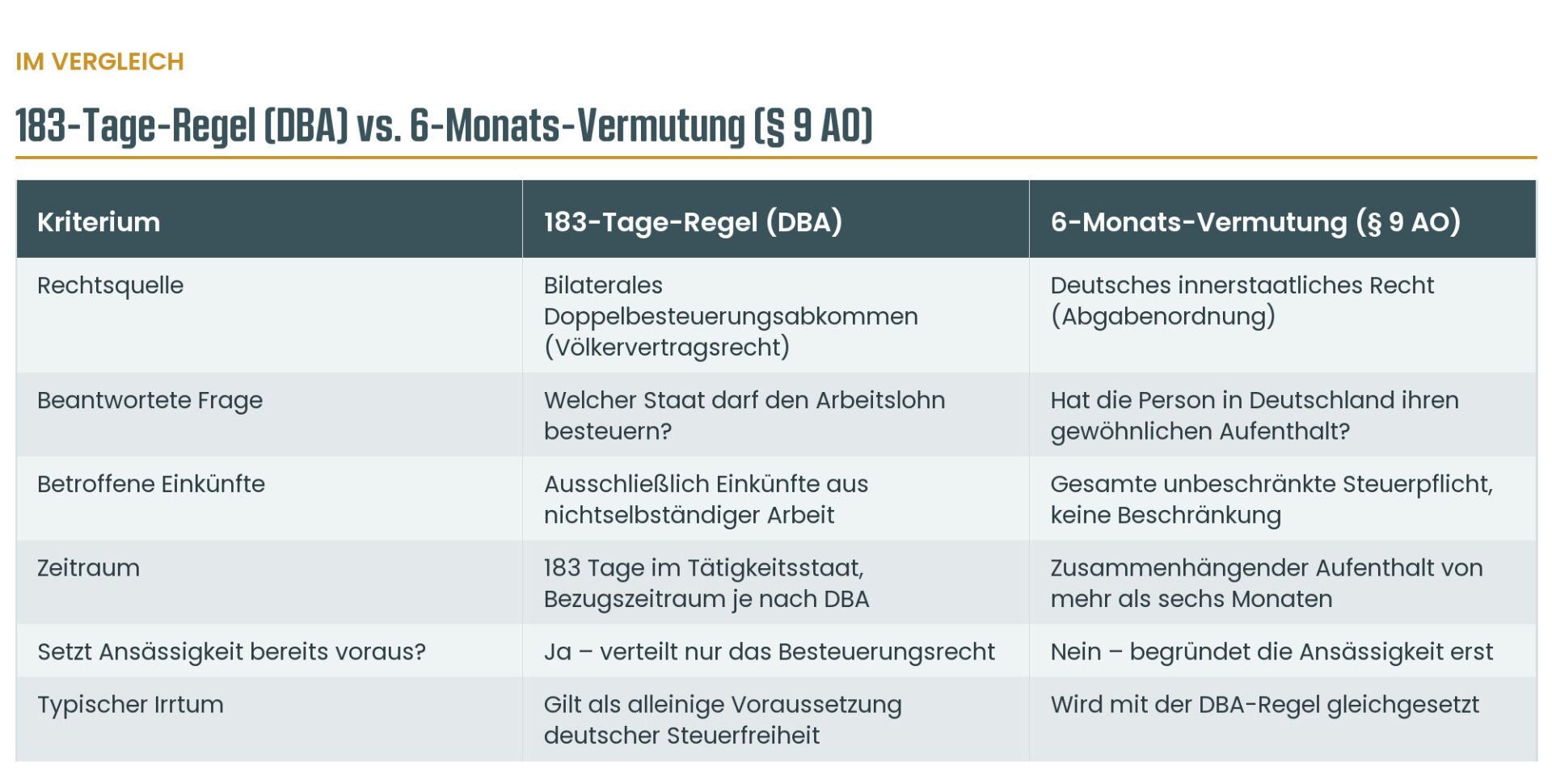
Remember the correct order of review: first clarify the question of residence under §§ 8/9 AO and § 1 EStG – only after that, if residence in more than one state is potentially at issue, does the DBA 183-day rule under Art. 15 OECD-MA come into play at all. Anyone who starts with the DBA rule is examining the wrong question first.
Why Confusing the Two Becomes Expensive: Employer Secondment and Working from Home Abroad
The distinction becomes especially relevant in practice in two situations that have noticeably increased in recent years: the employer’s fixed-term secondment of an employee abroad, and working from home from abroad.
An example illustrates the difference: an employee of a German company is seconded to a neighbouring country for nine consecutive months for a project, works there in the office of the local subsidiary, which bears the costs of the secondment, and returns to Germany only on a few weekends. Even if, by the end of the year, he had spent “only” 183 days at the actual project location, the DBA 183-day rule would not have applied here in any case: because the foreign subsidiary, as the economic employer, bears the remuneration, the second condition of Art. 15(2) OECD-MA is already not met – the right to tax the employment income would lie with the state of activity regardless of the length of stay. Independently of this, an entirely different question arises in parallel under § 9 AO: because the continuous stay abroad lasts nine months, the employee may, under the circumstances, have established a habitual abode in the state of activity itself – and must at the same time examine whether, by retaining his home in Germany, he has remained subject to unlimited tax liability there as well. Two independent examinations, two independent outcomes – the 183-day count alone conclusively answers neither of them.
The case of working from home abroad is similar in structure: if an employee works for their German employer for several months from a holiday apartment abroad, their actual place of work physically shifts there. Here, too, the 183-day rule may apply if a DBA exists and the three conditions are met – but again, it only governs the allocation of the right to tax the employment income. Whether the employee additionally loses their habitual abode in Germany, or establishes a new one in the home-office state, as a result of the multi-month stay abroad is determined independently, under § 9 AO or the corresponding national law of that state. In such cases, employers regularly face a third dimension as well, not explored further here: the risk of creating a permanent establishment in the home-office state.
Facts and Figures: Cross-Border Employee Secondment Is the Rule, Not the Exception
In the bilateral relationship between Germany and Austria alone, around 166,000 A1 secondment certificates were issued in 2020 – the largest single cross-border secondment flow within the entire EU. In the same year, Germany was overall among the states that issued the most A1 certificates in Europe.
This figure shows that situations in which employees work abroad for a fixed period on behalf of their employer are a routine, everyday occurrence for the German economy, happening millions of times over – and with every such secondment, both the question of the DBA 183-day rule and the question of §§ 8 and 9 AO potentially arise.
Beyond the EU as Well: Same Principle, Different Details
The basic principle of the 183-day rule is found not only in DBAs with EU member states, but also in agreements with states outside the EU. For example, the double taxation agreement between Germany and Serbia likewise contains a 183-day clause for income from employment in its Art. 15 – here measured by the respective calendar year rather than a rolling twelve-month period. This illustrates why a blanket “183-day rule of thumb,” applied without consulting the specific agreement in question and without examining the German residence question under §§ 8 and 9 AO, is not sufficient: the reference period and the detailed conditions differ from agreement to agreement.
When Is Legal Advice Worthwhile?
Confusing the DBA 183-day rule with the six-month presumption under § 9 AO is one of the most common misunderstandings in international tax law – precisely because the two rules sound similar but answer different questions and derive from different sources of law. Anyone who is seconded as an employee, works from home abroad, or deploys staff across borders as an employer should have both levels reviewed separately and in light of the specific individual case, rather than relying on a single day count.
Johannes Fiala is an attorney with experience in tax-related and international matters concerning secondment, working from home abroad, habitual abode, and double taxation. The firm, which focuses on international tax law, helps to classify each specific situation clearly between the DBA rule and German residence law.
Are you planning a secondment abroad, working from home from abroad, or unsure which of the two 183-day rules actually applies to your case? Contact the Fiala law firm to have your individual situation assessed from a legal perspective.


