
Published on 01.04.2008

What Does Asset Protection Mean?
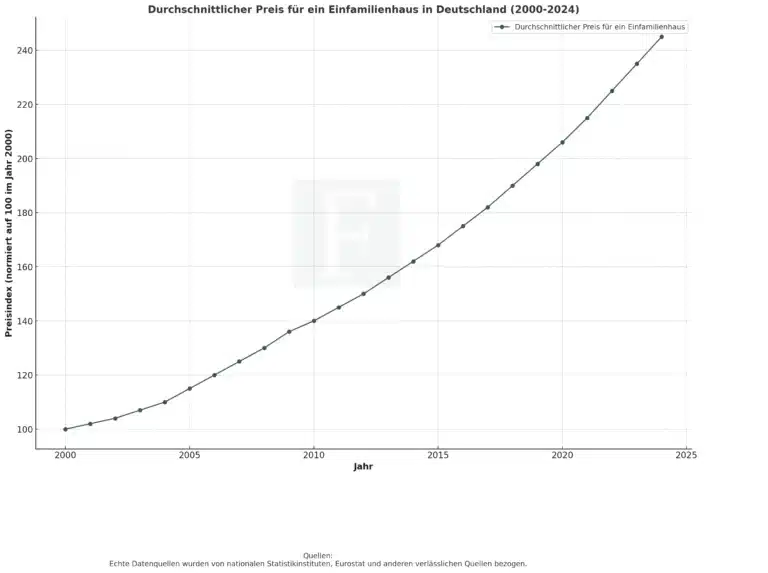
Fig. 1: The single-family home is rather unsuitable as an investment; prices are beginning to climb exponentially, which is hardly surprising given the expansion of the money supply.
Protecting Your Assets from Creditors, Ex-Spouses, Forced Heirs or the Tax Office
Options for Asset Protection
In the field of legally safeguarding assets, numerous options are available to protect one’s wealth effectively and to structure it in a legally secure manner. The aim of such measures is to preserve assets from access by creditors, ex-spouses, forced heirs or the tax office.
The structuring and arrangement of assets plays an important role here. This includes, among other things, the establishment of family foundations and family companies. These not only offer tax advantages but also enable the targeted administration and transfer of assets within the family. Protection can additionally be reinforced through the use of non-attachable assets, such as a garnishment-protection account.
Tax-structuring opportunities are likewise a central aspect of asset protection. Through targeted gifts and succession planning, wealth can be optimally distributed and protected during one’s lifetime. Furthermore, the international diversification of assets and income sources can offer considerable protection against risks.
It is important to have comprehensive information about the legal framework and the many options for asset protection. Every financial situation is unique, which is why sound advice from an experienced asset-protection lawyer provides the best basis for developing tailored solutions and implementing them effectively. Our goal is to protect your wealth in a legally secure manner and to structure it optimally.
Family-Law Structures, Family Foundation, Family Company
Non-Attachable Assets and the Garnishment-Protection Account
In the field of asset protection, it is crucial to identify certain assets that are legally non-attachable. For example, rights of residence can, with appropriate structuring, be protected from access by creditors. Converting or newly creating such assets can therefore represent an efficient means of asset protection.
Another important instrument for asset protection is the garnishment-protection account, the Pfändungsschutzkonto (P-Konto). If account garnishment threatens in the event of a liability claim, the P-Konto allows essential obligations to continue to be met. The garnishment-protection account provides protection against attachment pursuant to § 899 ZPO (German Code of Civil Procedure) up to the basic exemption amount of EUR 1,340 per calendar month (as of 1 July 2022). It makes no difference whether the money in the account derives from salary, profits or social benefits. Under certain circumstances it is also possible to increase the attachment-exempt amount (§ 902 ZPO).
For several years now, the self-employed have been able to place a private pension beyond the reach of creditors. This applies to products that are paid out as a lifelong annuity no earlier than age 60 or in the event of occupational disability (Berufsunfähigkeit). The insured person must have no option for early surrender, and only surviving dependants may be named as beneficiaries in the event of death. For all questions concerning the reliable protection of your assets, our experienced lawyers will competently support you.
Tax Structuring
Gifts
Succession-Law Structures
An inheritance event can bring considerable risks to a family’s wealth. Succession-law conflicts, the compulsory-share claims (Pflichtteil / forced heirship) of disinherited relatives, as well as unfavourable wills and inheritance tax, represent significant challenges. To ensure legally secure asset protection, careful and comprehensive succession planning is indispensable. Such planning takes account of both tax and economic aspects while at the same time addressing the unique family and interpersonal dynamics.
Succession-law structures include various instruments and measures that serve to protect wealth. These comprise wills, inheritance contracts and waivers of the compulsory share, but also gifts as well as corporate-law and foundation-law arrangements. These measures serve to structure the estate in a targeted manner and to minimise potential risks.
Special succession-law structures are necessary in particular cases, for example wills in favour of over-indebted heirs or to avoid the claims of divorced spouses. In such cases, prior and subsequent heirship instruments (Vor- und Nacherbschaft), combined with permanent execution of the will, can be deployed to protect the estate as effectively as possible and to optimise asset protection.
Through strategic planning and the right legal structuring, wealth can be secured for the long term and passed on to the next generation. As your asset-protection lawyer, we stand by you with our comprehensive expertise and experience to ensure optimal asset protection.
International Diversification of Assets
The international diversification of assets is a decisive building block within asset protection. When assets are spread across different countries, risks can be minimised and possible access by third parties to the entire estate made more difficult. This is particularly important for protecting your wealth against unforeseen legal and economic challenges. A carefully planned international diversification of assets offers not only additional protection against local economic fluctuations and uncertainties, but also tax advantages that can vary from country to country. To ensure that your strategies for asset diversification and asset protection are legally sound and efficient, advice from an experienced lawyer is indispensable. Our firm supports you in developing an individual and tailored solution that takes into account both your personal and your business objectives. In doing so, we attach great importance to ensuring that the international aspects of diversifying your assets comply with the respective applicable national and international provisions. A well-considered diversification of assets not only creates security but also contributes to the long-term preservation and growth of value.
Asset protection therefore also means turning to further considerations: for example, diversifying part of one’s wealth geopolitically and, indeed, holding part of it outside the EU. To understand this, one simply has to grasp that the law of enforcement (including of private claims that have been reduced to an enforceable title) is a sovereign function which is, in principle, confined to the state’s own territory. Owing to EU rules, however, it is also readily possible to enforce within European states (that is, across borders). In practice, such enforcement takes only a few weeks, even where the assets concerned are real estate located elsewhere in Europe.
International Diversification of Income Sources
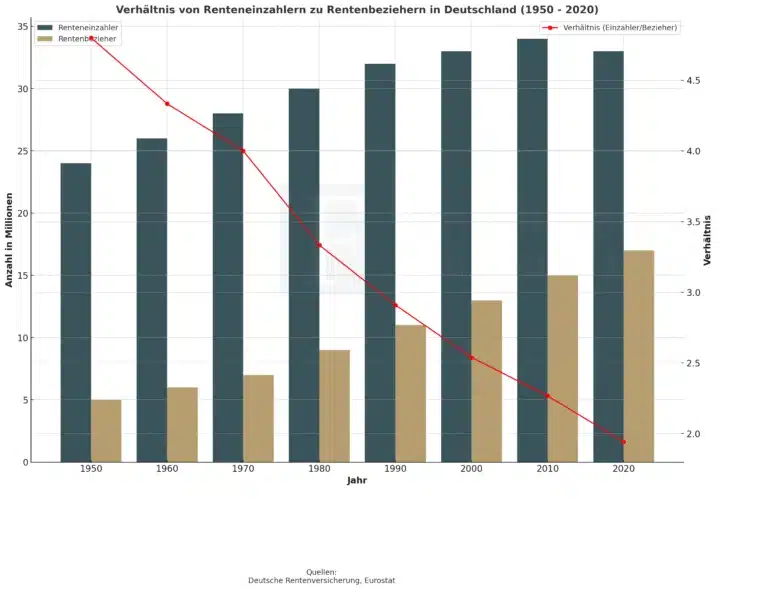
Fig. 2: Germany in demographic transition. The declining number of pension contributors makes the pension system increasingly fragile. State recourse to real-estate assets in the event of a burden-sharing levy (Lastenausgleich) is becoming ever more likely.
The international diversification of income sources is an essential component of effective asset protection. By diversifying international income sources, you can protect your assets from unforeseeable risks and economic uncertainties. This approach makes it possible to spread wealth across different countries and thereby reduce dependence on a single market or economy. The advantage is that the various legal systems and economic conditions can be harnessed to secure assets and optimise them for tax purposes. It is important here to observe the international legal framework in order to ensure that all asset-protection steps are legally compliant and secure.
The example of pensions in particular shows that the situation in Germany does not look very rosy. In many other European countries, pensions are considerably higher and can amount to more than 100% of final income, whereas in Germany they are usually below 50%. This will further aggravate the problem of old-age poverty in Germany in the coming years. Further figures, such as the lowest home-ownership rate for real estate, support this assessment.
Inflation is calculated by the state, but set in a way far removed from reality; real inflation is far higher than the federal government’s flattering figures. The late Professor Brachinger from Lake Constance examined the actual circumstances of a retired couple and of a typical four-person household, and then introduced the concept of so-called perceived inflation: corresponding charts can be found online, demonstrating that reality more often exhibits double-digit annual inflation rates. Pension increases are then only a fraction of that each year, so that life as a pensioner means increasing impoverishment over time. Read more on this topic in our article “Loss of Purchasing Power, Demographics and Low Interest Rates Are Destroying Pension Dreams”
[https://www.fiala.de/kaufkraftverlust-demographie-und-niedrigzins-zerstoeren-versorgungstraeume/]
On the one hand, this may mean securing part of one’s provision through pension systems abroad, but it also means, more generally, not putting all one’s eggs in one basket. One can certainly cover part of one’s retirement provision through the statutory pension, but should also consider other options. This follows precisely the principle of risk diversification: not betting everything on a single horse, and deliberately pursuing suitable options both at home and abroad.


