

Since the Military Service Modernization Act (Wehrdienstmodernisierungsgesetz) entered into force on 1 January 2026, alarming claims have been circulating in forums, on social media, and on some websites: Germans living abroad, it is said, must now expect to be called up, are allegedly no longer permitted to travel without Bundeswehr authorization, or have lost their right to conscientious objection as a result of the reform. Such claims frequently blend applicable law, political statements of intent, and simply outdated information. This article sets out what the current legal situation actually means for German nationals living abroad – based on the text of the law, official clarifications, and current case law, not on forum knowledge. It also addresses two points that are almost entirely absent from the public debate: what the “dormancy” (Ruhen) of conscription actually requires under the wording of the Military Service Act, and what applies to dual nationals whose second home country actively enforces conscription.
The Legal Starting Point: Nationality, Not Residence
German military law has traditionally been linked to German nationality, not to residence. Anyone who is a German national generally falls within the personal scope of military-law provisions – regardless of whether their center of life is in Germany, another EU member state, or a third country. This principle is not new and was not changed by the 2026 reform.
For practical purposes, however, a clarification by the Federal Foreign Office (Auswärtiges Amt) is relevant: for the duration of a permanent residence abroad, registration for military-law purposes lies dormant. In concrete terms, this means that no questionnaires are sent to Germans permanently living abroad, and they are under no obligation to provide information to the Bundeswehr (the German armed forces), for as long as their residence abroad continues. Only upon an actual return to Germany – not upon a mere visit – does registration revive. Those living abroad are therefore not legally “exempt,” but are, in practical and procedural terms, removed from the ongoing registration process for as long as they remain abroad.
What Dormancy Means Under the Law: The Wording of Section 1 WPflG
This clarification describes administrative practice, not the underlying legal basis. The status that is usually shortened in forums to “exempt” is set out in the statute itself – and the wording is worth examining closely, because it is narrower than many summaries suggest.
Section 1(1) of the Military Service Act (Wehrpflichtgesetz, WPflG) expressly also covers men with their habitual residence outside Germany – specifically where they either previously had their habitual residence in Germany, or “hold a passport or a certificate of nationality of the Federal Republic of Germany, or have otherwise placed themselves under its protection.” A German passport is thus itself a connecting factor, not merely a travel document.
Section 1(2) WPflG sets out the practically decisive legal consequence: conscription lies dormant “for as long as persons subject to conscription have their habitual residence and their economic livelihood outside the Federal Republic of Germany, where facts justify the assumption that they intend to maintain their habitual residence abroad.” Two details are regularly lost in summaries. First, the provision requires not only residence but, in addition, an economic livelihood abroad: a mere relocation of residence on paper is not sufficient if the person’s economic existence remains anchored in Germany. Second, dormancy is a state, not an extinguishment – it ends as soon as its requirements cease to be met, without any separate administrative decision being required.
There is also a provision that is almost entirely absent from the public debate: Section 1(3) WPflG names three situations in which conscription does not lie dormant despite residence abroad – where residence is relocated during ongoing military service, where residence is relocated without the authorization required under Section 3(2) WPflG, and where a relocation does not, in formal terms, leave the territorial scope of the Act. The second category shows how closely the authorization requirement and the dormancy rule are intertwined: a person who relocates abroad without the required authorization could not rely on dormancy at all. Against this background, the decree issued by the Federal Ministry of Defence (Bundesministerium der Verteidigung, BMVg) on 9 April 2026, discussed further below, takes on added significance, under which periods spent abroad are deemed authorized for as long as conscription remains suspended.
What the Military Service Modernization Act Has Actually Regulated Since 1 January 2026
The Bundestag passed the Act to Modernize Military Service (Wehrdienstmodernisierungsgesetz) on 5 December 2025; it was signed into law on 22 December 2025 and promulgated in the Federal Law Gazette (Bundesgesetzblatt) as BGBl. 2025 I No. 370 of 29 December 2025, entering into force on 1 January 2026. In substance, it regulates four core areas:
- Registration: The Federal Office of Bundeswehr Personnel Management (Bundesamt für das Personalmanagement der Bundeswehr) is authorized to process registration data (date of birth, place of birth, marital status, residence) of male German nationals aged 18 and over.
- Declaration of willingness / questionnaire: Men born in 2008 or later will, from 2026 onward, receive a questionnaire on motivation and suitability, which they are obliged to answer; women also receive the questionnaire, but answering it is voluntary for them. Anyone who misses the deadline risks a fine.
- Physical examination (Musterung): A mandatory physical fitness examination is planned to take effect on 1 July 2027 for the age groups concerned.
- Voluntary military service: The existing model of voluntary military service has been restructured, including higher pay and more flexible terms of service.
What the Act expressly does not change is the right to conscientious objection on grounds of conscience. According to consistent accounts from several independent sources, this right remains fully intact: anyone who refuses armed military service on grounds of conscience may instead perform civilian alternative service, as has been provided for decades under Article 4(3) of the Basic Law (Grundgesetz) and the Conscientious Objection Act (Kriegsdienstverweigerungsgesetz, KDVG). The new registration and examination obligations and the right to conscientious objection therefore exist side by side, not in conflict with one another.
The Path Back to Compulsory Service, Already Built Into the Act
One point is frequently rendered imprecisely in the public debate and therefore deserves particular care: although the Military Service Modernization Act is currently structured as a voluntary model, it already contains a statutorily anchored mechanism for departing from that model. If the number of volunteers proves insufficient and the security-policy situation, in the assessment of the Federal Government, requires it, a compulsory call-up of persons subject to conscription – even outside a formally declared state of tension or defense – may be ordered by statutory instrument (Rechtsverordnung). This statutory instrument expressly requires the consent of the Bundestag.
Important for classification purposes: this mechanism is currently valid law, but has so far not been activated. It is not, therefore, a forecast or speculation about a possible future reinstatement of general conscription, but an option that already exists in the statute today, albeit unused. Political voices – for instance from the Bundestag’s Defence Committee – have publicly expressed the personal expectation that a return to compulsory service could occur during this legislative term. These are political assessments by individual actors, not decided facts. An evaluation of volunteer numbers scheduled for 2027 will show whether, and how, this mechanism is actually used.
The Authorization Requirement for Stays Abroad: A Special Case That Caused Confusion in 2026
Alongside the new Act, an older provision exists that has not been repealed and caused considerable uncertainty in connection with the reform: Section 3(2) of the Military Service Act (Wehrpflichtgesetz, WPflG), by its wording, provides that men between the ages of 17 and 45 require authorization from the responsible Bundeswehr career center (Karrierecenter der Bundeswehr) for a stay abroad exceeding three months. This provision dates from before conscription was suspended in 2011 and has simply not been applied since then, though it was also never formally repealed.
When the Military Service Modernization Act entered into force, uncertainty arose as to whether this authorization requirement thereby regained practical significance – this was initially disputed even among specialists, and even Bundeswehr offices themselves initially gave inconsistent statements. The Federal Ministry of Defence (Bundesministerium der Verteidigung, BMVg) resolved the question by decree on 9 April 2026: for as long as conscription remains suspended, stays abroad are deemed authorized. Neither a notification nor a formal application is required – regardless of duration or destination country. For Germans already living permanently abroad, this applies expressly in the same way: visits to Germany and the subsequent return abroad do not trigger any separate authorization requirements.
The following table summarizes the key situations:
← Tabelle nach links wischen, um weitere Spalten zu sehen
| Situation | Registration/Examination | Authorization Requirement for Stay Abroad (Section 3(2) WPflG) |
|---|---|---|
| German already living permanently abroad | Lies dormant for the duration of the residence abroad, no questionnaire | Deemed granted under the BMVg decree of 9 April 2026, no notification required |
| German in Germany, planning to emigrate | Registration applies for as long as residence in Germany continues | Deemed granted under the decree, no application required |
| Return of a German living abroad to Germany | Registration revives upon establishing residence in Germany | Not applicable (stay is domestic) |
| Short visit to Germany by a German living abroad | No registration triggered by a mere visit | Not applicable |
| German voluntarily joins the armed forces of a foreign state (of which they also hold nationality) | To be assessed separately | Without prior authorization from the BMVg, risk of loss of German nationality under Section 28 of the Nationality Act (Staatsangehörigkeitsgesetz, StAG); automatically granted for nationality of an EU, EFTA, or NATO state |
This overview does not replace a legal assessment of the individual case, particularly because – as developments in 2026 show – administrative practice and decrees can change at short notice.
What Applies Today May Not Apply in an Emergency
All the rules described so far apply to the current situation: suspended conscription, a voluntary model, and a stay abroad possible without authorization. Anyone who concludes from this that the matter is permanently settled for them overlooks how quickly central parameters can shift in a state of tension or defense – a possibility already built into the law, not speculation.
- Age limit in an emergency: Under Section 3(5) WPflG, conscription ends in peacetime upon completion of the 45th year of age. In a state of tension or defense, however, this limit shifts to the end of the year in which the person turns 60. The Reservists Association (Reservistenverband) is even calling (as of April 2026) for it to be raised to 70. A 55-year-old is therefore by no means “off the hook” in an emergency – a figure that is regularly missing from the public debate.
- Conscription for women – precisely, not just as a slogan: Article 12a of the Basic Law expressly excludes women from armed service and any corresponding compulsory call-up. A change would require a two-thirds majority in both the Bundestag and the Bundesrat – constitutionally the highest possible hurdle, unlike the simple statutory instrument that could reactivate conscription for men. The political debate on this is in full swing, but the legally correct position is: an extension to women cannot happen “overnight.”
- Historical comparison – the Volkssturm of 1944: By decree of 25 September 1944, all “men fit for military service between the ages of 16 and 60” were conscripted, roughly six million men. This shows how far age limits were historically extended in a genuine emergency – though under the conditions of a state of exception at the end of a war, not as a blueprint for the current legal situation.
- Current example: Ukraine: In 2024, Ukraine’s mobilization age was lowered from 27 to 25 (statutory conscription applies to those aged 18 to 60); the United States has additionally proposed lowering the threshold to 18. This shows that age limits can shift within months, not decades, under actual wartime pressure.
Registration Law, Tax Law, and Nationality: Overlooked Pitfalls in Emigration Plans
Anyone who genuinely intends to emigrate for reasons related to military-service law should keep an eye on other areas of law that have nothing to do with conscription itself but can be equally costly or risky:
- Registration obligation upon return: A person living abroad who is not registered in Germany must register upon a stay exceeding three months, under Section 27(2) sentence 3 of the Federal Registration Act (Bundesmeldegesetz, BMG) – coincidentally the same three-month threshold as for the authorization requirement under Section 3(2) WPflG.
- No registration obligation abroad, but voluntary crisis preparedness (ELEFAND): German nationals abroad are under no obligation to register with German authorities. The Federal Foreign Office merely offers voluntary registration through the crisis preparedness list ELEFAND (“Elektronische Erfassung von Deutschen im Ausland,” Electronic Registration of Germans Abroad), which serves consular assistance in crisis and disaster situations. It is expressly not an instrument of military registration – in online discussions the two are occasionally confused, sometimes with the recommendation not to register as a precaution. This concern is unfounded.
- Residence verification under Section 24b WPflG: The Military Service Act contains its own procedure for verifying a person’s whereabouts. Under this procedure, the responsible authority transmits personal data to the Federal Office of Administration (Bundesverwaltungsamt), which forwards it, among others, to military replacement authorities, the Federal Foreign Office, and border police authorities, until the person’s whereabouts are known; the data must then be deleted. While conscription is suspended, this procedure currently has no practical significance. It shows, however, that the legislature has already addressed the case of unreachability procedurally – the widespread notion that a residence abroad simply makes a person “invisible” falls short.
- Dual residence and tax liability: For tax purposes, a second residence in Germany is not a minor matter. Under Section 8 of the Fiscal Code (Abgabenordnung, AO), even a room available for use at any time – for example, at one’s parents’ home – is sufficient to establish a German residence, even without a lease in the person’s own name (settled case law, including Fiscal Court of Münster, case no. 13 K 2675/10 Kg). This triggers unlimited tax liability in Germany under the worldwide income principle, regardless of the residence abroad. Anyone who then fails to declare income earned abroad in Germany risks tax evasion under Section 370 AO – irrespective of the military-law question.
- Child benefit and center of life: For child benefit (Kindergeld), what matters is not the registered address but the child’s actual center of life. A registration abroad that exists only on paper, while the child in fact continues to live predominantly in Germany (weekends, holidays, school), does not support the dormancy fiction. Anyone who continues to obtain child benefit from the family benefits office (Familienkasse) through false statements risks tax evasion under Section 370(1) No. 1 AO – the more specific provision as against Section 263 of the Criminal Code (Strafgesetzbuch, StGB).
- Nationality in connection with foreign military service: Section 109h of the Criminal Code (StGB) criminalizes recruiting a German for foreign military service – not a person’s own voluntary enlistment. Section 28 of the Nationality Act (Staatsangehörigkeitsgesetz, StAG), however, applies automatically: anyone who voluntarily joins a foreign armed force thereby generally loses German nationality (exception: joining the armed forces of an EU, EFTA, or NATO state). An additional complication under international law: under Additional Protocol I to the Geneva Conventions, mercenaries enjoy no combatant or prisoner-of-war status – a risk that is frequently overlooked in connection with “citizenship through military service” schemes.
- Exit tax under Section 6 of the Foreign Tax Act (Außensteuergesetz, AStG): Anyone who genuinely intends to emigrate should also be aware of the tax cost side. This affects persons who, within the preceding five years, held at least a one percent interest in a domestic or foreign corporation: emigration triggers a deemed disposal of that interest, and the increase in value is taxed even though no actual sale has taken place. Deferral was tightened by the 2022 implementation of the EU Anti-Tax Avoidance Directive (ATAD): the former unlimited EU/EEA deferral privilege has been abolished, leaving only installment deferral spread over seven years. Separately, since the 2024 Annual Tax Act, fund units held as private assets must also be considered: these do not fall under Section 6 AStG but under the new Section 19(3) of the Investment Tax Act (Investmentsteuergesetz, InvStG) – covering a single fund holding with acquisition costs of at least EUR 500,000 (not the market value on the date of emigration), or alternatively a holding of at least one percent of the units issued within the preceding five years. Anyone unaware of this can easily underestimate how financially significant emigration purely for military-law reasons can be for shareholders and larger investors.
The Right to Conscientious Objection Remains Untouched – Even With a Foreign Connection
The right to conscientious objection on grounds of conscience is among the most strongly protected fundamental rights in the German constitutional order. It is available to anyone who refuses armed military service on grounds of conscience and is applied for at the Federal Office for Family Affairs and Civil Society Functions (Bundesamt für Familie und zivilgesellschaftliche Aufgaben, BAFzA). Neither the Military Service Modernization Act nor the debate over the authorization requirement for stays abroad has changed anything about this right.
The Federal Court of Justice Decision of 16 January 2025 (4 ARs 11/24): What It Means – and What It Expressly Does Not
Research on this topic frequently encounters a decision of the Federal Court of Justice (Bundesgerichtshof, BGH) of 16 January 2025 (case no. 4 ARs 11/24), which is at times rendered in abbreviated or incorrect form. For context: the case concerned the extradition of a Ukrainian national to Ukraine for offenses committed there. The person concerned argued that extradition was impermissible because, despite his conscientious objection to military service, he could be called up for military service in Ukraine. The BGH held that neither Article 4(3) of the Basic Law nor the European Convention on Human Rights guarantees the unrestricted continuation of the right to conscientious objection even during a defensive war against an attack contrary to international law, and permitted the extradition.
This decision is discussed controversially in legal scholarship; critics object, among other things, that the panel recognized a restriction of a fundamental right without identifying the constitutional hurdles ordinarily required for such a restriction, and thereby departed from its own earlier case law. What matters for the question addressed here, however, is what the decision does not address: it concerns exclusively the extradition of a foreign national to a country engaged in a defensive war and makes no statement whatsoever about the conscription of German nationals or the German right to conscientious objection under the KDVG. Anyone who infers from this decision that the right to conscientious objection for Germans is fundamentally open to question is applying a decision on extradition law to a set of facts it does not address.
A Look at the Numbers
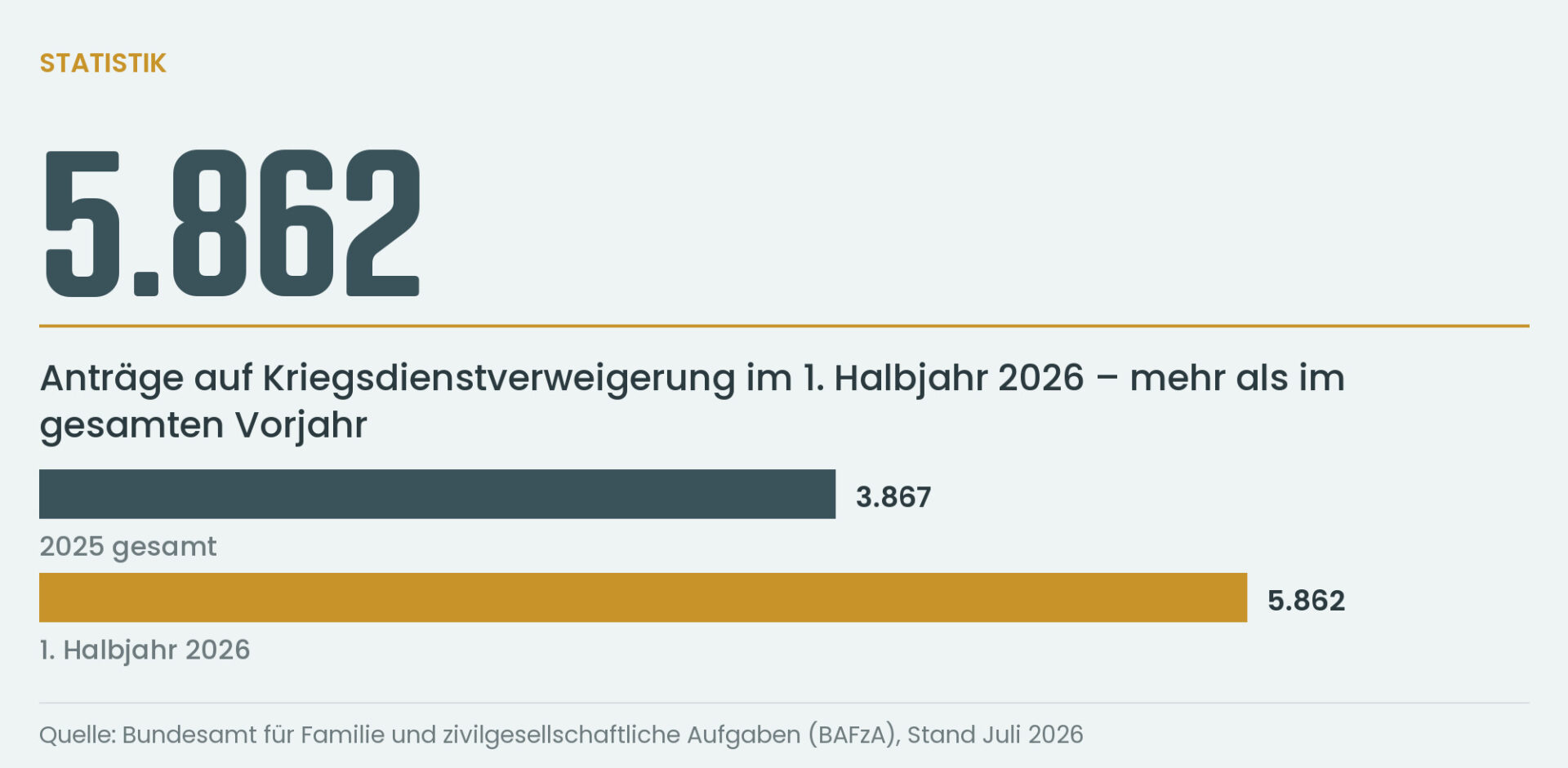
That the topic of military service is on many people’s minds is also reflected in the number of applications for conscientious objection processed by the BAFzA:
← Tabelle nach links wischen, um weitere Spalten zu sehen
| Period | Applications for Conscientious Objection |
|---|---|
| Full year 2025 | 3,867 |
| First half of 2026 (Jan.–Jun.) | 5,862 |
| January to July 2026 (cumulative) | 8,302 |
Already in the first half of 2026, more applications were received than in the whole of 2025. Reporting cites both the tense security-policy situation and the Military Service Modernization Act, which entered into force on 1 January 2026, as reasons – the new registration and questionnaire obligations appear to have prompted more young men to actively engage with the question of conscientious objection. (Source: Federal Office for Family Affairs and Civil Society Functions, as cited in an epd report, published inter alia on 14 July 2026.)
Dual Nationality: The Second Conscription Obligation That Is Often Overlooked
For many Germans living abroad, the more pressing practical question is not the German conscription obligation at all, but the foreign one. Anyone who, alongside their German passport, holds the nationality of a state in which conscription is not suspended but actively enforced can be directly subject to a call-up there. The fact that German conscription has been suspended since 2011, and that German registration lies dormant for those with a permanent residence abroad, changes nothing about the obligations owed to the second home state.
The underlying principle under international law is that a person with multiple nationalities should only have to fulfil their conscription obligation toward one state, ordinarily the state of their habitual residence. This principle is enshrined in Chapter II of the Council of Europe Convention of 6 May 1963 on Reduction of Cases of Multiple Nationality and on Military Obligations in Cases of Multiple Nationality (BGBl. II 1969 p. 1953), which provides for service performed in another contracting state to be credited. In addition, bilateral agreements exist, such as the German-Swiss agreement of 1958, which grants dual nationals a right of election that must be exercised by the completion of their 19th year. Under German law, this finds its counterpart in Section 11(1) WPflG, which exempts persons subject to conscription from military service to the extent that an exemption follows from treaties under international law.
The catch: these agreements only operate between the states party to them. Where no agreement exists, an obligation can, in the extreme case, exist in both states simultaneously, and crediting service already performed is by no means automatic.
This must be distinguished from the question, addressed above, of loss of nationality under Section 28 StAG: that ground for loss is linked to voluntary entry into a foreign armed force. A dual national called up on the basis of a conscription obligation existing in their second home country does not, in that respect, enter voluntarily – exactly where the line runs, in the individual case, between compulsory service and voluntary commitment, for instance upon a subsequent re-enlistment, is a question that should be examined carefully before facts are created.
Two Country Examples That Affect Many Families
- Turkey: Every male Turkish national is, under Turkish law, in principle subject to conscription, regardless of residence or any additional nationality. For nationals who live and work permanently abroad, a buy-out option exists under the so-called “dövizle askerlik” (foreign-currency military service) scheme, in exchange for payment. Among other requirements, this requires employment abroad totaling at least 1,095 days, i.e., three years. The buy-out amount is set in Turkish lira, adjusted several times a year, and in 2026 stood in the mid to upper four-figure euro range; the process is handled through Turkish foreign missions.
- Greece: Greece, too, maintains actively enforced conscription. Under Military Service Act 5265/2026, which entered into force on 10 January 2026, the status of permanent resident abroad was redefined: deferral of military service continues only if the ongoing residence abroad is proven every three years. If proof is not provided, the deferral is revoked and the person concerned is summoned for enlistment. For German-Greek dual nationals with permanent residence and employment in Germany, German diplomatic missions in Greece indicate that an entitlement to indefinite deferral exists – though this remains tied to a recurring obligation to provide proof.
Both examples illustrate the same pattern: a favorable status in the second home country is not a permanent state but is tied to evidence, deadlines, and periods of residence. It can lapse merely through a missed deadline, without any German authority taking note of it or notifying you. Anyone who carefully examines the German legal situation but not that of their second passport may well be examining the less relevant half.
How to Distinguish Reliable From Unreliable Online Sources
Anyone researching this topic online encounters sources of very varying quality. Differentiated specialist media such as Legal Tribune Online correctly identified the confusion surrounding the authorization requirement for stays abroad early on as an open legal question, without rushing to dramatize it. On the other hand – particularly on sensationally titled blog posts and politically colored websites – there are accounts that present the old, unused authorization provision of Section 3(2) WPflG as though every man fit for military service is already restricted in their freedom to travel today, or that falsely present the BGH’s extradition decision as a statement about German conscription. Neither holds up against the current legal situation. Anyone relying on individual forum posts or older articles published before the clarifying BMVg decree of April 2026 is also frequently working from an already outdated position.
Illustrative Example (Purely Hypothetical)
A purely hypothetical, constructed example with no connection to any actual case: a 24-year-old German has lived permanently in a neighboring EU country for three years, is registered there, and has deregistered in Germany. Following the reform, he reads a forum post claiming that he must “report to the Bundeswehr immediately” and becomes concerned. Under the current decree situation, registration lies dormant for the duration of his residence abroad; no questionnaire will be sent to him for as long as he lives there, and he does not need separate authorization for visits to Germany. Whether this changes – for instance, in the event of a planned return, or in the case of dual nationality carrying its own conscription obligations in the state of residence – can only be assessed based on the specific, current circumstances, not on a forum post.
Why an Individual Legal Assessment Is Worthwhile
The legal situation described here concerns the general, current state of affairs. In an individual case, particular circumstances may arise that make a separate review worthwhile: dual or multiple nationality carrying its own conscription obligations in the state of residence, a planned return to Germany, a questionnaire or examination notice already received, or the question of how military service in the state of residence relates to German nationality. Precisely because the decree situation – as developments from January to April 2026 show – can change at short notice, it is worth having the current position reviewed by legal counsel in case of doubt, rather than relying on older online sources.
The law firm of attorney Johannes Fiala advises on cross-border legal matters, including in areas where the legal and administrative situation – as is currently the case with military service law – remains in flux. If you live abroad and would like clarity on how the current legal situation regarding Bundeswehr conscription applies to your personal circumstances, please get in touch to discuss your individual situation.
Conclusion
For Bundeswehr conscription in the case of residence abroad, the following applies: the connecting factor is German nationality, not residence – but registration lies dormant for as long as a permanent residence abroad continues. This dormancy under Section 1(2) WPflG is not an extinguishment but a state that requires both residence and economic livelihood abroad, and ends once these cease to apply. The Military Service Modernization Act, in force since 1 January 2026, regulates registration, the questionnaire obligation, and future physical examinations, but leaves the right to conscientious objection untouched. The widely cited authorization requirement for stays abroad under Section 3(2) WPflG is, following the clarifying decree of the Federal Ministry of Defence of April 2026, deemed automatically granted for as long as conscription remains suspended. And the BGH decision of January 2025 on the extradition of a Ukrainian national makes no statement about German conscription. For dual nationals, the practically more important question is in any case frequently the conscription obligation of their second home country, which remains unaffected by the German suspension and carries its own deadlines and evidentiary requirements. Anyone with specific questions about their personal situation on this topic is better served by an individual legal assessment than by a forum search.


