

A parent dies with their last habitual abode in Germany – yet part of the estate consists of a holiday home in Spain, a bank account in Switzerland, or a business interest in the United States. For disinherited children and spouses, or those left with only a small share, a dual question then arises: does my compulsory portion claim (Pflichtteilsanspruch) under Section 2303 of the German Civil Code (Bürgerliches Gesetzbuch, BGB) – § 2303 BGB – apply to assets abroad at all, and can it actually be enforced there? Neither question can be answered in blanket terms; both depend on which succession law applies, where the assets are located, and whether the destination state recognises the compulsory portion as a legal institution at all.
Why Foreign Assets Complicate the Compulsory Portion Claim
German compulsory portion law is regarded as one of the strongest correctives to testamentary freedom in Europe: under § 2303 BGB, close relatives – descendants, spouses, and, in certain circumstances, parents – are entitled to a minimum share of the estate expressed in money, even where they have been passed over by will. The Bundesgerichtshof (Federal Court of Justice) even counts this right among the core principles of German public policy, addressed further below. As long as the entire estate is located in Germany, enforcing this claim rarely raises questions of principle.
That changes as soon as foreign assets are involved. Two levels then overlap: first, the conflict-of-laws question of which substantive succession law applies at all – and whether that law even recognises a claim comparable to the German compulsory portion. Second, the purely practical question of whether a payment claim obtained in Germany can also actually be enforced against assets located across the border. Both levels must be strictly distinguished in law, but are frequently conflated in practice.
Which Succession Law Applies? The EU Succession Regulation and Its Limits
Habitual Abode as the Default Connecting Factor
Within the states bound by the EU Succession Regulation (EU-Erbrechtsverordnung, EuErbVO) – that is, practically all EU member states except Denmark and Ireland – the applicable succession law is determined, as a rule, by the deceased’s last habitual abode (Article 21 EuErbVO), not by their nationality. The Regulation follows the principle of unity of succession: a single law is meant to govern the entire estate, regardless of the country in which individual assets are located. If the deceased’s last habitual abode was in Germany, their assets in Spain, Portugal, or Italy are, in principle, also subject to German compulsory portion law.
Choice of Law and Its Limits
Article 22 EuErbVO permits a choice of law in favour of the law of one’s home state. A German national permanently resident abroad may stipulate by will that German succession law is to apply – or, conversely, attempt to limit relatives’ claims by choosing a foreign law that has no concept of a compulsory portion. That such a choice of law does not operate without limit was clarified by the Bundesgerichtshof in its judgment of 29 June 2022 (IV ZR 110/21): choosing English law under Article 22 EuErbVO breaches German public policy (ordre public) (Article 35 EuErbVO) where, in a case with a sufficiently strong connection to Germany, it results in a child having no needs-independent compulsory portion claim at all. We examine the ordre public reservation in more depth below.
Outside the scope of the EuErbVO – for example for assets in the United States, the United Kingdom, or the United Arab Emirates – whether German law is recognised depends on the respective national conflict-of-laws rules of the third state. Many common-law states additionally distinguish between movable assets (connected to the domicile) and real estate (connected to the location of the property) – so-called scission of succession (Nachlassspaltung) – which can result in several legal systems applying side by side to one and the same estate.
Countries With and Without a Compulsory Portion Concept, Compared
The German compulsory portion is not a special case by international standards, but nor is it a given everywhere. Many continental European legal systems recognise a comparable institution of a mandatory minimum share, whereas the Anglo-Saxon legal tradition has traditionally placed considerably more weight on testamentary freedom.
← Tabelle nach links wischen, um weitere Spalten zu sehen
| Legal system | Compulsory portion / comparable institution | Characteristics |
|---|---|---|
| Germany | Yes (§§ 2303 et seq. BGB) | Fixed monetary claim, independent of the entitled person’s need |
| France | Yes (“réserve héréditaire”) | Mandatory share of the estate in favour of descendants |
| Italy, Spain | Yes (“legittima” / “legítima”) | Mandatory minimum share, structured differently in some regions |
| Austria, Poland | Yes (compulsory portion / “zachowek”) | Comparable concept, sometimes with differing quotas |
| Serbia | Yes (“nužni deo”) | Mandatory minimum share for descendants, spouses, and in some cases parents; a waiver is only possible to a limited extent under Serbian law |
| England and Wales | No, in the German sense | Only judicial discretion under the Inheritance (Provision for Family and Dependants) Act 1975 – no fixed entitlement |
| United States (most states) | No, for children | Usually only an “elective share” in favour of the spouse; exceptions include Louisiana, with “forced heirship” |
| Australia | No, in the German sense | Comparable to England: judicial “family provision” claims instead of a fixed quota |
This overview is simplified and does not replace an examination of the individual case, in particular because quotas and requirements can differ within a country depending on the state, region, or law reform. It does, however, show the fundamental fork in the road: anyone moving assets to a state in the right-hand column must assume that no compulsory claim comparable to the German compulsory portion exists there – which makes enforcement there considerably more difficult, or impossible.
Enforcing Compulsory Portion Claims against Foreign Assets
Under German law, the compulsory portion claim is a pure monetary claim against the heir or heirs – not a right in rem over individual estate assets (§ 2303(1) BGB). This has a practically important consequence: as long as the heir or heirs hold tangible assets in Germany, a person entitled to a compulsory portion can, in principle, sue for and enforce their claim in Germany even where part of the original estate was located abroad – the amount of the claim is simply calculated by reference to the value of the worldwide estate.
Matters become more difficult where the heirs themselves are also predominantly resident abroad, or hold their assets there. A judgment obtained in Germany must then be recognised and declared enforceable in the destination state. Within the EU, the EuErbVO (for succession-related decisions, Articles 39 et seq.) and the Brussels Ia Regulation (for general civil judgments) considerably ease this step. Vis-à-vis third states such as the United States, the United Kingdom after Brexit, or the United Arab Emirates, by contrast, no comparably automated procedure exists; enforcement then depends on bilateral agreements or the destination state’s own national enforcement law – and can be considerably delayed, or in individual cases effectively come to nothing, for example if the destination state does not recognise the compulsory portion as such.
In practice, a two-stage approach is therefore advisable: first, the claim for information under § 2314 BGB is used to establish the actual extent and value of the domestic and foreign assets – often the most laborious step, because foreign registers, banks, or authorities are not automatically obliged to provide information. Only after that comes the quantification and, where necessary, judicial pursuit of the payment claim, with the choice of the state of enforcement – Germany or abroad – depending decisively on where the heirs hold assets of value that are actually accessible.
Waiving or Limiting the Compulsory Portion on Emigration
Anyone planning to move abroad permanently often asks whether, and how, the compulsory portion claims of their own children or spouse can be limited or excluded by contract. German law provides for this in § 2346 BGB, the compulsory portion or inheritance waiver (Pflichtteils- bzw. Erbverzicht): a contract between the testator and the entitled person that must be notarised (§ 2348 BGB) and is regularly concluded with both sides participating. Such a waiver can, in principle, also be validly agreed where there is a foreign connection, provided that German law applies or the chosen foreign law permits a comparable contract – Article 25 EuErbVO likewise permits a choice of law for succession contracts, albeit subject to its own requirements for validity.
A mere move abroad alone, however, does not automatically substitute the local, possibly compulsory-portion-free law for such a contract. In EU cases, what remains decisive is the habitual abode at the time of death (Article 21 EuErbVO); anyone who permanently and demonstrably relocates the centre of their life to a state with no compulsory portion concept can thereby actually achieve the result that the law of that state applies instead of German compulsory portion law. As the Bundesgerichtshof’s ruling on public policy shows, however, this remains no automatic free pass: where a sufficiently strong connection to Germany continues to exist despite the move – for example because substantial assets, the family, or previous centres of life remained in Germany – German courts can, in an individual case, refuse to apply the foreign, compulsory-portion-free law. There is no blanket formula for when a connection to Germany is “sufficiently strong”; the courts decide according to the circumstances of the individual case.
Hypothetical example for illustration: An entrepreneur permanently relocates her habitual abode to England, sells her German property, and thereafter holds her assets mainly in a British custody account. If she dies there, English law would, in principle, apply – with the result that her child living in Germany has no automatic compulsory portion claim under § 2303 BGB, but could at most bring a discretionary claim under English law. If, by contrast, a rented property in Munich remains part of the estate and the family’s centre of life is in fact in Germany, the assessment – as in the Bundesgerichtshof’s case – may turn out differently. This example serves only to illustrate the legal position and does not describe an actual case.
The Ordre Public Reservation: A Limit on Foreign Succession Law
The ordre public reservation (Article 35 EuErbVO; under national law, Article 6 of the Introductory Act to the German Civil Code, Einführungsgesetz zum Bürgerlichen Gesetzbuche, EGBGB) allows German courts to refuse to apply foreign law that would otherwise be applicable, where its result would be manifestly incompatible with fundamental principles of German law. The threshold is deliberately set high: a mere difference in evaluation – for example a lower compulsory portion quota abroad – is not enough. Only where the result, measured against the circumstances of the individual case, contradicts fundamental German notions of justice does the reservation apply.
It was precisely this threshold that the Bundesgerichtshof found to be met in 2022, for the case in which choosing English law, given a strong connection to Germany, results in a child having no needs-independent compulsory portion claim whatsoever. The court classified compulsory portion law, as an institution, as belonging to the core of German public policy. For practice, this means: anyone attempting to exclude compulsory portion claims entirely through a choice of law or by moving abroad should be aware that German courts can intervene in an individual case where a connection to Germany continues to exist – the ordre public reservation is not a safety net for every arrangement, but a real standard of review that serious succession planning must reckon with.
Facts and Figures: Cross-Border Succession Cases in the EU
How relevant cross-border connections actually are in succession law is shown by an estimate from the European Commission, dating from the time the EU Succession Regulation was drawn up, on which the enactment of the Regulation was based. No reliable figure citable with an exact source in the text of the Regulation itself, nor any more recent official survey, could be found on this point, and it is therefore expressly identified here as an estimate:
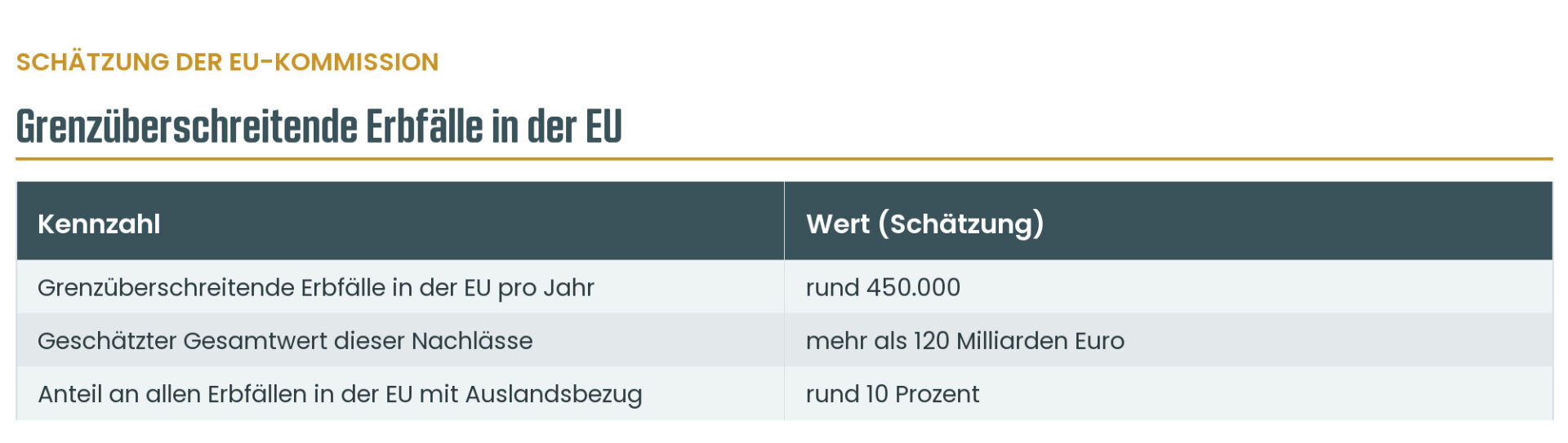
This order of magnitude makes clear that succession cases involving foreign assets are no marginal phenomenon, but affect a significant proportion of all estates within the EU – with correspondingly high potential for conflict where persons entitled to a compulsory portion and the assets are located in different legal systems.
Practical Recommendations
Draw up an asset overview at an early stage. Persons entitled to a compulsory portion should not rely on assumptions, but should specifically extend the claim for information under § 2314 BGB to foreign assets as well.
Clarify the applicable law early. Whether German or foreign succession law applies is generally decided by the deceased’s habitual abode at the time of death – this question should be clarified before any further strategy is pursued.
Draft choice-of-law clauses and compulsory portion waivers carefully. Anyone making a choice of law as a testator, or wishing to agree a waiver, should factor in the ordre public reservation and the degree of remaining connection to Germany from the outset.
Think ahead about the place of enforcement. Even before bringing a claim, it is worth examining where the heirs actually hold realisable assets – this determines whether enforcement in Germany is sufficient or recognition abroad becomes necessary.
Keep an eye on time limits. The regular three-year limitation period for the compulsory portion claim (§§ 195, 199 BGB) runs regardless of how long it takes to establish foreign assets. A separate, longer limitation rule (§ 2332 BGB) has, since the 2010 succession law reform, applied only to the supplementary compulsory portion claim against the recipient of a gift under § 2329 BGB, not to the ordinary compulsory portion claim against the heirs themselves.
Conclusion
German compulsory portion law does not automatically lose its effect merely because assets are located abroad or those involved live there – but it depends decisively on which succession law applies under conflict-of-laws rules, and whether a German judgment can also be enforced in the destination state. While many continental European states recognise an institution comparable to the German compulsory portion, large parts of the Anglo-Saxon legal tradition do without one – with noticeable consequences for practical enforceability. The ordre public reservation sets a limit on arrangements intended to eliminate the compulsory portion entirely where a connection to Germany continues to exist.
The Fiala law firm has published extensively on international succession law and asset protection and supports both persons entitled to a compulsory portion in enforcing their claims against foreign assets, and testators in structuring their succession across national borders in a legally sound manner. Please feel free to contact the firm on a non-binding basis to discuss your individual situation in an initial consultation.


