

Anyone who moves between several countries as a digital nomad will sooner or later hear the line: “Stay nowhere longer than 183 days, and you’re tax-free.” This rule of thumb sounds simple – and, stated in such blanket terms, it is wrong. For German tax liability, what matters is not primarily a day count spent abroad, but two independent connecting factors under German tax law: domicile under § 8 of the German Fiscal Code (Abgabenordnung, AO) and habitual abode under § 9 AO. Anyone who ignores both risks remaining subject to unlimited tax liability in Germany despite years of living abroad – often without even realizing it.
This article explains how habitual abode should actually be understood for digital nomads, why a retained home in Germany can become a silent tax trap, and what applies in cases of dual residence in two states.
The Misconception: “No 183 Days Anywhere = Tax-Free”
The 183-day limit is indeed part of many double taxation agreements (Doppelbesteuerungsabkommen, DBA) – but there it usually governs only a special case: whether the state in which someone works temporarily for an employer receives the right to tax that income from employment. It does not answer the underlying question of whether a person remains subject to unlimited tax liability in Germany at all. That underlying question is decided initially and solely under German law – specifically under § 8 and § 9 AO.
Digital nomads who work as self-employed individuals or freelancers and deliberately keep their stays short to remain “under 183 days” therefore often overlook the real risk: they carefully count their days abroad, but fail to check whether they are simultaneously establishing or maintaining a domicile or habitual abode in Germany.
Two Independent Connecting Factors: Domicile and Habitual Abode
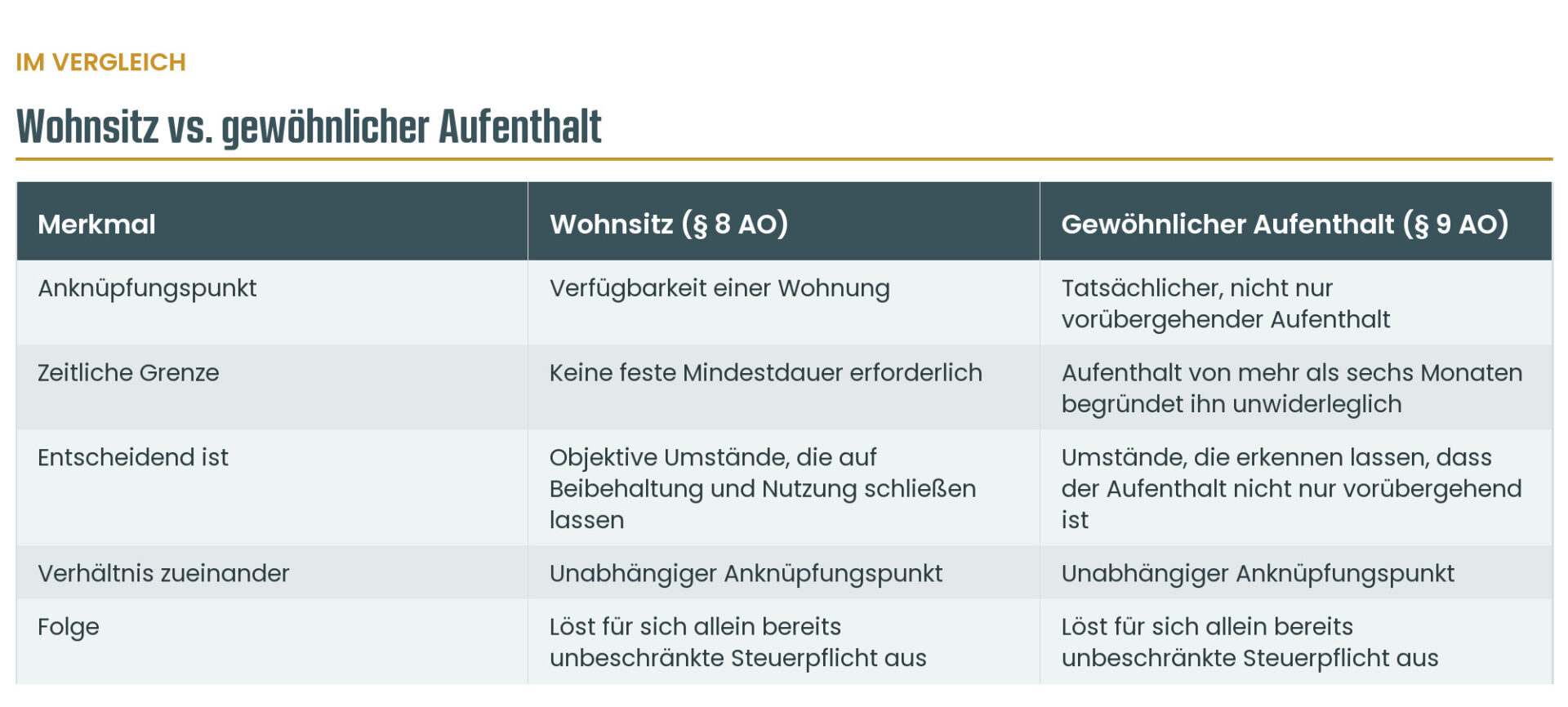
German income tax law attaches unlimited tax liability to two separate criteria. It is sufficient for either one of them to be met – avoiding both at the same time is therefore essential for digital nomads who consider themselves no longer tax-resident in Germany.
Domicile under § 8 AO
Under § 8 AO, a person has their domicile wherever they have a home available under circumstances indicating that they will keep and use it. What matters is the objective availability of a home – not how many days per year it is actually used. A home that remains available to the person, for example one that is kept furnished and ready or is only sublet on a short-term basis, can establish a domicile even if the person spends most of their time abroad.
Habitual Abode under § 9 AO
Habitual abode, by contrast, is tied to a person’s actual presence in a place. Under § 9 AO, a person has their habitual abode wherever they stay under circumstances indicating that their presence at that place or in that area is not merely temporary. A continuous stay of more than six months conclusively and irrebuttably establishes a habitual abode – short interruptions, such as brief trips, are disregarded.
Why This Distinction Is Crucial for Digital Nomads
Because both criteria can independently trigger unlimited tax liability, it is not enough to avoid only one of them. Anyone who gives up their home in Germany but, through frequent, recurring stays in Germany, in fact establishes a habitual abode there remains liable to tax. Conversely, anyone who is rarely in Germany anymore but still has their parents’ home, their own condominium, or a room available to them can nonetheless remain resident in Germany under § 8 AO.
The Silent Tax Trap: The Retained Home
In practice, the same mechanism appears again and again: digital nomads give up their centre of life in Germany, terminate their employment, and may even deregister with the local residents’ registration office (Einwohnermeldeamt) – but, out of convenience, for cost reasons, or out of emotional attachment, keep their apartment or a room at their parents’ home. That alone can be enough to let the domicile under § 8 AO continue, regardless of how many days per year the person actually spends there.
It becomes particularly treacherous when, at the same time, no new, clearly documented tax residence is established abroad. What results is what is sometimes referred to in practice as a “nowhere tax resident”: the person subjectively assumes they are no longer subject to unlimited tax liability in any country, because they only ever stay briefly anywhere – but in fact they remain subject to unlimited tax liability in Germany, because the home there was never cleanly given up. The result is frequently a tax return left unfiled for years, while tax claims and interest continue to accrue in the background.
An Illustrative Example (Hypothetical)
To illustrate the point, consider a purely hypothetical example, not based on any actual client matter: a freelancer travels through Southeast Asia and South America for several years, never staying anywhere longer than four months at a stretch, and assumes she is “no longer registered for tax purposes anywhere.” However, she has not terminated her furnished two-room apartment in Germany, but only rented it out temporarily, because she wants to “be able to come back at any time.” Under § 8 AO, this apartment remains available to her – with the possible consequence that, under German law, she has remained subject to unlimited tax liability throughout the entire period, regardless of the number of days she spent abroad.
Dual Residence: The Tie-Breaker Rules under Double Taxation Agreements
Sometimes a person simultaneously establishes tax residence in two states under each state’s respective national rules – for example, in Germany under § 8 or § 9 AO, and at the same time in the new state of stay under that state’s own law. If a double taxation agreement exists between the two states, so-called tie-breaker rules apply in this case, which in their basic structure follow the model conventions commonly used internationally in this field. They determine which state is given priority as the state of residence for purposes of the agreement.
The review is typically carried out in a fixed sequence until a clear result is reached:
← Tabelle nach links wischen, um weitere Spalten zu sehen
| Step | Criterion |
|---|---|
| 1 | In which state does the person have a permanent home available? |
| 2 | If a permanent home is available in both states: where is the centre of vital interests (the closer personal and economic relations)? |
| 3 | If the centre of vital interests cannot be clearly determined: where does the person have their habitual abode? |
| 4 | If the person has a habitual abode in both states or in neither: what is the person’s nationality? |
| 5 | If the question remains unresolved: it is settled through a mutual agreement procedure between the tax authorities involved |
It is important to understand that these tie-breaker rules do not resolve the underlying problem that both states can, in the first instance, assert their own tax claims under their respective domestic law. Where an agreement applies, they only decide which state is granted priority as the state of residence – German unlimited tax liability as such initially remains unaffected by this and must be resolved through the application of the agreement.
Practical Recommendation: Clear Deregistration Instead of a Grey Area
A clear recommendation for action follows for digital nomads: the grey area is the real risk factor – not living abroad as such. Anyone who genuinely wants to change their tax status should do so in a documented and verifiable manner, rather than relying on a day count:
- Actually give up the home in Germany (by terminating the lease or letting it out on an unlimited-term basis), rather than keeping it available “just in case”
- Complete the deregistration with the residents’ registration office (Einwohnermeldeamt) and the tax deregistration with the tax office (Finanzamt), and keep the corresponding documentation
- Actively establish tax residence in the new state of stay and, where possible, obtain a certificate of residence
- Continuously document stays, lease agreements, flight movements, and the centre of business and personal relationships, in order to be able to prove the relocation if it is ever called into question
- In the case of frequently changing stays without a fixed new centre of life, have it reviewed at an early stage whether a connecting factor in Germany nonetheless continues to exist
Precisely because domicile and habitual abode can independently trigger unlimited tax liability, a structured review of one’s own situation before relocating abroad is worthwhile – if in doubt, including a legal assessment, rather than relying on rules of thumb from internet forums.
Conclusion
For digital nomads, habitual abode is only one of two independent ways of remaining subject to unlimited tax liability in Germany – domicile under § 8 AO is the second, and often underestimated, way. Anyone who cleanly and verifiably terminates both criteria can credibly demonstrate their changed tax status. Anyone who instead relies on a mere day count while quietly keeping their old home, by contrast, risks continuing to be treated as subject to unlimited tax liability in Germany despite years of living abroad.
Individual Advice on Habitual Abode and Domicile
Every situation faced by a digital nomad is different – depending on the countries of stay, the types of income involved, applicable double taxation agreements, and the previous housing situation in Germany. The law firm of attorney Johannes Fiala, which focuses on international tax law, helps clients realistically assess their own status and document their relocation abroad in a legally sound manner. If you are uncertain about your habitual abode or domicile, contact the firm at an early stage to discuss your individual situation.


