

Anyone emigrating as a digital nomad usually turns first to the tax question: domicile, habitual residence, double taxation agreements. A second question, legally entirely independent of the first, is often overlooked in the process: does mandatory coverage under Germany’s statutory health, pension, and long-term care insurance continue while working from abroad, whether on the move or on a permanent basis – or does the insurance obligation end without anyone consciously deciding so?
Tax law and social insurance law follow different statutes and different standards. A person can remain subject to unlimited tax liability in Germany and still fall out of statutory health insurance – or, conversely, be tax-resident abroad while remaining within the German social insurance system for months or years. Settling the tax side alone does not settle the social insurance side.
Three Legal Regimes, Depending on Where You Go
Whether, and for how long, German social insurance coverage continues after departure from Germany depends substantially on the destination country. Legally, three levels must be distinguished, which are examined in a fixed order of precedence:
- EU, EEA, and Switzerland: Regulation (EC) No 883/2004 on the coordination of social security systems takes precedence here.
- Countries with a bilateral social security agreement: Germany has concluded its own agreements with a number of non-EU states, though the scope of these agreements varies from country to country and is generally narrower than EU coordination.
- All other countries: Here, provided the requirements are met, only national German law applies – in particular the Ausstrahlung (continued application) principle under Section 4 of the German Social Code Book IV (Sozialgesetzbuch IV – SGB IV, referred to below as “§ 4 SGB IV”).
Within the EU/EEA and Switzerland: Coordination, Not Collision
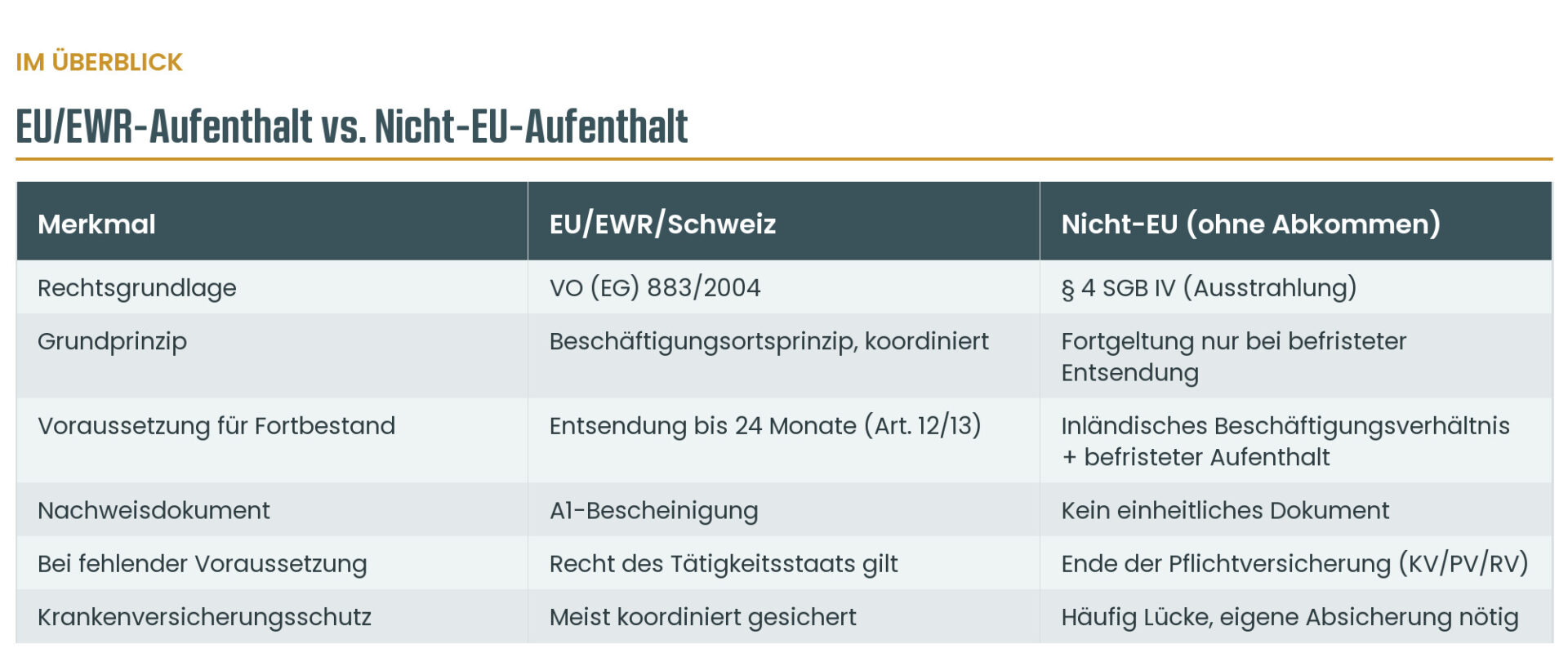
Within the scope of Regulation 883/2004, the principle of the place of employment applies as a rule (lex loci laboris, Article 11 of Regulation 883/2004): what generally matters is the state in which the activity is actually carried out – not the place of residence and not nationality. For digital nomads, however, an important exception applies.
Secondment: German Coverage Continues for up to 24 Months
Anyone temporarily posted by an employer established in Germany to another EU/EEA state or to Switzerland remains within German social insurance for the duration of the secondment – for a maximum of 24 months – under Article 12 of Regulation 883/2004. Comparable principles apply to self-employed persons who temporarily relocate their activity to another member state. This status is evidenced by the so-called A1 certificate (A1-Bescheinigung), which must be carried on site and produced on request to authorities or clients.
Facts and figures: In 2023, Germany issued more than 2 million A1 certificates – by far the highest number among all EU member states, and an increase of around 408,000 over the previous year. Germany was thus simultaneously the country with both the most issued and the most received A1 certificates in the entire EU. *(Source: European Commission / HIVA-KU Leuven, “Posting of Workers – Report on A1 Portable Documents issued in 2023”.)*
When There Is No Classic Secondment
Many digital nomads are not “sent” in the sense of a classic secondment, but instead work independently and on the move from changing EU states. For persons who ordinarily work in two or more member states, Article 13 of Regulation 883/2004 applies: if a substantial part of the activity is carried out in the state of residence, that state’s law applies; otherwise, for employees, the employer’s registered seat is generally decisive, and for self-employed persons, the centre of their activities. Here too, clarification through an A1 certificate is advisable in order to avoid double coverage or an unclear allocation.
Outside the EU: Ausstrahlung under § 4 SGB IV
Once a digital nomad leaves the scope of Regulation 883/2004, the so-called Ausstrahlung principle under § 4 SGB IV comes into play – provided no social security agreement applies instead. In its core, the provision reads:
“Insofar as the provisions on the obligation to be insured and the entitlement to insurance presuppose an employment, they also apply to persons who, within the framework of an employment relationship existing within the territorial scope of this Code, are posted to a territory outside that scope, if the secondment is limited in time from the outset, either due to the nature of the employment or by prior contractual agreement.” (§ 4 Abs. 1 SGB IV)
Under § 4 Abs. 2 SGB IV, this applies correspondingly to self-employed persons. Ausstrahlung therefore requires two conditions to be met together:
- An employment relationship continues to exist in Germany (for self-employed persons: a corresponding domestic basis for the activity), and
- the stay abroad is limited in time from the outset – either because the nature of the activity entails this (for example, a fixed-term project) or because this has been contractually fixed in advance.
It is precisely on this second point that Ausstrahlung fails for many digital nomads. Anyone travelling the world without a fixed return date, without a continuing domestic employment relationship, and without a clearly limited assignment generally does not meet the requirements of § 4 SGB IV. German social insurance obligations then end – regardless of whether a tax link to Germany continues to exist in parallel or not.
Serbia as an Example: A Bilateral Agreement without Automatic GKV Coverage
Serbia lies outside the EU and the EEA, so Regulation 883/2004 does not apply there. A social security agreement does exist between Germany and Serbia – legally, this is the still-effective German-Yugoslav agreement of 1968, which formally covers health, accident, pension, and unemployment insurance. In practice, however, its benefit is aimed primarily at posted employees and at the aggregation of pension insurance periods – it does not provide a digital nomad who moves to Serbia independently and self-employed with any automatic continuation of German statutory health insurance (gesetzliche Krankenversicherung – GKV). Anyone who moves there without a secondment and without a continuing domestic employment relationship faces, in social insurance terms, essentially the same situation as in a country with no agreement at all: German mandatory coverage regularly ends, and private or voluntary cover must be organised independently.
What Happens After the 24 Months – and What Is Often Overlooked
The rules on secondment and on the bilateral agreement with Serbia discussed so far immediately raise follow-up questions that are regularly overlooked in practice.
Extension beyond 24 months. Without further action, the principle of the place of employment (Article 11 of Regulation 883/2004) automatically applies once the secondment period expires – mandatory insurance in the state of activity, with no option to choose otherwise. Under Article 16(1) of Regulation 883/2004, however, the competent authorities of both states can agree on an exception, on application, and extend German coverage beyond the 24 months, for example to 36 months. In practice, this is common for projects that are foreseeably longer, but it must be applied for in good time through the German Liaison Office for Health Insurance Abroad (Deutsche Verbindungsstelle Krankenversicherung Ausland – DVKA).
No “choice” between private health insurance (PKV) and a foreign statutory health scheme outside the EU/EEA. As soon as local employment or self-employment is taken up in the destination country, that country’s own national mandatory insurance automatically applies. Example Serbia: the RFZO (Republički fond za zdravstveno osiguranje – Serbia’s national health insurance fund) requires mandatory registration as soon as someone is employed or self-employed there – entry-level contributions start at around €45 per month.
A standby policy (Anwartschaftsversicherung) exists in the GKV too, not only in the PKV. Several statutory health insurers – for example TK (Techniker Krankenkasse), Audi BKK, or AOK – offer their own standby policy for longer stays abroad at a reduced special premium (in the range of €75 to €85 per month instead of the full voluntary contribution), which secures later reinstatement without a waiting period. Structurally, this differs from the PKV-typical distinction between a “small” and a “large” standby policy, where the retention of accumulated ageing reserves (Alterungsrückstellungen) additionally plays a role – but the principle of suspending cover while retaining a secured right of return exists in both systems. For long-term care insurance, the two are coupled in each case: the GKV standby policy generally also secures the return to statutory long-term care insurance, while under the PKV, mandatory private long-term care insurance runs in parallel with the PKV standby policy.
Local employment accelerates the switch. If someone additionally takes up local employment in the destination country – for example in Serbia, alongside an ongoing German secondment – this immediately triggers mandatory registration there (RFZO), regardless of the status of the German secondment. The precise treatment of such dual-employment situations, where one employer in Germany posts the person abroad while a second employer in the destination country also employs them, is a matter for individual assessment in each case.
“Turning the game around.” For some, the goal is not avoidance but a deliberate move into the less expensive foreign statutory health scheme. The cost comparison – RFZO from around €45 per month versus German GKV contributions – shows that, in many destination countries (with exceptions such as the United States), this can be a legitimate option rather than merely a risk.
What the End of Mandatory Coverage Means in Practice
If the social insurance obligation ends for lack of Ausstrahlung and for lack of an applicable agreement, this affects the three branches of insurance differently:
Health insurance: Mandatory membership in statutory health insurance (GKV) generally ends once employment, Ausstrahlung, and domestic residence all lapse. Anyone who was previously covered under GKV can, under certain conditions, join voluntary insurance under § 9 SGB V (Book V of the German Social Code, governing statutory health insurance) – this requires, among other things, a specific period of prior coverage (generally 24 months within the last five years, or an uninterrupted 12 months immediately before leaving) as well as a timely, written declaration of accession within three months. Alternatively, a pure standby policy is an option: it is less expensive but only secures the later right to return to GKV, without providing any actual benefits during the stay abroad. Anyone unaware of this difference sometimes believes they are covered, when in fact no insurance protection exists while abroad.
Long-term care insurance: This is legally linked to health insurance. Anyone who continues voluntary coverage under GKV is automatically covered for long-term care as well; anyone who leaves GKV regularly loses this protection too.
Pension insurance: No insurance obligation continues once employment and Ausstrahlung have ended. Regardless of residence and nationality, however, voluntary contributions can be paid into the German statutory pension insurance scheme in order to avoid gaps in the contribution record and not jeopardise entitlement to future benefits.
Health insurance in particular is the greatest practical risk here: travel and long-term travel health insurance policies, which many digital nomads take out in any case, are generally designed to cover acute, unforeseen illness during a time-limited stay – not permanent, comprehensive healthcare. Anyone relying solely on such a policy can overlook a real coverage gap in the case of chronic illness, plannable treatment, or a longer period abroad.
EU/EEA Stays and Non-EU Stays at a Glance
Hypothetical Example
Purely for illustration, without reference to any actual client matter: a self-employed software developer initially works for several months from Portugal, then for a few weeks from Thailand, and finally for six months from Belgrade. For the time in Portugal, depending on how his activity is structured, an allocation under Regulation 883/2004 may still be possible. At the latest with the move to Thailand and then to Serbia, he leaves the scope of EU coordination; lacking a continuing domestic employment relationship and without a return date fixed from the outset, he does not meet the requirements of Ausstrahlung under § 4 SGB IV. Without a timely decision in favour of voluntary insurance or some other form of cover, he would risk finding himself, during this phase, without reliable health insurance protection – a state of affairs he might only become aware of at the point of his first serious illness.
Practical Recommendations for Digital Nomads
- Before departure, clarify whether a genuine, time-limited secondment exists or an open-ended, indefinite digital nomad lifestyle is planned – the legal classification depends substantially on this
- For stays in the EU, the EEA, or Switzerland, apply for an A1 certificate in good time, including as a self-employed person
- For stays outside the EU, check whether and to what extent a social security agreement exists with the destination country – and whether its scope even covers your own situation
- Do not let the three-month deadline for joining voluntary health insurance under § 9 SGB V lapse if continued coverage is desired
- Understand precisely the difference between voluntary insurance with a full entitlement to benefits and a mere standby policy before making a decision
- Consider voluntary contributions to pension insurance in order to avoid gaps in the contribution record
- Carefully review the scope of any travel or long-term travel health insurance and do not mistake it for full-fledged health insurance
Conclusion
For digital nomads, social insurance law and tax law are two separate construction sites with their own rules, their own deadlines, and their own risks. Within the EU, the EEA, and Switzerland, Regulation 883/2004, together with the A1 certificate, provides a coordinated and mostly predictable framework. Outside this area, it is the narrow requirement of Ausstrahlung under § 4 SGB IV – a continuing employment relationship and a stay limited in time from the outset – that determines whether German social insurance continues. Where these requirements are absent, as is the case for many digital nomads travelling freely and indefinitely, mandatory coverage ends – with the consequence that health, long-term care, and pension insurance protection must be actively and promptly reorganised.
Individual Advice on Social Insurance for Digital Nomads
Whether Ausstrahlung under § 4 SGB IV applies in an individual case, whether a social security agreement applies, or whether mandatory coverage ends, depends on the specific structure of the activity, the destination country, and the prior insurance history. The law firm of attorney Johannes Fiala, with a focus on international social insurance and tax law, helps clients realistically assess their own social insurance status before departure. If you have questions about your health, pension, or long-term care insurance as a digital nomad, contact the firm at an early stage to discuss your individual situation.


