

The discussion surrounding the German Distance Learning Protection Act (Fernunterrichtsschutzgesetz, FernUSG) has so far focused overwhelmingly on domestic coaching and training providers. What is easily overlooked, however, is that comparable questions can also arise in cross-border situations: foreign universities offer distance learning programs to participants residing in Germany, third-party providers organize online exam preparation courses for international qualifications, and digital education platforms have long been operating across national borders.
For participants, this raises a question that simply does not arise with a purely German provider: does the FernUSG apply at all if the contracting party is based abroad? And if so, how can such a claim be enforced in practice? The following article provides an overview of the constellations in which the FernUSG can become relevant even where foreign providers are involved, which law actually applies, and what additional risks exist with cross-border education offerings. The general requirements of the FernUSG itself – such as the distinction between coaching and distance learning or the requirements for monitoring learning progress – are addressed in detail elsewhere and are assumed as known here.
1. Starting Point: Does German Law Apply to Foreign Providers as Well?
By its wording, the Distance Learning Protection Act is addressed to “providers” (Veranstalter) of distance learning (§ 1 FernUSG). It does not expressly tie in to the provider’s place of business, but to the nature of the service and the participant’s need for protection. The key question in cross-border offerings is therefore not “Where is the provider based?” but rather: does German law apply to the contract at all?
Which Law Applies: The Rome I Regulation
For contractual obligations with a cross-border element, the applicable law within the EU is generally determined by Regulation (EC) No 593/2008 on the law applicable to contractual obligations (the Rome I Regulation, Rom I-VO). An important protective rule applies to consumer contracts: even if the parties have contractually agreed on a foreign legal system, the consumer may not be deprived of the mandatory protective provisions of the state of their habitual residence – provided that the provider directs its professional or commercial activity to that state (Art. 6(2) Rome I Regulation).
For a foreign provider that specifically markets its distance learning or coaching offering to persons residing in Germany, German law – including the FernUSG – can therefore apply, even where the contract stipulates foreign law. In practice, the following factors are typically used as indicators of such “directing” of activity toward the German market: German-language course content and contractual documents, targeted advertising in the German market, prices quoted in euros, and the option to pay using payment methods common in Germany. The more of these features are present, the more readily a deliberate targeting of German participants can be established.
Which Court Has Jurisdiction?
Alongside the question of the applicable law, disputes with a foreign provider also raise the question of which court has jurisdiction. Within the EU, the Brussels Ia Regulation (EU) No 1215/2012 sets out special rules of jurisdiction for consumer contracts: where a business directs its activity to the consumer’s state of domicile, the consumer can, under certain conditions, also sue in their own place of domicile rather than at the provider’s place of business abroad. For providers outside the EU, by contrast, jurisdiction is governed by the general rules of German and international civil procedure, which can significantly complicate enforcement in individual cases.
2. Typical Cross-Border Constellations
In practice, three recurring case groups can be observed in which FernUSG questions intersect with a cross-border element.
Foreign Universities Offering Distance Learning Programs
Foreign universities increasingly offer distance or postgraduate programs leading to academic qualifications – for example, a magister or master’s degree. Where such a program meets the criteria of § 1 FernUSG (transfer of knowledge for payment, predominantly physical separation between instructors and learners, and provision for monitoring learning progress) and specifically targets participants living in Germany, the question can arise whether the offering must also be classified under German law as distance learning requiring approval.
In practice, this is particularly relevant where the foreign institution does not hold state recognition in its target country, or where the qualification awarded is not recognized in Germany. In that case, the participant may invest substantial sums in a multi-year program whose qualification has little or no value domestically.
An illustrative example (hypothetical): A participant residing in Germany enrolls with a foreign institution for a multi-year distance learning program, which is advertised via a German-language website and billed in euros. Only toward the end of the program does it become apparent that the intended qualification is not recognized in Germany – and that the program also lacked the required approval from the State Central Office for Distance Learning (Staatliche Zentralstelle für Fernunterricht, ZFU), even though it may have constituted distance learning subject to the approval requirement. Such a scenario illustrates why both questions – FernUSG approval and recognition of the qualification – arise independently of one another and, ideally, should be examined before the contract is concluded.
Exam Preparation Courses Offered by Third-Party Providers
Another practically relevant constellation involves third-party providers offering exam preparation courses for foreign qualifications or certifications. Such courses are frequently run as online programs featuring video material, learning modules, and accompanying sessions. Structurally, they differ little from the coaching formats that case law has already classified as potential distance learning. Whether the actual qualification is awarded by a foreign institution is, in principle, irrelevant to whether the preparation course, as an independent service, can fall under the FernUSG if it meets the statutory criteria – regardless of where the course provider is based.
Digital Education Platforms Not Based in Germany
International education platforms offering paid courses or certificate programs can likewise fall within the scope of the FernUSG if they direct their offering to the German market – for example, through German-language content, targeted advertising aimed at German users, or localized payment options. The mere fact that a platform is technically accessible worldwide, however, is not by itself sufficient to establish a deliberate targeting of the German market.
3. Additional Risk: Loss or Non-Recognition of the Qualification
Alongside the FernUSG issue, cross-border offerings carry a further, independent risk: the intended qualification may not be recognized in Germany from the outset, or an initially existing recognition may lapse during the course of the program – for example, because the institutional accreditation of the foreign institution changes.
Cross-border recognition of educational qualifications depends on a range of factors – including bilateral agreements, the institutional accreditation of the foreign institution, and the applicable professional-regulatory requirements in Germany. A participant completing a multi-year distance learning program with a foreign institution therefore bears the independent risk that the qualification will ultimately be unusable, or only of limited use, domestically.
If a missing FernUSG approval is added to this, the participant may have two independent grounds for action: the contract may be void for violation of § 7(1) FernUSG – with the possible consequence that course fees already paid can be reclaimed – and, independently of that, the qualification awarded may be worthless, or only of limited use, domestically.
4. Cross-Border Enforcement: What Applies When the Provider Is Based Abroad?
Even where it is established that German law applies to the contract and that a repayment claim exists in principle, a practical question remains: how can such a claim actually be enforced against a provider based abroad? Here, it makes a considerable difference whether the provider is based within or outside the EU.
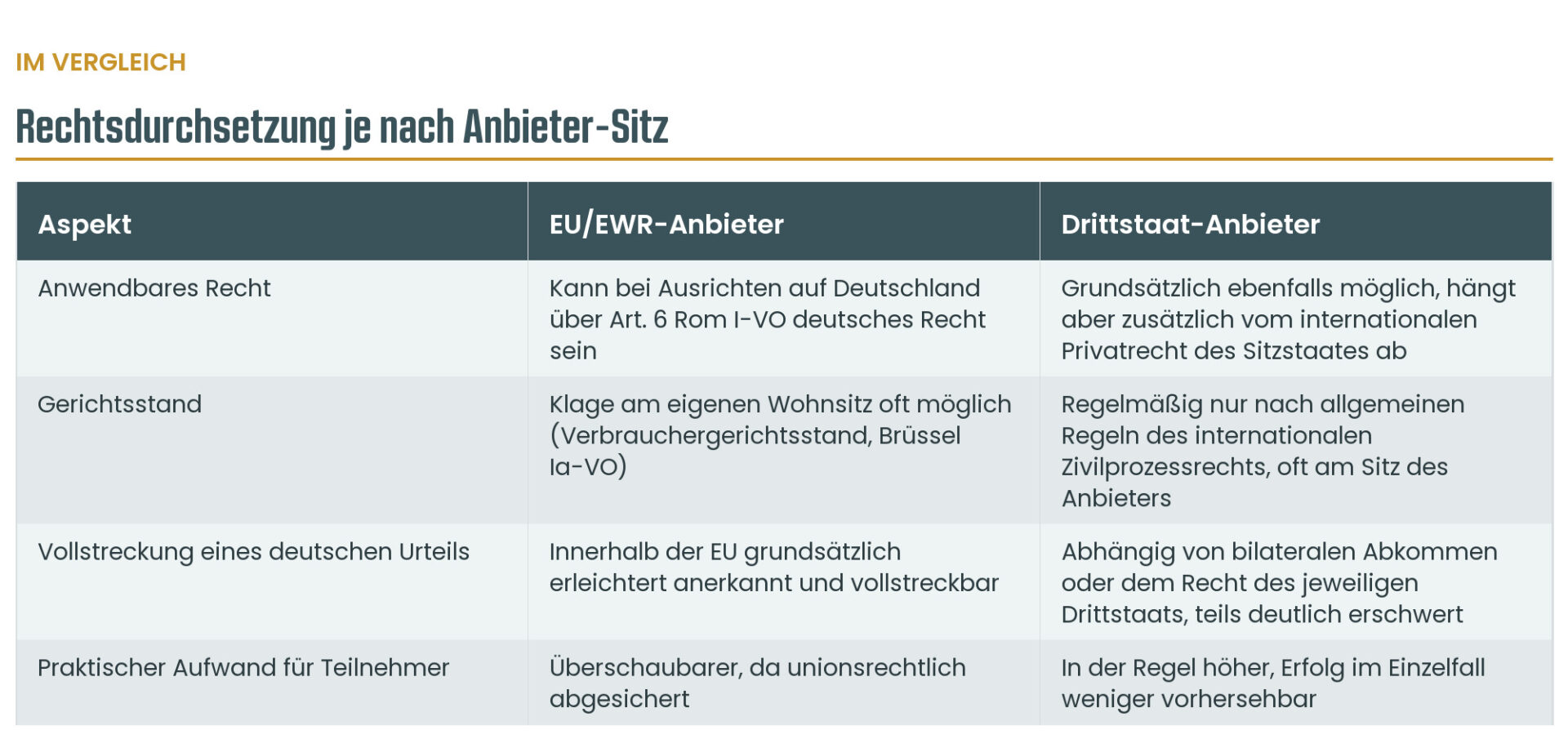
For participants, this means that even a repayment claim that is well-founded in principle does not automatically translate into actual enforceability where the provider is based outside the EU. Anyone considering taking action against a foreign provider should therefore factor in this enforcement question at an early stage – ideally already when deciding whether and how to pursue a claim.
5. Practical Significance and Open Questions
The application of the FernUSG to cross-border situations has not yet been conclusively settled by the highest courts. The more recent case law of the Federal Court of Justice (Bundesgerichtshof, BGH) on the FernUSG relates, as far as can be seen, exclusively to domestic providers. Nevertheless, the principles established in that case law – in particular the broad interpretation of the statutory criteria, its applicability even between businesses, and the confirmed constitutionality of the FernUSG – provide grounds for concluding that the Act’s protective mechanisms could, in principle, also apply to foreign providers, provided German law is applicable in the individual case.
For participants in international distance learning or online programs, this means that anyone investing substantial sums in a cross-border education offering should review not only the quality and recognition of the intended qualification, but also whether the offering is subject to the requirements of the FernUSG and, if so, whether the corresponding approval actually exists.
For foreign providers specifically serving the German market, the mirror-image question arises as to whether they require ZFU approval and whether their contract drafting meets the requirements of the FernUSG. Anyone who omits this review risks not only the voidness of individual contracts, but potentially also repayment claims from a larger number of German participants at once.
Conclusion
The FernUSG issue does not end at the German border. As soon as a foreign provider directs its distance learning or coaching offering specifically to participants residing in Germany, German law – and with it the FernUSG – can apply, regardless of where the provider is formally based. Combined with the independent risk of missing or subsequently lapsing recognition of the qualification, as well as the practical hurdles involved in cross-border enforcement of claims, this results in substantial economic risks for participants that do not exist in this form with a purely domestic offering.
Conclusive guidance from the highest courts on these cross-border questions is still outstanding. Precisely for this reason, a careful review of both the applicable law and the specific structure of the offering is advisable in the case of international distance learning or coaching offerings – ideally before a long-term contract is signed with a foreign provider.
Attorney Johannes Fiala and the law firm, based in Munich and specializing in distance learning law and international consumer law, advise participants in cross-border distance learning and coaching programs as well as providers seeking to structure their offering for the German market in a legally sound manner – from assessing the applicability of the FernUSG to pursuing or defending against repayment claims. Please feel free to contact the firm on a non-binding basis to have your specific case assessed in an initial consultation.


