

The coaching and mentoring industry has experienced enormous growth in recent years. Online programs, mastermind groups, and business mentoring formats in particular have established themselves as lucrative business models. At the same time, however, the legal debate surrounding these offerings has intensified: when does a coaching program actually constitute distance learning within the meaning of the German Distance Learning Protection Act (Fernunterrichtsschutzgesetz, FernUSG)?
A series of decisions by Germany’s Federal Court of Justice (Bundesgerichtshof, BGH) from 2025 and 2026 has significantly clarified this question. For providers, this can have substantial consequences: if a coaching program is legally classified as distance learning without holding the approval required under § 12 FernUSG, the entire contract may be void. Participants may then, under certain circumstances, be entitled to reclaim fees already paid.
The following article explains the current state of the case law, outlines the criteria for distinguishing coaching from distance learning, and describes which legal requirements providers should observe in order to avoid the risk of repayment claims.
Why Online Coaching Is Being Reassessed Under the Law
For a long time, the coaching industry received only marginal attention from a legal perspective. Many programs were regarded as individual consulting services that did not fall under traditional education regulation.
With increasing digitalization, however, the structure of many offerings has changed. Modern coaching programs often consist of a combination of several elements:
- video lessons or member portals
- structured modules
- workbooks and assignments
- regular group calls
- feedback or Q&A sessions
As a result, many coaching programs increasingly resemble traditional distance learning courses. The BGH has therefore clarified in several decisions that the label given to an offering – “coaching,” “mentoring,” “mastermind” – is irrelevant to its legal classification. What matters exclusively is the actual content and structure of the program: it is not the marketing that determines the legal classification, but the service actually provided.
The Legal Basis: The Distance Learning Protection Act
The FernUSG is designed to protect participants in distance learning courses. It is intended to ensure that providers only offer programs that meet certain requirements regarding quality and transparency.
Under § 1 FernUSG, distance learning exists where three conditions are met cumulatively:
- the transfer of knowledge and skills for payment,
- the instructor and the learner are predominantly separated in space,
- the provider is required to monitor the learner’s progress.
If these conditions are met, the offering is legally classified as distance learning – regardless of how it is marketed. In that case, approval by the State Central Office for Distance Learning (Staatliche Zentralstelle für Fernunterricht, ZFU) is required under § 12 FernUSG. If this approval is missing, the distance learning contract is void under § 7 FernUSG. The consequence: course fees already paid may, under certain circumstances, be reclaimed.
Recent Case Law from the Federal Court of Justice
Several decisions of the BGH have clarified this issue in recent years. Of particular relevance are:
- BGH, judgment of 12 June 2025 – III ZR 109/24
- BGH, judgment of 2 October 2025 – III ZR 173/24
- BGH, judgment of 15 January 2026 – III ZR 80/25
- BGH, judgment of 5 February 2026 – III ZR 137/25
- BGH, judgment of 5 February 2026 – III ZR 74/25
- BGH, judgment of 12 February 2026 – III ZR 73/25
These decisions contain several important clarifications.
Coaching can constitute distance learning. The BGH has clarified that coaching programs, too, can in principle fall under the FernUSG if they actually convey knowledge in a systematic manner.
The FernUSG also applies to business customers. This is particularly relevant in practice: the Act protects not only consumers but can also apply to contracts between businesses. Many coaching providers have previously argued that their customers were businesses and therefore not protected. Under current BGH case law, this argument frequently no longer holds. This line of reasoning was confirmed, among other cases, in the “E-Commerce Master Club” case (BGH, judgment of 2 October 2025 – III ZR 173/24): a coaching program priced at EUR 7,140 gross (comprising video modules, weekly coaching calls, VIP email support, and a completion certificate) was declared void for lack of ZFU approval – despite the contract having been concluded by a business under § 14 (1) of the German Civil Code (Bürgerliches Gesetzbuch, BGB).
Monitoring of learning progress is interpreted broadly. The BGH has further clarified that monitoring of learning progress does not require a formal examination. It can already be sufficient if participants have the right to ask questions about the course material, receive feedback during calls, have assignments discussed, or receive individual feedback. As a result, many coaching programs already meet this criterion without the parties involved being aware of it.
The approval requirement also withstands constitutional scrutiny. In its judgment of 5 February 2026 (III ZR 74/25), the BGH expressly examined the approval requirement under § 12 FernUSG and the resulting voidness under § 7 (1) FernUSG against the standard of the freedom of occupation guaranteed by Article 12(1) of the Grundgesetz (Germany’s Basic Law, i.e., its constitution), and held both provisions to be constitutional. Providers therefore cannot successfully argue against the approval requirement on the grounds that it violates their freedom to practice their occupation.
The Four Key Questions for Assessing Coaching Programs
The BGH’s case law can be summarized in four key questions.
Does the Program Convey Knowledge or Skills?
The first question is whether the contract is genuinely aimed at conveying knowledge. Typical indicators include structured learning modules, video lessons, didactically structured content, workbooks or assignments, and defined learning objectives.
If, by contrast, the focus is on individual consulting or support – such as individual strategy development, personal business consulting, or case-specific analysis – this tends to argue against classification as distance learning. Ultimately, what matters is the overall focus of the particular program.
Does the Transfer of Knowledge Take Place Predominantly at a Physical Distance?
A particularly important aspect of the recent case law concerns the type of communication involved. The BGH distinguishes between asynchronous and synchronous instruction.
In the case of asynchronous instruction – such as video lessons, member portals, online courses, PDF materials, or self-study – knowledge is conveyed on a time-delayed basis. This clearly indicates distance learning.
In the case of synchronous instruction, by contrast, communication takes place simultaneously, for example in live Zoom seminars, live workshops, or interactive training sessions. Such formats can more closely resemble traditional in-person instruction and do not necessarily fall under the FernUSG. What ultimately matters is which element actually characterizes the program in practice.
Is There Monitoring of Learning Progress?
The BGH interprets this criterion very broadly. It can already be sufficient if participants have the opportunity to ask questions about the course material, receive feedback during live calls, have assignments corrected, or receive individual support. Many coaching programs therefore meet this criterion almost automatically as soon as any form of feedback is provided.
Has ZFU Approval Been Obtained?
If the preceding criteria are met, the offering legally constitutes distance learning. In that case, ZFU approval is mandatory. Without such approval, the contract may be void.
Typical Coaching Formats and Their Legal Classification
The following four case groups are hypothetical, simplified examples intended for illustration – they do not represent actual client matters but show typical constellations encountered in practice:
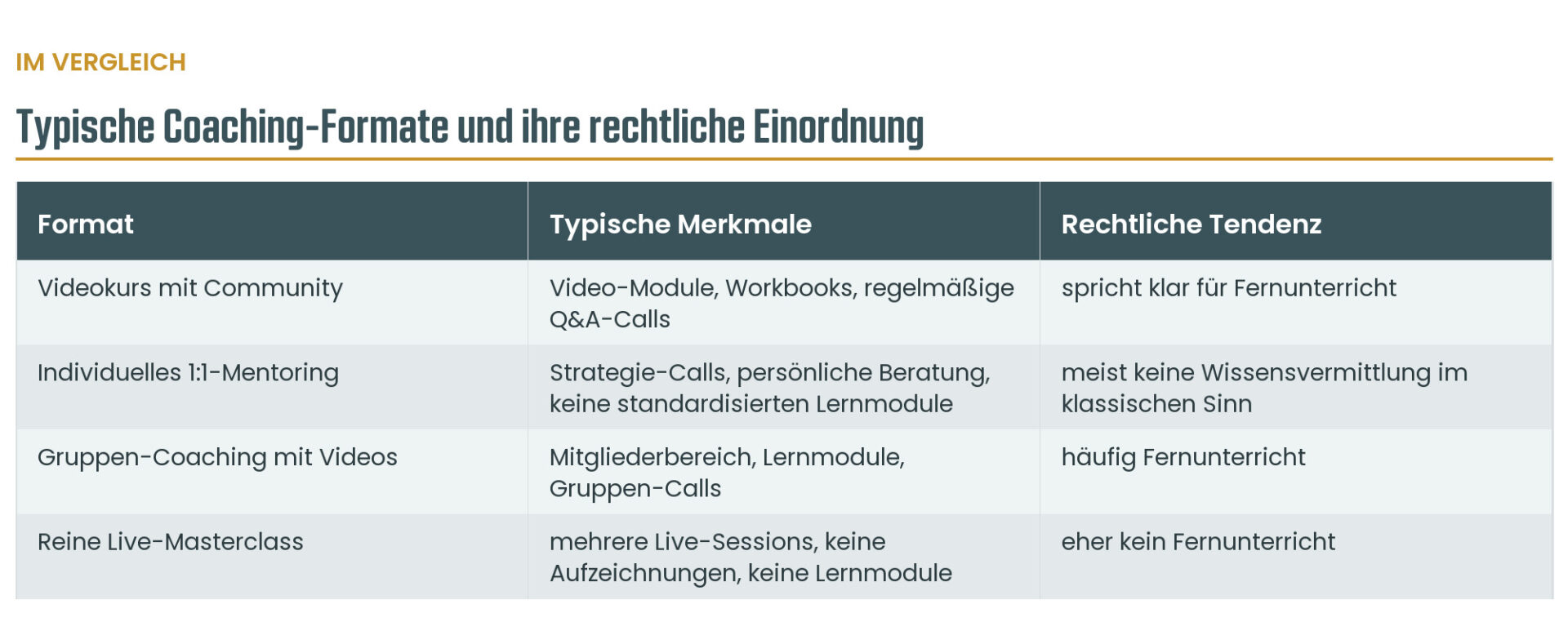
As the overview shows, no single feature is decisive in isolation; rather, what matters is the overall picture presented by each program.
Checklist: Indicators of Distance Learning
Providers should review their programs using a simple checklist. The following factors, in particular, indicate distance learning:
- structured learning modules
- video lessons
- workbooks and assignments
- feedback on learning progress
- a member portal
The more of these elements a program contains, the more likely it is to legally constitute distance learning.
Obligations Where a Coaching Program Qualifies as Distance Learning
If it turns out that a program actually constitutes distance learning, several points must be observed:
- ZFU approval. The course must be approved by the State Central Office for Distance Learning (ZFU). The approval process examines, among other things, the course concept, the teaching materials, the contract terms, and the advertising.
- Distance learning contract. The contract must contain certain minimum information, for example on the duration of the course, the learning objectives, the pricing, and the rights of termination.
- Transparent advertising. Advertising for the program must not create false expectations regarding its content, scope, or results.
Conclusion: Coaching Is Not Automatically Distance Learning
Current case law presents a nuanced picture. Coaching can constitute distance learning – but it does not have to. What matters is not the label given to a program, but its actual content. The distinction between asynchronous learning and live interaction is particularly relevant here, and even simple feedback options can be sufficient to establish monitoring of learning progress within the meaning of the Act.
For providers, this means that anyone offering structured online learning programs should have it carefully assessed whether the offering is legally classified as distance learning – and should take the resulting requirements regarding approval, contract drafting, and advertising into account at an early stage. For participants, conversely, this means that with high-priced online programs, it can be worthwhile to have the legal classification reviewed – particularly where the program relies heavily on video-based learning content and assignments and no ZFU approval is apparent.
The Fiala law firm, based in Munich, advises providers and participants of online coaching and mentoring programs on questions relating to the Distance Learning Protection Act. Attorney Johannes Fiala has many years of experience assisting clients with the legally sound structuring of coaching offerings, as well as with the review of repayment claims arising from potentially void distance learning contracts. Please contact the firm if you would like your coaching program assessed from a legal perspective or wish to review claims under an existing contract.


