

Anyone relocating the centre of their life abroad inevitably runs into the topic of the registration duty on moving abroad and military conscription (Meldepflicht Wohnsitz im Ausland Wehrpflicht) – two terms that are often searched together but sit on different legal levels. The registration-law side is clearly regulated: under the Federal Registration Act (Bundesmeldegesetz, BMG), a duty to deregister with a fixed deadline applies on moving away. Less clear is what this deregistration has to do with registration for military service. This article sets out the registration-law duties, names deadlines, the range of fines and special cases, explains the consequences of failing to deregister, and shows where the two areas of law actually intersect.
Why the registration duty on moving abroad matters at all
The German registration system primarily serves to make a person’s whereabouts traceable for the authorities – from the tax administration through the social security bodies to courts that need to serve documents. When moving within Germany, re-registration runs largely automatically via registering at the new place of residence. Anyone who moves abroad and gives up their domestic residence entirely does not have this automatic forwarding – which is why the law provides for a separate, active duty to deregister.
This duty to deregister is purely a matter of registration law. It says nothing about how the move is treated for tax purposes, what social security consequences it has, or whether it is connected to registration for military service. It is precisely this blending of different areas of law that causes uncertainty in practice – the topics touch each other without being legally identical.
The statutory framework: Section 17 BMG
The core of the registration-law duty is Section 17 of the Federal Registration Act. Under it, anyone who moves out of a dwelling and does not take up a new dwelling within Germany must deregister – for example, because the move leads abroad. Deregistration is possible at the earliest one week before the planned move and must take place at the latest two weeks after the actual move, at the registration authority previously responsible. As a rule, the local residents’ registration office or citizens’ office (Bürgeramt) of the former place of residence is responsible, and in many municipalities this can now also be done online.
Important for practical purposes: this deadline applies regardless of the reason for the move – whether a posting abroad for work, retirement abroad, study, or a general change of location. The registration-law duty attaches solely to the fact of moving out without a new domestic residence.
Digital processing deserves a closer look: the electronic procedure under Section 23a BMG, under which the previous registration authority provides a pre-filled registration form, expressly applies only to registering on a move within Germany. There is no corresponding nationwide uniform online procedure for deregistering to move abroad – whether it can be done digitally depends on what the relevant municipality offers.
Registration duties at a glance: what, when, where
The following table summarises the main registration-law duties and related obligations on moving abroad.
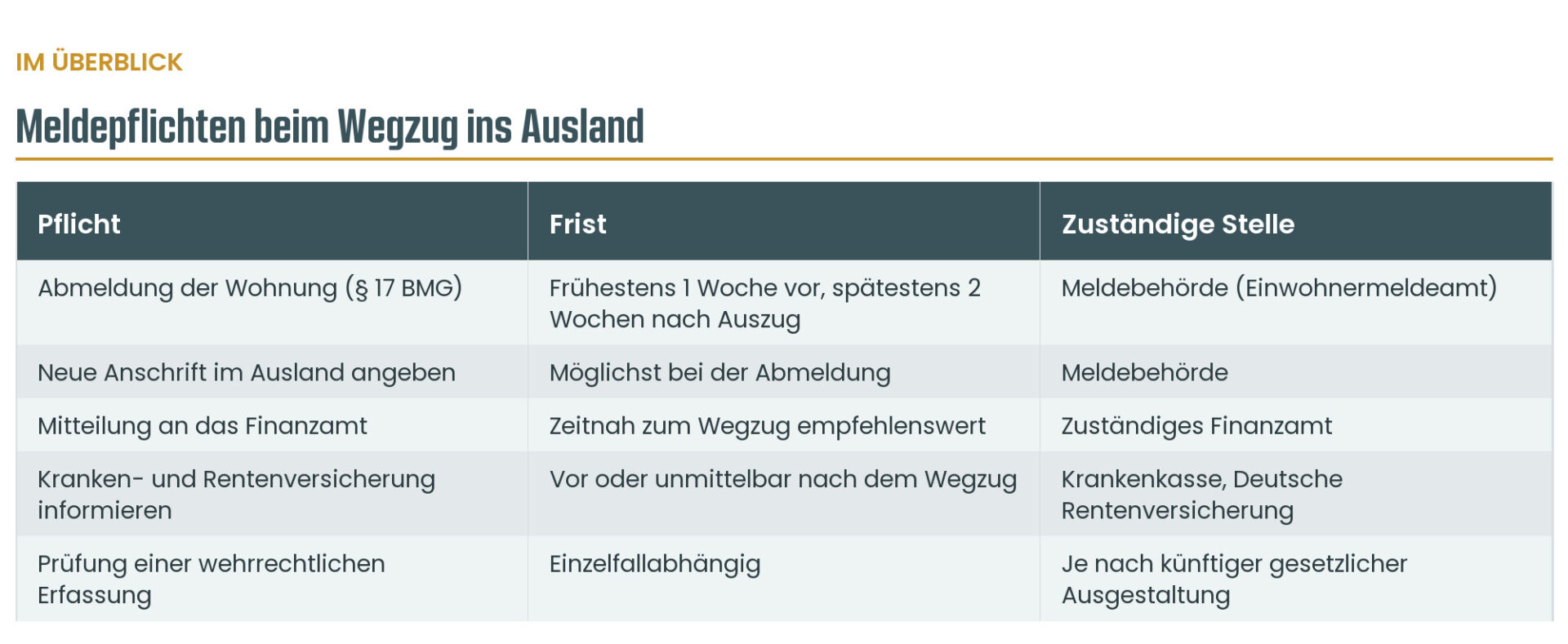
The overview shows: deregistering with the residents’ registration office is only the first step. Anyone wanting to handle the move properly has to keep several authorities and registers in mind, each following its own rules.
Consequences of failing to deregister
If the deregistration deadline is missed or overlooked entirely, two kinds of consequences threaten: one formal-legal, and several practical.
A fine as a regulatory offence. Anyone who fails to deregister, or fails to do so in time, contrary to Section 17(2) BMG commits a regulatory offence (Ordnungswidrigkeit) under Section 54(2) BMG; this covers both intentional and negligent conduct. The fine range for such breaches under Section 54(3) BMG goes up to EUR 1,000 – a statutory ceiling, not a standard amount; the actual amount depends on the individual case and the fining practice of the local authority. In practice, such a breach is not pursued in every case – a residual risk nonetheless remains, particularly if authorities become aware of the omitted deregistration in the course of other matters.
Practical disadvantages often weigh more heavily. More relevant than the fine risk are the indirect consequences of a failed or delayed deregistration:
- Tax uncertainty: anyone still listed on the population register with a domestic dwelling provides an indication of a continuing residence (Wohnsitz) within the meaning of Section 8 of the Fiscal Code (Abgabenordnung, AO) – with the result that unlimited tax liability could continue even though the centre of life has long since moved abroad. Conversely, registration-law deregistration does not replace the separate tax assessment of whether a residence or habitual abode in Germany has actually been given up.
- Social security follow-up issues: an unclear registration status can lead to inconsistencies in health, long-term care and pension insurance, for example if contributions continue to be charged or benefit entitlements stall due to conflicting address details.
- Delivery problems: official letters, tax assessments or court documents are sent to the last registered address. If it is no longer current, deadlines can be missed – for example, in objections against assessments.
- More difficult retrospective correction: anyone who only catches up on deregistration years later often faces queries that unnecessarily complicate a simple administrative act.
A hypothetical example for illustration, with no connection to any real case: a person moves abroad permanently but misses the deadline for timely deregistration. Two years later they receive a letter from the tax office, which, on the basis of the continuing registered address, still assumes a domestic residence. Proving that the centre of life had already been relocated abroad earlier usually succeeds in the end, but causes effort that timely deregistration would have avoided.
Civil registration law and military conscription: two different legal levels
At this point a clear distinction is worthwhile, because the two topics are often searched together and thereby easily conflated. The duty to deregister under Section 17 BMG is a purely registration-law obligation. It ensures that authorities are informed of the move so that the population register stays accurate. Any registration for military service purposes – that is, the question of whether and in what form a person is eligible for, or registered for, military or basic military service – is, by contrast, a separate legal question that does not automatically follow from, or get resolved by, registration-law deregistration.
The concrete interface: registration data and the Bundeswehr
There is nonetheless a point of contact between the two areas of law, and it runs via the population register. Under Section 58c of the Soldiers Act (Soldatengesetz), the registration authorities transmit annually, by 31 March, to the Federal Office of Bundeswehr Personnel Management the surname, first names and address of German nationals who will turn eighteen in the following year. This data may only be used to send information material about service in the armed forces; it must be deleted at the latest one year after transmission.
The legal position has changed since 1 January 2026: the right to object to this transmission previously available under Section 36(2) BMG was abolished without replacement by Article 12 of the Military Service Modernisation Act (Wehrdienstmodernisierungsgesetz) of 22 December 2025; transmission blocks already entered were deleted from the population registers. The legal basis for the data transmission is now Sections 34, 34a, 38 and 39 BMG in conjunction with Section 15 of the Military Service Act (Wehrpflichtgesetz, WPflG) and Sections 58b, 58c and 77 of the Soldiers Act. At the same time, responsibility for military registration has passed from the local registration authorities to the Bundeswehr administration, which now processes registration data for this purpose.
The point of reference for such a transmission is the domestic address held on the register. Anyone properly deregistered is no longer listed there with a dwelling in Germany. This expressly does not amount to an “exemption” from military registration – military service law attaches to nationality, not to residence. Conversely: anyone who fails to deregister remains listed with a domestic address on the register, and thus within all the transmission and delivery channels attached to it.
What this means for registration for military service
Although this article deliberately stays with the registration-law starting point, the obvious follow-up question cannot go unanswered: for the duration of a permanent residence abroad, registration for military service purposes rests, following a clarification by the Federal Foreign Office and under Section 1(2) of the Military Service Act (WPflG), provided that – alongside the stay – the person’s actual livelihood is also based abroad. Germans living abroad on a permanent basis accordingly do not receive questionnaires, for as long as the residence abroad continues. This is not a registration-law exemption in the narrower sense, but a separate consequence under military service law arising from the actual living situation – deregistration itself merely documents it. The full account of this legal position – the requirement for approval under Section 3(2) WPflG, the relevant Federal Ministry of Defence decree, the three exceptions to the suspension, cases of return, and special constellations involving dual nationality – can be found in our separate article on Bundeswehr conscription and residence abroad. Anyone with doubts in an individual case, for example when planning to move abroad at an age relevant to conscription, should nonetheless have their own situation checked separately against the current legal position, rather than relying on statements from forums or outdated sources.
What can be stated regardless of the outcome of this discussion: the duty to deregister under Section 17 BMG remains a separate obligation that must be met independently of how any registration for military service purposes develops in future.
Special cases: secondary residence, return, and minor family members
Three situations deviate from the standard case and are regularly misclassified in practice.
Anyone keeping a home in Germany does not deregister. The duty to deregister under Section 17(2) BMG presupposes that no dwelling remains in Germany. Anyone who keeps a dwelling when emigrating – for example, an owned flat or a permanently available room in their parents’ house – does not meet this condition. What is frequently misunderstood here is the status of the dwelling: under Section 21(3) BMG, a secondary residence (Nebenwohnung) is any further dwelling within Germany. If only a single domestic dwelling remains, it is consequently not a secondary residence but the sole one – and is registered as the main residence, even if the centre of life is abroad. A “secondary residence in Germany” alongside a foreign main residence does not exist under registration law, because Section 21 BMG only distinguishes dwellings within Germany from one another. This is tax-sensitive, because a main residence held on the population register tends to reinforce rather than weaken the question of a continuing residence within the meaning of Section 8 AO.
A separate registration duty applies for longer stays in Germany. Anyone living abroad without a registered dwelling in Germany is not permanently exempt from the registration duty. Section 27(2) BMG excludes short-term stays, shortening the relevant period to three months for people who otherwise live abroad; if this threshold is exceeded, registration must be made up within two weeks. This deadline runs regardless of whether the stay was originally intended to be short, in the case of several months of project work, a sabbatical, or a family care situation.
Children and people under guardianship do not deregister themselves. Section 17(3) BMG shifts responsibility: for people under sixteen, the duty to register falls on the person out of whose dwelling they move – generally the parents. For adults with an appointed carer or guardian, that person takes on the deregistration. It must nonetheless be carried out separately for each person and is not dealt with as a single family matter on one form.
After deregistration: confirmation of registration, identity documents and voting rights
Deregistration completes the registration-law process – but several follow-on questions only begin at that point.
The confirmation of deregistration is the key piece of evidence. Under Section 24(2) BMG, the person subject to the registration duty receives, free of charge, written or, where the process was carried out electronically, electronic confirmation of the deregistration. This document should be kept: it is the proof used to demonstrate the move to third parties. The contribution service of ARD, ZDF and Deutschlandradio (Beitragsservice), for example, regularly requires such proof to cancel the broadcasting fee (Rundfunkbeitrag) on moving abroad – and because the obligation to pay does not end with moving out but requires notification to the contribution service, fees for months after departure quickly accrue without any action of one’s own. Insurers, banks and vehicle registration offices typically also ask for this proof.
The identity card remains valid; the duty to hold one ends. The duty to hold an identity card under Section 1 of the Identity Card Act (Personalausweisgesetz) attaches to the general registration duty, or to habitual abode within Germany; anyone living abroad permanently and deregistered is no longer subject to it. The existing identity card does not become invalid through deregistration, however, but continues to run normally until the date printed on it. Without a dwelling in Germany, a choice can be made as to whether the foreign address, or a note that there is no main residence in Germany, is entered. For a later reissue, the competent German diplomatic mission abroad is then the point of contact; a surcharge for issuance abroad applies there in addition to the standard fee, and applying within Germany is only possible for good cause. Anyone holding a document due to expire soon saves themselves effort by having it reissued before departure.
The right to vote continues – but only on application. With deregistration, automatic inclusion in the electoral roll of the former home municipality ends. The right to vote itself is not thereby lost: Germans abroad can take part in federal elections under Section 12(2) of the Federal Elections Act (Bundeswahlgesetz) if, after turning fourteen, they lived in Germany continuously for at least three months and this stay was no more than 25 years ago – or if, for other reasons, they are personally and directly familiar with, and affected by, political conditions in Germany. A formal application for entry in the electoral roll is nonetheless required, and afresh for every election. It must reach the competent municipality no later than the 21st day before the election; this deadline cannot be extended.
Checklist: the registration process when moving abroad
A structured approach is recommended:
- Clarify the competent registration authority and procedure: arrange an appointment or check whether the municipality offers digital deregistration.
- Observe the time window: deregistration at the earliest one week before moving out, at the latest two weeks afterwards.
- Have the required documents ready: identity card or passport, and, if represented, a corresponding power of attorney.
- Provide the new foreign address, if already known, or alternatively arrange a mail forwarding order.
- Keep the confirmation of deregistration for later proof to third parties.
- Inform the tax office and have the tax residence question clarified separately from registration-law deregistration.
- Notify health, long-term care and pension insurance of the move to clarify contribution and benefit questions early.
- Check other registers and contracts: broadcasting fee, vehicle registration, bank accounts and ongoing insurance policies.
- In case of uncertainty about military service questions: obtain separate, up-to-date legal advice rather than relying on blanket assumptions.
Conclusion
The registration duty on a change of residence abroad is clearly regulated by Section 17 BMG: a fixed two-week deadline, a fine range of up to EUR 1,000 under Section 54 BMG, separate rules for a remaining dwelling, minor family members and longer stays in Germany. Less clear-cut is how the move relates to registration for military service – what is certain since 1 January 2026 is only that the legal basis for objecting to the transmission of registration data to the Bundeswehr has been removed. Anyone who keeps the two levels separate, deregisters on time and seeks individual advice on doubtful questions avoids both fine risks and the more common practical disadvantages of an unclear registration status.
If you are planning a move abroad and would like legal clarity on your registration duty, the tax consequences, or related questions: Rechtsanwalt Johannes Fiala and the firm have published extensively on, and advise on, the registration-law, tax and other aspects of emigrating. Get in touch to discuss your individual situation.


