

Decades ago, your father relocated his residence to Spain and passed away there. You and your siblings live in Germany and are now asking yourselves: does German inheritance law still apply to the estate because your father was German – or does Spanish law now apply instead? This question arises not only when a parent or other relative has moved away from Germany. Anyone living abroad who wonders whether their relatives in Germany will still inherit under German law faces the same fundamental issue. Contrary to what many assume, the applicable inheritance law is determined not primarily by the nationality of the deceased or the heirs, but by the deceased’s last habitual residence. Heirs in Germany confronted with a cross-border inheritance case should understand this basic rule and its exceptions – and know how to prove their status as heirs, both in Germany and abroad.
The Starting Point: Why “German” Does Not Automatically Mean “German Inheritance Law”
A widespread misconception holds that German inheritance law automatically applies whenever the deceased was German. This has changed fundamentally with the EU Succession Regulation (Regulation (EU) No. 650/2012, referred to below by its German abbreviation, EU-ErbVO), which has applied since 17 August 2015. For succession matters, the Regulation generally no longer looks to nationality, but to the deceased’s habitual residence at the time of death. In practice, this means that a German national who has permanently relocated the centre of their life abroad may well be subject to foreign inheritance law – even if all the heirs live in Germany and likewise hold German nationality.
For heirs, this is often the first surprise: neither their own nationality nor their own place of residence affects which inheritance law applies to the estate of a relative who died abroad. What matters is solely the situation of the deceased.
The Basic Rule: The Deceased’s Habitual Residence Is Decisive
Under Art. 21 Abs. 1 EU-ErbVO, the succession as a whole is governed by the law of the State in which the deceased had their habitual residence at the time of death. Habitual residence is not the same as a registered domicile under residence-registration law; rather, it is determined by the actual centre of the person’s life: where did the person predominantly live and work, and where were their social and family ties? A long-standing, stable stay in Portugal, France, or the Canary Islands will, as a rule, establish habitual residence there – with the consequence that, in principle, the inheritance law of that country applies, not German law.
For heirs in Germany, this means that before any question of an Erbschein (German certificate of inheritance) or distribution of the estate can be addressed, it must first be established where the deceased actually had their habitual residence. This determination is not a mere formality – it can itself be disputed, for example in the case of persons commuting between two countries or a move shortly before death.
The Exception: Choice of Law in Favour of German Nationality
The EU Succession Regulation provides for an important exception to the basic rule: under Art. 22 EU-ErbVO, any person may, by express declaration in a disposition of property upon death – that is, in a will or contract of succession (Erbvertrag) – choose the law of the State whose nationality they possess, either at the time of making the choice or at the time of death. A German national who lives permanently abroad can therefore stipulate by will that German inheritance law is to continue to apply to their estate – regardless of where they last habitually resided.
For heirs, this option is of central practical importance. If a relative who died abroad left a will, it should be specifically checked whether it contains a choice-of-law clause. Such a clause can completely change the outcome of the analysis: without a choice of law, foreign law will generally apply, whereas with a valid choice of law, German inheritance law continues to govern – with consequences, for instance, for compulsory share (Pflichtteil) claims and statutory succession.
When the Deceased Lived Outside the EU: Third Countries and Renvoi
The EU Succession Regulation does not apply only within the EU; it has universal application (Art. 20 EU-ErbVO): even where the deceased had their habitual residence in a third country – for example Switzerland, the USA, Thailand, or the United Arab Emirates – German courts and authorities will, in principle, apply the Regulation’s conflict-of-laws rules. This can result in the law of that third country applying.
There is an additional peculiarity: if the law of the third country in turn refers back to German law, so-called renvoi (a reference back or onward reference) may apply under Art. 34 EU-ErbVO. As a result, despite permanent residence abroad, German inheritance law may ultimately apply after all. Whether such a renvoi exists in a given case depends on the private international law of the third country concerned – a point that is frequently overlooked in the initial assessment of a cross-border inheritance case.
Overview: Which Inheritance Law Applies to Heirs in Germany?
The following table summarises the most important scenarios from the perspective of heirs confronted with a cross-border inheritance case:
← Tabelle nach links wischen, um weitere Spalten zu sehen
| Scenario | Inheritance Law Generally Applicable | Note for Heirs |
|---|---|---|
| The deceased had their habitual residence in Germany until death | German inheritance law | Applies regardless of the heirs’ nationality or place of residence |
| The deceased lived permanently in an EU Member State (e.g. France, Spain), no choice of law | Law of the last habitual residence | German nationality of the deceased or the heirs alone is not sufficient |
| The deceased lived in another EU State, with an express choice of law in favour of German law (Art. 22 EU-ErbVO) | German inheritance law | The will/contract of succession should be specifically checked for a choice-of-law clause |
| The deceased lived in a third country (e.g. USA, Thailand, UAE), no choice of law | In principle, the law of the habitual residence, subject to a possible renvoi (Art. 34 EU-ErbVO) | In individual cases, German law may apply again despite residence abroad |
| The deceased lived in a third country, with a choice of law in favour of German law | German inheritance law | A choice of law is, in principle, also possible with respect to third countries |
| Only the heirs live abroad; the deceased had their habitual residence in Germany | German inheritance law | The heirs’ place of residence or nationality is irrelevant to the applicable law |
This overview does not replace an individual assessment, but it shows that the answer to the question “Does German inheritance law still apply to me?” depends decisively on where the deceased last lived and whether a choice of law was made – not on where the heirs themselves live.
Facts and Figures: As of 1 January 2025, around 329,900 German nationals were resident in Switzerland, just over 239,500 in Austria, and just over 131,800 in Spain – with a continued upward trend in all three countries compared with the previous year. These three countries alone therefore account for several hundred thousand situations in which the question of the applicable inheritance law can become relevant for heirs in Germany (source: Federal Statistical Office, Destatis, data as of 2025).
Which Court Has Jurisdiction? German Probate Courts Despite the Deceased’s Residence Abroad
In addition to the question of the applicable law, heirs face a second, often overlooked question: which court actually has jurisdiction to issue an Erbschein (certificate of inheritance) or a European Certificate of Succession? The EU Succession Regulation also sets out rules on this point.
Under Art. 4 EU-ErbVO, general jurisdiction lies with the courts of the Member State in which the deceased had their habitual residence. If the deceased’s last habitual residence was outside the EU, Art. 10 EU-ErbVO provides for subsidiary jurisdiction: German courts may have jurisdiction if estate assets are located in Germany and the deceased either held German nationality or – if not – had their habitual residence in Germany within the five years preceding the court being seised. For heirs, this means that even where a relative last lived in Thailand or the USA, a German probate court can have jurisdiction for the entire administration of the estate, provided assets are located in Germany – which often avoids the detour of foreign court proceedings.
Proving Heir Status: European Certificate of Succession vs. German Certificate of Inheritance (Erbschein)
Once it has been established which law applies and which court has jurisdiction, heirs face the practical question: how do they prove their status as heirs to banks, land registries, or authorities? In principle, two instruments are available for this purpose, and they differ considerably in their scope.
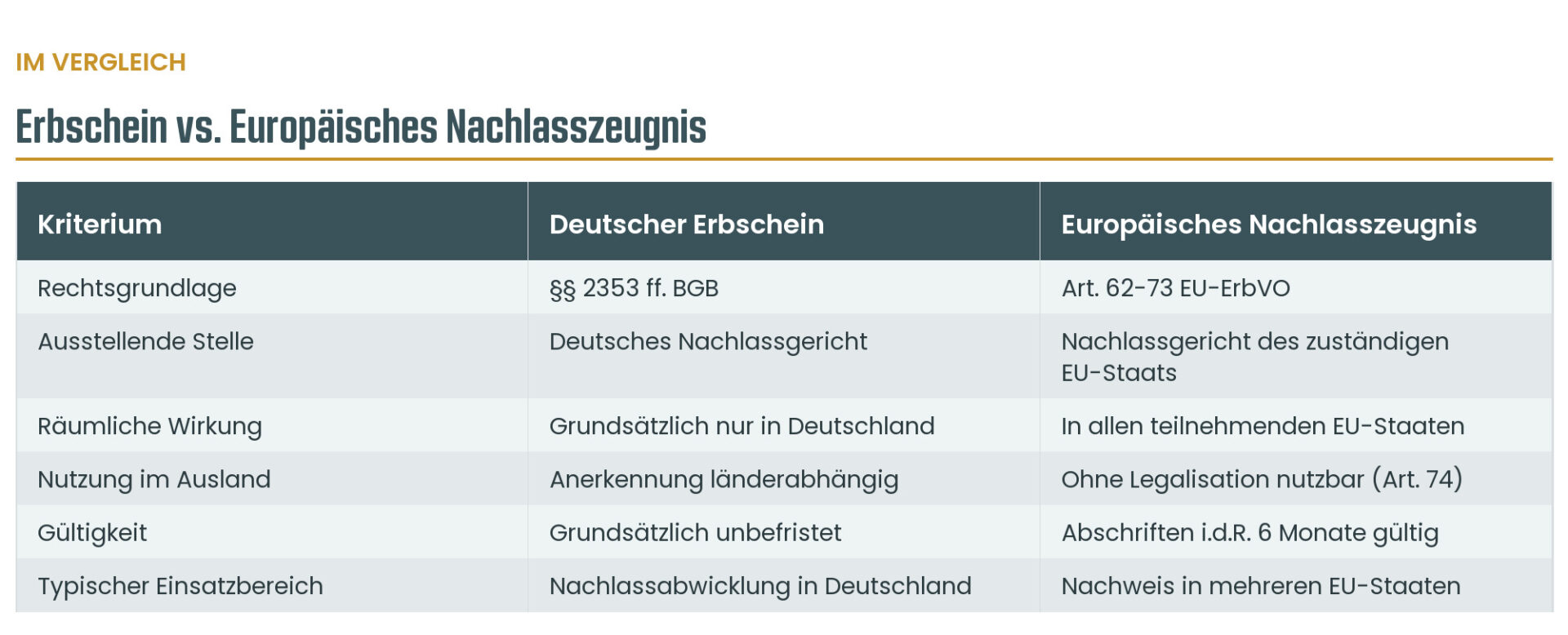
For heirs dealing exclusively with assets in Germany, the traditional Erbschein will generally suffice. However, as soon as assets in several EU Member States are involved – for example, a property in France and a bank account in Germany – the European Certificate of Succession can considerably simplify the process of proof. Both documents can, in principle, be applied for in parallel; which one is more appropriate in a given case depends on the composition of the estate.
Recognition of German Certificates of Inheritance Abroad
This is a point that heirs often become aware of only once an account or a property abroad needs to be administered: the German Erbschein is a national document and, in the first instance, takes direct effect only within Germany. If heirs wish to use it abroad – for example, with a foreign bank or a foreign land registry – recognition depends on the rules the country in question provides for this purpose.
Within the EU, this uncertainty can be avoided by using the European Certificate of Succession, since it was created specifically for cross-border proof of heir status. Outside the EU, legalisation or an apostille of the Erbschein is frequently required, and foreign authorities sometimes additionally demand a certified translation or a separate local probate procedure. Anyone expecting to deal with assets outside the EU should clarify this question at an early stage – not only once a foreign bank makes the release of assets conditional on it.
Practical Steps for Heirs in Germany
The foregoing gives rise to several practical steps to take where a cross-border inheritance case is imminent or has already occurred:
Establish the deceased’s habitual residence. Only once it is established where the deceased actually had the centre of their life can it be assessed which law applies in principle.
Specifically search the estate documents for a choice-of-law clause. A will or contract of succession may contain a choice of law in favour of German law that changes the outcome of the entire analysis.
Distinguish between an EU Member State and a third country. In the case of residence outside the EU, it must additionally be examined whether a renvoi under Art. 34 EU-ErbVO may come into play.
Determine the competent court. Particularly where the deceased’s habitual residence was in a third country, it should be examined whether German courts may have jurisdiction under Art. 10 EU-ErbVO.
Choose the appropriate proof document. Depending on which countries the estate assets are located in, a German Erbschein, a European Certificate of Succession, or both may be appropriate.
An Illustrative Example (Purely Hypothetical)
By way of illustration, here is a purely fictional example that does not describe any actual client or case from our firm: a German mother emigrates to Portugal many years ago and lives there until her death. Her adult children live in Germany and initially assume that German inheritance law applies, since both parents were German. However, the estate contains no will with a choice-of-law clause. Because the mother had her habitual residence in Portugal until her death, Portuguese inheritance law applies in principle – potentially with different rules, for example regarding the compulsory share. For a German bank account belonging to the mother, the children nevertheless need proof of their heir status that can be used in Germany; a European Certificate of Succession may be suitable for this purpose, as it takes effect throughout the EU without a separate recognition procedure.
An Important Distinction: Inheritance Law Is Not Inheritance Tax
Everything stated so far concerns exclusively the civil-law question of which inheritance law applies to the estate. It says nothing yet about whether and where inheritance tax is payable – that is a separate connecting factor that must be examined independently, and one that is frequently confused with the civil-law question in practice.
Under § 2 Abs. 1 Nr. 1 of the German Inheritance and Gift Tax Act (Erbschaftsteuer- und Schenkungsteuergesetz, ErbStG), unlimited German inheritance tax liability already arises where either the deceased or the acquirer – that is, the heir – was a German resident (Inländer) at the time of the inheritance. For the example described at the outset, this means that even if the father who died in Spain had his habitual residence there and Spanish inheritance law therefore applies – for lack of a choice of law – the estate remains subject to German inheritance tax as long as the children, as heirs, are resident in Germany. Under the worldwide estate principle (Weltvermögensprinzip), the entire estate is captured, including foreign accounts – irrespective of which inheritance law applies as a matter of civil law. Whether and to what extent this results in double taxation through foreign inheritance tax, and how this can be mitigated, depends decisively on whether one of only six German inheritance tax double taxation treaties exists with the country concerned – this separate question is addressed in detail in a dedicated article by the firm.
Regardless of whether a treaty exists, heirs are in any event subject to their own duty to notify: under § 30 ErbStG, the acquisition must be reported to the competent tax office within three months of becoming aware of it. Banks – including foreign branches of German institutions – are also required under § 33 ErbStG to report the accounts of deceased persons to the tax office within one month; banking secrecy does not apply across borders in the event of death.
Anyone who focuses solely on the question “Which inheritance law applies?” can easily overlook that inheritance tax liability follows its own, often stricter, logic.
Conclusion: The Deceased’s Habitual Residence Is Key – Not the Heirs’ Nationality
For heirs in Germany confronted with a cross-border inheritance case, a change of perspective is worthwhile from the outset: it is not one’s own nationality or place of residence that determines whether German inheritance law applies, but primarily the deceased’s last habitual residence – supplemented by the possibility of an express choice of law in favour of German law. Anyone who additionally establishes which court has jurisdiction and whether an Erbschein or a European Certificate of Succession is the more suitable form of proof avoids unnecessary delays in administering the estate.
The Fiala law firm, with a focus on international inheritance law, assists heirs in establishing their status as heirs on a legally sound basis in cross-border inheritance cases – from reviewing the applicable law and the question of jurisdiction to selecting the appropriate proof document. As an attorney experienced in cross-border succession matters, Dr. Fiala is familiar with the typical pitfalls that can arise where different legal systems intersect. Please feel free to contact the firm on a non-binding basis to discuss your situation in an initial consultation.


