

Shareholders of a German GmbH (limited liability company) who are planning to move abroad tend to focus first on the new place of residence, visa requirements, or future health insurance coverage. From a tax perspective, however, a different issue can carry far greater weight: the so-called exit tax under § 6 of the German Foreign Tax Act (Außensteuergesetz – AStG). This provision does not affect the GmbH itself – the company continues to exist in Germany with its registered seat unchanged – but the shareholder personally, who gives up German residence or habitual abode while retaining the shares. This scenario is considerably more common than the formal relocation of an entire company abroad, and it is frequently underestimated in practice, since no shares are actually sold upon emigration. This article explains when § 6 AStG applies, how deferral actually works today, and what matters when valuing shares in a non-listed GmbH.
What Is the Exit Tax Under § 6 AStG? The Deemed Disposal
The underlying principle of § 6 AStG is as simple as it is consequential: once an individual’s unlimited income tax liability in Germany ends – typically because residence and habitual abode are relocated entirely abroad – the law deems a disposal at fair market value to have occurred with respect to that person’s shares in corporations. No actual sale takes place; the shares remain in the same person’s custody account or, in the case of a GmbH, in the same shareholder register. For tax purposes, however, the transaction is treated as if the shares had been sold at market value on the day before the departure. The difference between this deemed sale proceeds and the original acquisition cost is subject to taxation – immediately, and without the shareholder receiving any actual liquidity from the transaction. If substantial hidden reserves have built up since the GmbH’s formation, this can result in a considerable tax liability falling due immediately, even though not a single euro has actually changed hands.
When Does § 6 AStG Apply? The One-Percent Minimum Shareholding Threshold
Not every GmbH shareholder who emigrates automatically falls within the scope of the exit tax. The decisive link is to § 17 of the German Income Tax Act (Einkommensteuergesetz – EStG): the provision covers shares in domestic or foreign corporations in which the taxpayer held, directly or indirectly, at least a one-percent interest at any point within the five years preceding the departure. A shareholder who, for example, holds only a minimal stake of 0.3 percent in a GmbH therefore does not fall within § 6 AStG in the first place.
It is important to understand that § 6 AStG does not provide for any de minimis threshold or tax-free allowance on the deemed capital gain itself. Anyone who exceeds the one-percent threshold must, in principle, pay tax on the full deemed increase in value – there is no “insignificant amount” that remains tax-free. The one-percent threshold is purely a threshold of applicability: it determines whether § 6 AStG applies at all, not how much tax ultimately becomes due. This distinction is frequently conflated in practice and should be kept clearly separate when planning an emigration.
Valuing the GmbH Shares: The Underestimated Point of Contention
For listed shares, the fair market value on the relevant valuation date can usually be derived without difficulty from the share price. For a non-listed GmbH, this reference value is missing – and this is precisely where the greatest disputes with the tax authorities regularly arise in practice. In the absence of a market price, the tax office generally falls back on the simplified income capitalization method (vereinfachtes Ertragswertverfahren) under §§ 199 ff. of the German Valuation Act (Bewertungsgesetz – BewG). Under this method, the average operating results of the three financial years preceding the valuation date – adjusted for an appropriate notional owner’s salary – are multiplied by the capitalization factor set out in § 203 BewG. This factor has stood at 13.75 for years and can, for profitable but asset-light companies, produce enterprise values many times higher than the actual market value – an effect that can particularly affect service and consulting businesses with low capital requirements but strong ongoing earnings.
The simplified income capitalization method is not mandatory, however. Shareholders may instead submit their own valuation report to the tax office – for example, prepared under the income approach or the discounted cash flow (DCF) method in accordance with the valuation standard IDW S1 issued by the German Institute of Public Auditors (Institut der Wirtschaftsprüfer) – demonstrating a lower fair market value. Under the case law of the Bundesfinanzhof (Federal Fiscal Court) (judgment of 2 December 2020 – II R 5/19), taxpayers have their own right to choose the valuation method in this respect: a methodologically sound report can displace the simplified income capitalization method, although the tax authorities are not automatically bound by it and may review the report on technical grounds and, where appropriate, contest it. Anyone seeking a realistic assessment of the potential exit tax burden should therefore address the business valuation early on, rather than shortly before the planned departure – if only to allow sufficient time to commission a robust valuation report should the statutory simplified method prove disadvantageous.
Deferral of the Exit Tax: EU/EEA and Third Countries Compared
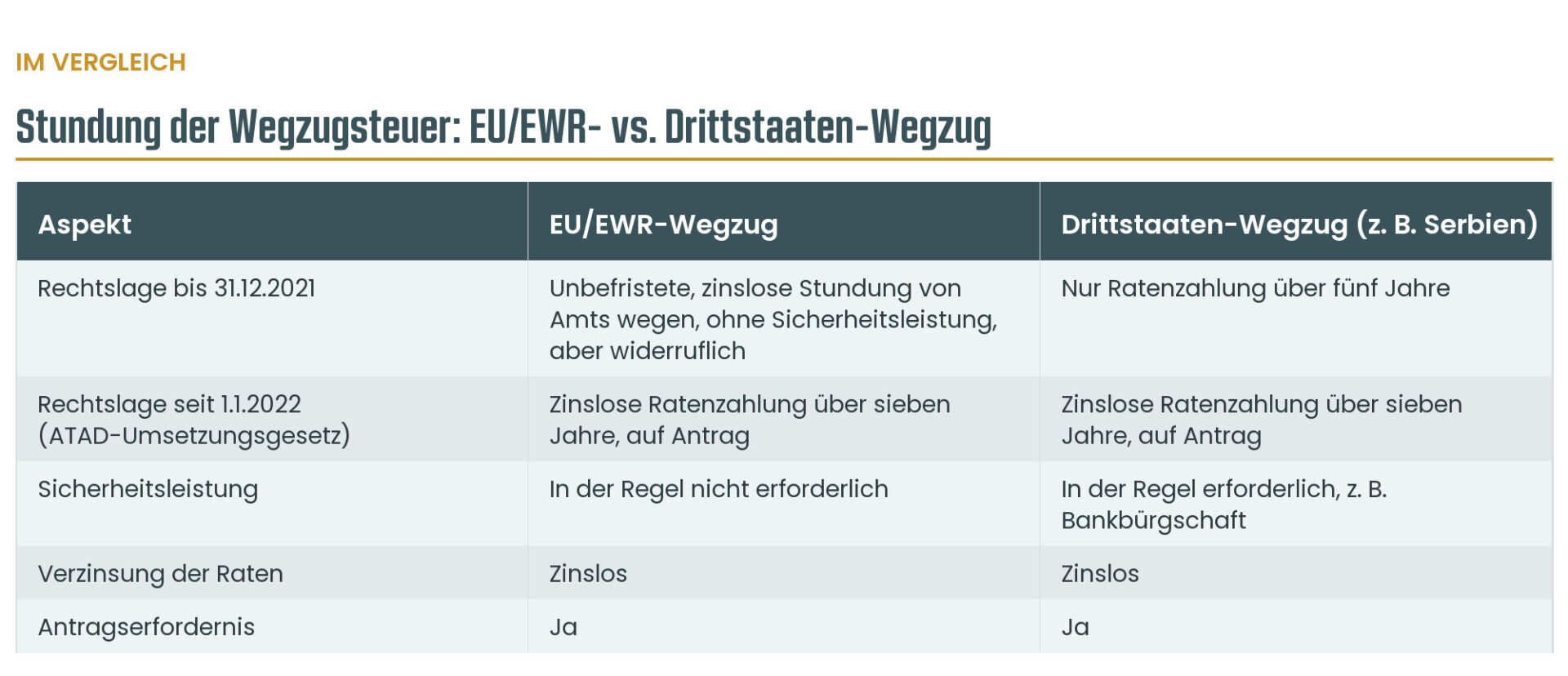
The legal position on deferral has changed fundamentally in recent years – and this is precisely where outdated information still frequently circulates online. Until 31 December 2021, the rule was as follows: anyone emigrating within the EU or the European Economic Area (EEA) received an indefinite, interest-free deferral of the exit tax automatically, without having to provide security. This deferral was, however, revocable – for example, in the event of a later actual sale of the shares. For an emigration to a third country outside the EU/EEA – such as Switzerland or the United States – only payment in installments over five years was available.
The Act Implementing the Anti-Tax Avoidance Directive (ATAD-Umsetzungsgesetz), passed by the Bundestag on 21 May 2021, abolished this distinction for all emigrations from 1 January 2022 onward. Since then, a uniform regime has applied to both EU/EEA and third-country emigrations: on application, the tax is deferred interest-free in seven equal annual installments – no longer indefinitely, but on a clearly time-limited, installment basis. Contrary to what is often assumed, § 6 Abs. 4 AStG also no longer distinguishes between EU/EEA and third countries when it comes to security: under the statute, the installment payment is, “as a rule”, to be made conditional on the provision of security – such as a bank guarantee or a pledge of the shares – irrespective of whether the destination country belongs to the EU/EEA or is a third country such as Serbia. In practice, the tax authorities therefore regularly require such security even for an emigration within the EU or the EEA.
A practically significant exception to this uniform regime applies to Switzerland – not because of any proximity to the EEA, but because of the Agreement on the Free Movement of Persons between the EU and Switzerland. The Court of Justice of the European Union (CJEU) held in its judgment of 26 February 2019 (C-581/17, “Wächtler”) that immediate taxation of the increase in value upon emigration to Switzerland violates this agreement. The Bundesfinanzhof drew the consequence from this in its judgment of 6 September 2023 (I R 35/20) that shareholders emigrating to Switzerland – unlike those emigrating to any other third country – are entitled to an indefinite, interest-free deferral until the shares are actually sold, rather than merely the seven-year installment arrangement; the tax authorities may demand security in this context only in exceptional cases.
In practical terms, this means that the once-decisive advantage of emigrating within the EU – the indefinite deferral – has, since 2022, survived only as a special case for Switzerland. For all other destination countries, whether an EU/EEA member state or another third country, the same seven-year installment arrangement applies, which the tax authorities generally make conditional on the provision of security.
The Returning-Taxpayer Rule: Retroactively Eliminating the Exit Tax
An important form of relief is provided by the so-called returning-taxpayer rule (Rückkehrerregelung) under § 6 Abs. 3 AStG. If the shareholder returns to Germany within seven years of emigrating and once again becomes subject to unlimited tax liability there, the tax claim lapses retroactively – provided that the shares have not been sold in the meantime and no other so-called harmful events have occurred, such as a hidden contribution of the shares into another company. Installments already paid are refunded in that case. The seven-year period – which stood at five years before the ATAD reform – can, on application, be extended by a further five years, allowing up to twelve years in total during which the exit tax is not finally assessed. A precondition for the extension is that the shareholder’s intention to return continues to exist throughout this entire period, for example because the stay abroad was, from the outset, designed to be time-limited for professional reasons.
The returning-taxpayer rule is practically relevant because by no means every emigration is planned as permanent. Anyone who, for instance, moves abroad for a fixed-term overseas project and has the return to Germany in view from the outset should document this intention and factor in the requirements of the returning-taxpayer rule from the very beginning – not only once the return is already imminent.
Practical Example: How the Exit Tax Takes Effect
Example (purely hypothetical, for illustration purposes): A shareholder holds 30 percent of the shares in a well-performing, non-listed GmbH with stable earnings and plans to relocate permanently to a country outside the EU that does not belong to the EEA. In this – entirely fictional – example, the shareholder would have to expect, before departure, that the tax office would estimate the value of the shares under the simplified income capitalization method in the absence of a stock market listing, which, given the company’s strong earnings position, could result in a comparatively high deemed capital gain. The resulting tax could, on application, be paid in installments over seven years, although presumably only against security of the kind the tax authorities generally require regardless of the destination country. A scenario like this illustrates why both the valuation question and the deferral requirements should be clarified before the actual move – if necessary, also by means of an independent valuation report that can be submitted to the tax office.
Facts and Figures: Emigration from Germany Is Rising
According to the Federal Statistical Office (Statistisches Bundesamt), the net migration loss of German nationals – that is, the balance of emigration and immigration – rose to around 97,000 people in 2025, up from around 81,000 in 2024. The most important destination countries were Switzerland (23,000), Austria (14,000), and Spain (10,000). Germany has recorded a continuous net emigration of its own nationals every year since 2005.
These figures naturally capture all reasons for emigration and are not specific to GmbH shareholders with exit-tax-relevant holdings. They do show, however, that cross-border relocation of German nationals is increasing overall – and with it, the number of cases in which entrepreneurially active individuals holding GmbH shares face the question of whether and how § 6 AStG applies to their planned emigration.
Why Early Planning Is Critical
The biggest mistake in dealing with the exit tax is rarely a mistaken legal assessment, but rather a lack of time for an informed decision. Anyone who examines the share valuation, the deferral requirements, and the returning-taxpayer rule only shortly before the move has little remaining scope to commission an independent valuation report or to arrange the security required for an emigration to a third country in good time. Forward-looking planning should, in particular, include:
- early assessment of whether the one-percent threshold under § 6 AStG is reached at all,
- a realistic assessment of the fair market value of the GmbH shares, if necessary by means of an independent valuation report,
- clarifying whether the destination country is, exceptionally, Switzerland, for which an indefinite, interest-free deferral may apply instead of the seven-year installment arrangement, due to the Agreement on the Free Movement of Persons,
- documenting any intention to return, if the stay abroad is not planned as permanent,
- coordinating with tax advisors in the destination country to avoid double taxation.
Conclusion
The exit tax under § 6 AStG affects GmbH shareholders regardless of whether the company itself remains in Germany – what matters is solely the shareholder’s personal emigration. Since the 2022 ATAD reform, a uniform seven-year installment arrangement applies to both EU/EEA and third-country emigrations; the former advantage of an indefinite deferral within the EU no longer exists. Anyone who thinks through the valuation question for non-listed shares, the requirements for installment payment, and the options under the returning-taxpayer rule at an early stage can structure their emigration in a legally sound manner and with a calculable tax burden.
Attorney Johannes Fiala and his law firm have published extensively on international tax and corporate law and support GmbH shareholders in planning an emigration abroad – from assessing exit tax liability, through share valuation, to coordination with foreign advisors. Feel free to contact the firm on a non-binding basis to discuss your personal situation in an initial consultation.


