

The concept of habitual abode is one of the most important connecting factors in tax law – and, at the same time, one of the most frequently misunderstood. Anyone who has their habitual abode in Germany is, as a general rule, subject to unlimited income tax liability there, regardless of whether a dwelling is formally registered or not. Particularly in cases of relocation abroad, extended stays overseas, or international lifestyles, confusing habitual abode, residence, and the registered address under residents’ registration law repeatedly leads to costly misjudgments. This article classifies the definition, explains the practically relevant six-month rule, and shows what really matters when drawing the distinction.
What Does Habitual Abode Mean in Tax Law? The Definition under § 9 AO
The statutory definition is found in § 9 of the German Fiscal Code (Abgabenordnung, AO). Under this provision, a person has their habitual abode at the place where they are present under circumstances indicating that their stay at that place or in that area is not merely temporary.
The core idea behind this: what matters is not any formal act – no registration, no enrollment, no contract – but the actual circumstances of the stay. What is decisive is whether the overall picture shows that a person lives at a place for more than a merely temporary period. This may be the duration of the stay, but also factors such as the center of life, family ties at the location, or the regularity of the stay.
This means that habitual abode differs fundamentally from formal registrations. The tax office examines the actual living circumstances – not what is stated on a form.
The Six-Month Presumption: How It Works in Practice
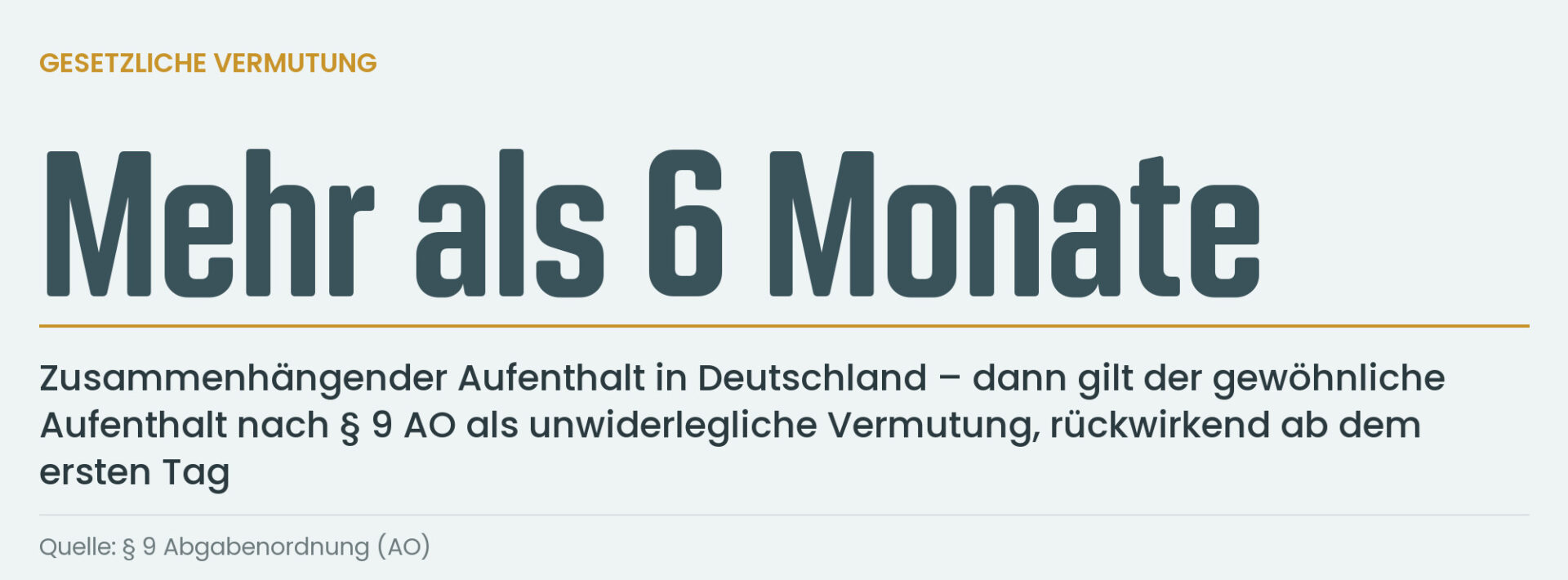
To make the interpretation of the indeterminate legal concept of “not merely temporary” more tangible, § 9 AO contains an important special rule: an uninterrupted stay of more than six months is always deemed, from its very beginning, to constitute a habitual abode. Brief interruptions – such as a weekend trip, a short business trip, or a two-week holiday – are harmless in this regard and do not interrupt the six-month period.
Two aspects are particularly important here for practice:
- “From the beginning” means retroactively. Anyone who actually stays at one place for more than six months without interruption has, under the law, their habitual abode there not only from the sixth month onward, but already from the first day. This can be of considerable significance for the retroactive tax classification of a year of residence.
- This is an irrebuttable presumption. Once the six-month threshold is exceeded, it can, as a general rule, no longer be argued that the stay was “actually only temporary.” Conversely, a stay of less than six months does not automatically mean that no habitual abode exists – in that case, the general assessment of circumstances under § 9 sentence 1 AO once again applies.
Hypothetical example for illustration (not an actual client situation): A person spends nine consecutive months in Germany, interrupted by two one-week trips to other European countries. Under the statutory presumption, this stay establishes a habitual abode in Germany from the outset – with the consequence that, as a general rule, unlimited tax liability exists in Germany, even if the person is simultaneously registered in another country or owns a dwelling there.
Habitual Abode vs. Residence (§ 8 AO): The Crucial Difference
In addition to habitual abode, German tax law recognizes, under § 8 AO, a second and independent connecting factor: residence. Under this provision, a person has their residence at the place where they maintain a dwelling under circumstances from which it may be inferred that they will keep and use that dwelling.
What matters in practice is this: habitual abode and residence are two independent sets of requirements. Under § 1 Abs. 1 of the German Income Tax Act (Einkommensteuergesetz, EStG), the presence of just one of the two criteria is already sufficient to be subject to unlimited income tax liability in Germany – with the consequence that, as a general rule, the person’s entire worldwide income is subject to German taxation. Both requirements therefore do not need to be met at the same time.
In practice, this means: even someone who no longer maintains a dwelling in Germany can remain subject to unlimited tax liability solely on account of a sufficiently long or circumstance-based stay. And conversely: someone who spends most of their time abroad but keeps a German dwelling available for use at any time can remain liable to tax solely on the basis of the residence criterion – regardless of how often they are actually there.
Why the Registered Address under Residents’ Registration Law Plays No Role for Tax Purposes
A particularly common misunderstanding concerns the relationship between tax law and residents’ registration law (Melderecht). Many assume that deregistering with the residents’ registration office (Einwohnermeldeamt) automatically also ends their tax residency in Germany. This is not the case.
As described above, tax law is linked to the actual circumstances: to habitual abode under § 9 AO and to residence under § 8 AO. Both terms are independently defined and must be assessed independently of any registration proceedings. Deregistering or re-registering with the residents’ registration office has, in itself, no direct effect under tax law – it is merely an indication, nothing more. Conversely, even someone who is registered nowhere in Germany under residents’ registration law can, based on the actual circumstances, still have a tax residence or habitual abode within Germany.
This independence from residents’ registration law is one of the central points that is regularly underestimated when planning a relocation abroad.
The Three Concepts Compared
The following overview compares the three concepts and their key characteristics:
← Tabelle nach links wischen, um weitere Spalten zu sehen
| Criterion | Habitual Abode (§ 9 AO) | Residence (§ 8 AO) | Registered Address under Residents’ Registration Law |
|---|---|---|---|
| Legal Basis | Fiscal Code (AO), tax law | Fiscal Code (AO), tax law | Federal Registration Act (Bundesmeldegesetz), administrative law |
| Connecting Factor | Actual presence under circumstances indicating more than merely temporary residence | Maintaining a dwelling with the intention to keep and use it | Formal registration with the registration authority |
| Temporal Aspect | Irrebuttable presumption where the uninterrupted stay exceeds six months (brief interruptions are harmless) | No fixed time limit; the intention to use the dwelling is decisive | Governed by the registration deadlines for registering/deregistering |
| Requires a Dwelling? | No | Yes | Yes |
| Effect on Tax Liability | On its own, already establishes unlimited income tax liability (§ 1 Abs. 1 EStG) | On its own, already establishes unlimited income tax liability (§ 1 Abs. 1 EStG) | No direct effect under tax law, merely indicative |
| Typical Misconception | Confused with mere length of stay in a tourist sense | Equated with formal ownership or a lease agreement | Mistakenly regarded as decisive for tax purposes |
Why This Distinction Is Crucial When Relocating or Emigrating Abroad
Particularly when a permanent relocation of the center of life abroad is planned, the correct classification of habitual abode and residence often determines whether unlimited tax liability in Germany actually ends or whether it continues – frequently without this being intended.
Typical pitfalls in practice:
- The dwelling is kept “as a precaution.” If a German dwelling continues to be kept available for personal use after relocating abroad – for instance furnished for occasional visits – this alone can maintain the residence requirement under § 8 AO and thus unlimited tax liability, irrespective of the actual length of the stay abroad.
- Longer return stays are underestimated. Anyone who, after relocating abroad, regularly returns to Germany for extended, uninterrupted periods for professional or private reasons risks establishing a habitual abode – and thus unlimited tax liability – once again, simply through the six-month presumption.
- Deregistration is confused with relocating for tax purposes. Because tax law operates independently of residents’ registration law, formally deregistering with the residents’ registration office alone is not sufficient to end tax residency in Germany.
- Double taxation issues are examined too late. Where a tax connecting factor is established both in the destination country and in the (supposed) country of departure, the additional question arises as to how a double taxation agreement allocates residency in case of doubt – an assessment that requires its own independent legal evaluation.
These points show that a clean distinction between habitual abode, residence, and residents’ registration law is not an academic question, but has immediate financial consequences – ranging from the question of which income is taxable in Germany to potential situations of double taxation.
When Is Legal Advice Worthwhile?
The statutory definition in § 9 AO reads simply, but its application to a specific individual case often is not. Whether a habitual abode or a residence exists in Germany in an individual case, or has been effectively terminated, depends on a wide range of actual circumstances – from the length of the stay, through the use of living space, to family and professional ties. Anyone planning a relocation abroad, living and working abroad, or commuting between several countries should clarify these questions at an early stage – rather than only in the course of a later tax audit.
Johannes Fiala is an attorney with experience in tax and international matters relating to relocation abroad, emigration, and cross-border asset structures. The firm, which specializes in international tax law, assists clients in correctly classifying their personal situation with regard to habitual abode and residence and in structuring it in a legally sound manner.
Are you planning to relocate abroad, or are you unsure whether your habitual abode or residence in Germany still exists? Contact the Fiala law firm to have your individual situation legally assessed – before the tax office does.


