

Anyone planning to move abroad eventually faces a very fundamental question: does German citizenship actually survive emigration, or is it put at risk by the move itself? The concern is understandable, since a great deal of half-truths on this topic circulate online. The short answer up front: no one loses German citizenship simply by moving away from Germany. Grounds for loss do exist in the law, but they attach to specific, deliberate acts – not to a person’s place of residence. This article sets out which situations can actually become relevant and what matters when deciding whether to acquire an additional citizenship.
Keeping German Citizenship When Emigrating: The Basic Rule
German nationality law does not tie the continued existence of citizenship to habitual residence. Anyone who moves to Portugal, the United Arab Emirates, Thailand, or anywhere else, works there, opens a bank account, buys real estate, or even settles there permanently remains a German citizen. Registering a residence abroad, deregistering in Germany, or living outside Germany for many years likewise has no bearing on citizenship.
The same applies in principle to children born abroad: they acquire German citizenship through their German parents regardless of place of birth, and this has no retroactive effect on the parents’ own citizenship. One important limitation does apply, however, starting with the second generation born abroad – more on that below.
In short: emigration as such is not an event the law lists as a ground for loss. The actual grounds for loss are narrowly defined and concern entirely different circumstances.
When Is German Citizenship Actually Lost?
The Former Main Case: Acquiring a Foreign Citizenship
For decades, the practically most important ground for loss was set out in § 25 Staatsangehörigkeitsgesetz (StAG) – the German Nationality Act: anyone who acquired the citizenship of another state upon their own application automatically lost their German citizenship as a result. This provision is the source of much of the uncertainty still found in emigrant forums today.
This rule no longer applies. With the Gesetz zur Modernisierung des Staatsangehörigkeitsrechts (StARModG) – the Act to Modernize Nationality Law – of 22 March 2024, which entered into force on 27 June 2024, § 25 StAG was repealed without replacement. Since then, acquiring a foreign citizenship upon application no longer results in the loss of German citizenship. With this reform, the legislature abandoned the former principle of avoiding multiple nationality: holding several citizenships side by side is now generally accepted – both for naturalizations in Germany and for Germans who become naturalized abroad.
For emigrants, this is the most significant change of recent years. Anyone who today applies for citizenship in their new country of residence loses nothing from the German perspective as a result. Whether the new home country, for its part, requires giving up German citizenship is a strictly separate question: that is governed solely by the law of the state concerned, and some states still require the renunciation of all prior citizenships as a condition of naturalization.
Which Grounds for Loss Still Exist Today
§ 17 Abs. 1 StAG conclusively lists the ways in which German citizenship can be lost. After the reform, only three grounds remain.
Renunciation (§ 26 StAG). Only a person who already holds more than one citizenship may renounce German citizenship – the aim is precisely to prevent statelessness from arising this way. Renunciation must be declared in writing, requires official approval, and takes effect only once the certificate of renunciation has been handed over. Approval must be refused to civil servants, judges, and soldiers for as long as their service relationship continues, and may be granted to conscripts only with the consent of the Federal Ministry of Defence; exceptions apply, among other things, where the person concerned has had their habitual residence abroad for at least ten years.
Joining foreign armed forces (§ 28 StAG). Anyone who, on the basis of voluntary enlistment and without the consent of the Federal Ministry of Defence or the body it designates, joins the armed forces or a comparable armed unit of a foreign state loses German citizenship. The same applies to active participation in the combat operations of a terrorist organization abroad. Loss does not occur if it would render the person stateless, if the person is still a minor, or if an intergovernmental agreement authorizes the enlistment. Voluntariness is decisive here: anyone called up for service in their second home state under a statutory conscription duty does not lose German citizenship as a result – § 28 StAG requires voluntary enlistment, not conscription. In practice, the provision is mainly relevant for dual nationals who volunteer for a foreign military without an existing conscription obligation, or for reservists who voluntarily extend an already-completed period of conscript service.
Revocation of an unlawful naturalization (§ 35 StAG). A naturalization can be revoked if it was obtained through fraudulent misrepresentation, threat, bribery, or through intentionally false or incomplete statements that were material to the decision. Revocation is permissible only within ten years of the naturalization being announced, and it applies retroactively.
There is also the special case of § 17 Abs. 2 StAG: a child can retroactively lose German citizenship acquired by birth if the requirements for that acquisition later cease to apply – for example, where an acknowledgement of paternity is successfully contested. Numerous exceptions apply here as well, including for children who have already turned five, and in all cases where statelessness would otherwise result.
By contrast, three provisions still regularly mentioned in older guides no longer exist: release upon application (formerly §§ 18 to 24 StAG), loss through adoption by a foreigner (formerly § 27 StAG), and the option requirement for multiple nationals born in Germany (formerly § 29 StAG). All three were abolished by the reform of 27 June 2024. This has a practical consequence that comes as a surprise: anyone who wants to give up their German citizenship today because another state requires it for naturalization there can now only do so through renunciation under § 26 StAG – and that presupposes that the other citizenship already exists.
In practice, these case groups concern only a small circle of people and are irrelevant to the vast majority of emigrants.
Legacy Cases: Anyone Who Acquired a Foreign Citizenship Before 27 June 2024
The reform does not have retroactive effect. For acquisitions and losses that were completed before 27 June 2024, the law in force at the time continues to apply. Anyone who, for example, was naturalized in a third country in 2015 without first obtaining a retention permit lost German citizenship at that moment – and that loss is not automatically revived by the change in the law.
In such legacy cases, it must nevertheless be examined whether one of the exceptions in force at the time applied. Since 2007, loss under § 25 Abs. 1 Satz 2 StAG a. F. (old version) did not occur if the citizenship acquired was that of another EU member state or Switzerland. Nor did the ground for loss apply where a foreign citizenship was acquired without an application of the person’s own, for instance by operation of law through marriage or through descent.
Anyone who has actually lost German citizenship is not permanently excluded from regaining it. § 13 StAG gives former Germans and their minor children with habitual residence abroad the possibility of discretionary naturalization, provided identity and citizenship have been clarified and the further statutory requirements are met. Because this is a discretionary decision, continuing ties to Germany and a carefully prepared application carry particular weight.
Children Born Abroad: The Generational Cut-Off Under § 4 Abs. 4 StAG
One point regularly overlooked by emigrants does not concern their own citizenship but that of their children and grandchildren. Children of German parents born abroad generally acquire German citizenship by descent, regardless of their place of birth. § 4 Abs. 4 StAG, however, contains what is known as a generational cut-off: German citizenship is not acquired upon birth abroad if the German parent was themselves born abroad after 31 December 1999 and has their habitual residence there. Where both parents are German, both must meet these requirements. Cases in which the child would otherwise be stateless are excepted.
The exception to this exception is decisive: acquisition still occurs if, within one year of the birth, an application is filed to have the birth recorded in the German register of births. To meet this deadline, it is sufficient for the application to reach the competent German mission abroad within that period. The child then acquires German citizenship retroactively as of the date of birth.
In practice, this one-year deadline is easily missed – for instance, where the foreign birth certificate is issued only after a delay, or where travel to the nearest German mission is burdensome. Anyone who, as the second generation born abroad, has children there should therefore set the registration process in motion early. Claims under Artikel 116 Abs. 2 Grundgesetz (the Basic Law) and under § 15 StAG remain unaffected.
Proof and Formalities: What Germans Abroad Should Arrange
Whether citizenship continues to exist is one question; proving it is another. Anyone who has lived abroad without a German residence for decades eventually encounters, at the latest when applying for a new passport, the question of how to demonstrate uninterrupted German citizenship.
§ 30 StAG provides for a binding determination of citizenship for precisely this purpose. On application, and upon credible demonstration of a legitimate interest, the citizenship authority determines whether German citizenship exists; documents, extracts from residents’ registers, or other written evidence from which it can be inferred with reasonable probability that citizenship was acquired and not subsequently lost are sufficient as proof. If the determination is positive, a certificate of citizenship (Staatsangehörigkeitsausweis) is issued – often the most practical basis for further applications for families in the second or third generation abroad.
Two further formalities should be noted. Germans without a domestic residence are not automatically included in the electoral register: anyone wishing to take part in federal elections (Bundestagswahlen) must, under § 18 Bundeswahlordnung (BWO) – the Federal Elections Regulation – file a formal application for registration afresh before every election, which must reach the competent municipality no later than the 21st day before the election; this deadline cannot be extended. In addition, Germans abroad can register with their diplomatic or consular mission via ELEFAND, the Federal Foreign Office’s (Auswärtiges Amt) crisis-preparedness registration list, which secures access to such deadline notices in addition to consular support.
Overview: What Jeopardizes German Citizenship – and What Does Not
The following table summarizes the key constellations to make the question of keeping German citizenship when emigrating more tangible.
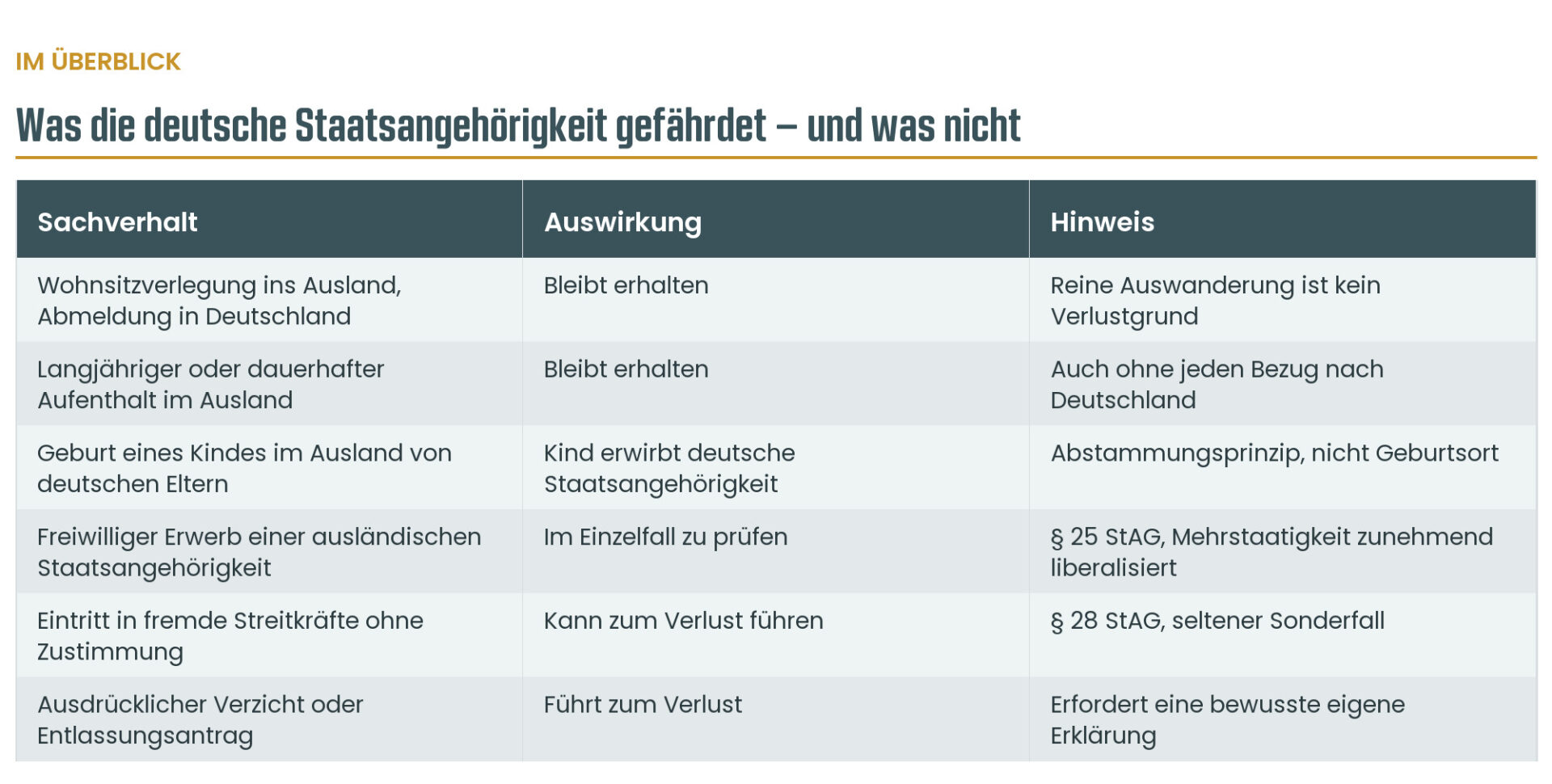
The table shows that the great majority of situations emigrants typically go through do not touch on citizenship at all. It becomes relevant only where a deliberate, formal declaration is at stake – such as a renunciation under § 26 StAG.
Before Acquiring a Second Citizenship: What Matters
Anyone living abroad who, over the years, is considering naturalization in their new home country should not take this step without a prior legal review. Three points are particularly relevant:
The law currently in force. What matters is which rules actually apply at the time of the planned acquisition – not what is stated in an experience report on an emigrant forum. Many such posts reflect the legal position before 27 June 2024 and are therefore outdated.
The retention permit no longer exists. Until 26 June 2024, anyone wishing to keep German citizenship despite naturalizing in a third country had to apply beforehand for a permit to retain it (Beibehaltungsgenehmigung). This procedure no longer exists, because its legal basis fell away together with § 25 StAG; such an application is today neither necessary nor possible. Anyone who encounters offers presenting a retention permit as a mandatory requirement should be wary. The former procedure is now relevant only for assessing legacy cases.
Tax-related connecting factors. Independent of citizenship, emigration and giving up a German residence can raise their own tax questions, for instance regarding extended limited tax liability (erweiterte beschränkte Steuerpflicht) or reporting obligations. These issues are legally distinct from the citizenship question but should also be considered as part of an emigration.
An Illustrative Example (Purely Hypothetical)
To make these connections more tangible, here is a purely fictional example that does not describe any real client or case from our firm: a person emigrates after several years of professional work in a country outside the EU and has lived there for some time. This alone changes nothing about their German citizenship. If this person now considers applying for the citizenship of their new country of residence, their German citizenship remains unaffected from the German perspective, as has been the case since 27 June 2024. The situation becomes legally relevant from a different angle: if the destination state requires giving up all prior citizenships, a sequencing problem arises, because renunciation under § 26 StAG is only possible once the new citizenship already exists. It is precisely this interplay that is worth examining before the application is filed.
Why Legal Advice Before Emigrating Makes Sense
Precisely because the law on multiple nationality is in flux and blanket statements found online quickly become outdated, an individual review before major decisions is advisable – particularly before applying for an additional citizenship. The Fiala law firm has published extensively on international and tax law relating to emigration and relocation and advises clients on the related legal and tax decisions. As an attorney experienced in cross-border matters, Mr. Fiala is familiar with the typical pitfalls that can arise at the intersection of nationality law, immigration law, and tax law.
Conclusion: Keeping German Citizenship When Emigrating Is Not a Problem in the Vast Majority of Cases
Anyone emigrating generally need not worry about their German citizenship. Since 27 June 2024, this also holds true when applying for citizenship in a new home country: automatic loss under § 25 StAG no longer applies. What remains are only three narrowly defined grounds for loss: renunciation, joining foreign armed forces, and the revocation of a fraudulently obtained naturalization. Two other points nevertheless deserve attention: legacy cases predating the cut-off date, and the one-year deadline under § 4 Abs. 4 StAG for children born abroad. A timely review tailored to the specific case remains the safest way to avoid unpleasant surprises.
Are you planning to emigrate or considering acquiring an additional citizenship, and would you like clarity on the legal and tax consequences? Contact the Fiala law firm to discuss your individual situation before making far-reaching decisions.


