

Digital coaching programmes, business mentoring and mastermind groups have grown into a significant market. For participants, such programmes are often associated with substantial costs – prices ranging from several thousand to five-figure sums are not unusual. Alongside this, a legal debate has developed that has now reached Germany’s Federal Court of Justice (Bundesgerichtshof, BGH): when does a coaching programme legally amount to distance learning within the meaning of the German Distance Learning Protection Act (Fernunterrichtsschutzgesetz, FernUSG)?
For providers, this question is no academic formality. If a coaching programme is classified as distance learning without holding the licence required under Section 12 FernUSG, the underlying contract can be void in its entirety – with the result that participants can reclaim fees already paid. The following article sets out the current case law from the provider’s perspective: what contractual drafting duties apply, what liability risks arise, and when the FernUSG’s licensing requirement applies.
Why the label given to an offering is not legally decisive
Many coaching programmes originally grew out of personal consulting. With digitalisation, however, the structure of many offerings has changed: video lessons, member portals, workbooks, live calls and feedback sessions are now offered in a wide range of combinations. As a result, numerous coaching programmes increasingly resemble classic distance learning courses.
The case law is clear: whether an offering is marketed as “coaching,” “mentoring” or a “mastermind” is not legally decisive. What matters is solely the actual structure of the service. Under Section 1 FernUSG, distance learning exists where three conditions are met cumulatively: the transfer of knowledge or skills for payment, a predominantly spatial separation between instructor and learner, and monitoring of the learner’s progress by the provider. If these conditions are met, the course must be licensed by the State Central Office for Distance Learning (Staatliche Zentralstelle für Fernunterricht, ZFU) under Section 12 FernUSG. If this licence is missing, the contract can be void under Section 7(1) FernUSG.
The BGH case law of 2025/2026: the key clarifications for providers
Several decisions of the Federal Court of Justice have recently refined the application of the FernUSG to coaching programmes – in particular the judgments of 12 June 2025 (III ZR 109/24), 15 January 2026 (III ZR 80/25), 5 February 2026 (III ZR 74/25 and III ZR 137/25), and the default judgment of 12 February 2026 (III ZR 73/25). For providers, several principles follow that need to be taken into account when structuring their own programmes.
Coaching can amount to distance learning. Whether an offering falls under the FernUSG cannot be answered in the abstract, but depends on the specific range of services in the individual case. What matters is whether the emphasis lies on the transfer of knowledge or on individual, personal consulting.
The “business customer” argument does not hold up. The FernUSG protects not only consumers but, under the BGH’s case law, expressly also business customers (Unternehmer) within the meaning of Section 14 of the German Civil Code (Bürgerliches Gesetzbuch, BGB). The argument that a customer “acted for their business” and is therefore not in need of protection accordingly fails for many coaching programmes aimed at the self-employed and founders.
Monitoring of learning progress is interpreted broadly. A formal examination is not required. Even a contractually granted right to ask questions about the course content can suffice, for example in the form of live Q&A calls, feedback rounds or individual responses – elements that are standard in many coaching programmes.
Synchronous vs asynchronous as the new key question. In its judgment of 5 February 2026 (III ZR 137/25), the BGH clarified that not every physical distance amounts to spatial separation. What matters is whether the transfer of knowledge takes place predominantly asynchronously – for example, via recorded videos or modules available on demand – or predominantly synchronously, in real time, for example in live seminars. A provider cannot simply “exempt” itself by additionally offering live calls if the actual learning progress rests on an asynchronous system of modules.
The Act is held to be constitutional. In its judgment of 5 February 2026 (III ZR 74/25), the BGH expressly reviewed the licensing requirement under Section 12 FernUSG and the nullity consequence under Section 7(1) FernUSG against the standard of freedom of occupation under Article 12(1) of the German Basic Law (Grundgesetz) and held them constitutional. For providers, this means: the assumption that the FernUSG will soon be watered down on constitutional grounds does not hold up on the current state of the law.
The central distinction: transfer of knowledge or individual consulting
Providers are well advised to make a sober assessment of their own programme against the criteria developed by the BGH. The following overview summarises the key distinguishing features – though in practice the distinction is often fluid, because many programmes contain both knowledge-transfer and consulting elements:
← Tabelle nach links wischen, um weitere Spalten zu sehen
| Feature | More like distance learning | More like consulting |
|---|---|---|
| Focus | Systematic transfer of knowledge | Individual, case-specific advice |
| Content | Standardised modules, lessons, curriculum | Personal analysis, strategic recommendations |
| Materials | Videos, workbooks, assignments, PDF guides | Supporting documents without a learning structure |
| Delivery | Predominantly asynchronous (available on demand) | Predominantly synchronous (live discussions, workshops) |
| Feedback | Learning-related: questions on content, marking of assignments | Situation-related: strategy feedback, sparring |
| Participant group | Standard programme for a broad target group | Tailored to an individual |
An example from the case law illustrates the boundary: in the decision III ZR 74/25, the BGH had to deal with a sixteen-week “blockchain masterclass training” comprising more than fifteen hours of video material, accompanying reports and weekly live calls with an opportunity to ask questions. Although marketed as “coaching,” the court of appeal classified the offering as distance learning. By comparison – purely hypothetical and with no connection to any real case – a coach who offers exclusively individual strategy calls without standardised learning modules is likely to remain within the field of personal consulting.
Who has to prove what – and why the wording of the contract is decisive
The burden of pleading and proof for the requirements of the FernUSG lies in principle with whoever relies on them – generally, therefore, the participant reclaiming their fee. The BGH has, however, indicated a secondary burden of pleading on the provider where the contract describes the teaching concept only superficially or in vague, content-free terms. A deliberately vague description of the service accordingly gives providers no procedural advantage.
There is a further important point from the judgment in III ZR 137/25: what matters is the contractually agreed content of the service, not solely how it is actually carried out. Anyone who predominantly delivers their service synchronously should reflect exactly that in the contract and in the description of the service. Particular attention is warranted here for a practice common in the industry: if live sessions are recorded and made permanently available to participants on demand, the offering acquires an asynchronous element that can tip the classification.
Why repayment claims arise – and why nullity does not automatically mean full repayment
Coaching contracts are generally classified in law as contracts for services (Dienstverträge). The provider does not thereby owe a particular result, only their activity – classic warranty claims for a failure to achieve an economic result therefore generally do not exist. This is precisely why disappointed participants frequently examine whether the contract is void in its entirety under the FernUSG: if the ZFU licence is missing for a programme that is actually to be classified as distance learning, the contract is void under Section 7(1) FernUSG, and repayment claims are pursued via Section 812(1) BGB (unjust enrichment).
For providers, the case law also contains a degree of relief: even where a contract is void, the entire fee does not necessarily have to be repaid. In its decision III ZR 74/25, the BGH pointed out that a repayment claim can be limited under the principles of set-off theory (Saldotheorie) to the extent that the provider can claim compensation for the value of services already rendered (Section 818(2) BGB). Unwinding the contract must therefore, in an individual case, be assessed in a differentiated way – a blanket “everything back” does not apply automatically.
Providers should not rely on this, however. The Senate referred the case back to the court of appeal because no findings had yet been made on compensation for value, and in doing so referred to its leading decision of 12 June 2025 (III ZR 109/24): there, the BGH had set high requirements for compensation for value – the provider must show that, had the participant known of the missing licence, they would have entered into a comparable contract with a different, compliant provider and paid a fee for it; in that case, the claim for compensation for value failed entirely for lack of such submissions. That this evidence can nonetheless succeed in an individual case is shown by lower-court case law – the Paderborn Local Court (Amtsgericht Paderborn), by judgment of 5 September 2025 (57a C 183/24), rejected a repayment claim because the participant faced an equivalent claim for compensation for value from the provider. This is, however, an individual decision.
Two further points concern the status of contracts already concluded. A subsequently granted ZFU licence takes effect only for the future and does not cure the nullity of existing contracts – anyone who obtains the licence retrospectively does not thereby eliminate the risk attached to the existing book of business. And repayment claims become time-barred under the standard three-year limitation period (Section 195 BGB), which under Section 199(1) BGB only begins at the end of the year in which the claim arose and the participant became aware, or ought through gross negligence to have become aware, of the circumstances giving rise to it. Given a legal position that has been disputed for years, this point in time is itself prone to dispute – contracts from past years are therefore not automatically out of reach simply because of the passage of time.
Contractual drafting duties where a licence is required
If a programme is legally classified as distance learning, specific drafting duties arise for the provider:
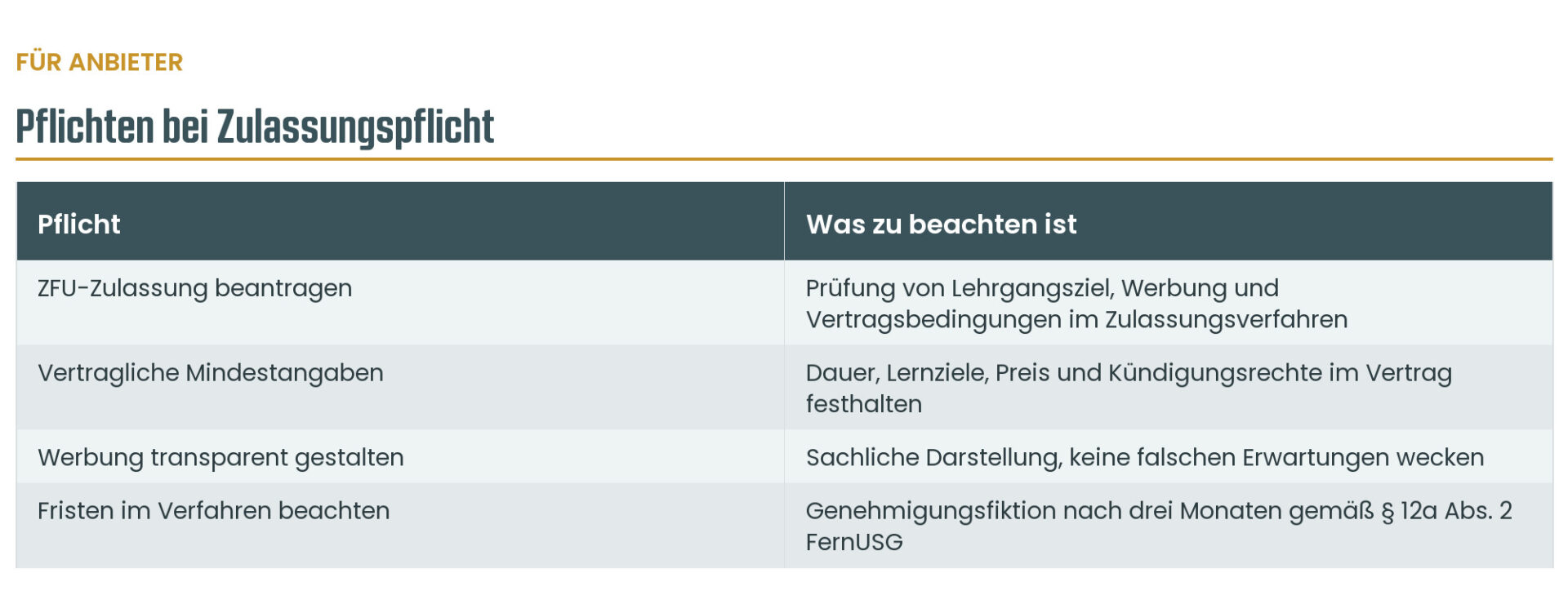
In the licensing procedure, it is examined, among other things, whether the course is suitable for achieving the stated learning objective, whether the advertising meets the statutory requirements, and whether the contractual terms comply with the statutory requirements. The distance learning contract must, among other things, contain details of the duration of the course, the learning objectives, the price and rights of termination, and the marketing of the programme must not create false expectations.
Mandatory requirements as to form and payment
Beyond the licence itself, the FernUSG contains mandatory contract law that directly affects terms common in the industry. Under Section 3 FernUSG, the participant’s declaration of intent leading to the conclusion of the contract requires text form; before the contract is concluded, information must be provided on, among other things, the nature and validity of the course qualification, the duration and frequency of instruction, and the intervals at which materials are supplied.
The payment rules of Section 2 FernUSG are more far-reaching still. The fee must be paid in instalments covering no more than three months at a time, and the individual instalments may not exceed the proportion attributable to the relevant period. Advance payment for the entire course is thereby excluded – which affects the widespread practice of collecting four- or five-figure programme fees in full at the time the contract is concluded. Under Section 2(4) FernUSG, no separate fees may be charged for activities connected with concluding the contract; contractual penalties, liquidated damages and exclusions of liability to the detriment of the participant are invalid under Section 2(5) FernUSG.
The non-waivable right of termination
Under Section 5 FernUSG, the participant can terminate the contract for the first time at the end of the first half-year after conclusion of the contract, with six weeks’ notice, and thereafter at any time with three months’ notice, in each case in text form. Only the proportion of the fee corresponding to the value of the services rendered up to termination is then owed. Fixed minimum terms of twelve months without an ordinary right of termination, as frequently provided for in mentoring and mastermind contracts, cannot be effectively agreed once the programme is classified as distance learning.
How the licensing procedure works
The application to the ZFU must be accompanied by a complete course concept; the learning materials must be available for at least the first third of the course, and a binding schedule must be submitted for the remainder. Under Section 12a(2) FernUSG, the licence is deemed granted if the authority has not decided within three months. Courses serving exclusively leisure or entertainment purposes are merely subject to a notification requirement under Section 12(1) FernUSG – this route is generally not available for business-related professional programmes.
Not only civil law: the risk of a fine
Beyond the civil-law consequence of nullity, the FernUSG contains its own sanctioning provision. Under Section 21(1) no. 1 FernUSG, any organiser who intentionally or negligently markets a distance learning course that is not licensed under Section 12(1) sentence 1 commits a regulatory offence; the same applies to marketing significant, unlicensed changes to a course. The fine can be up to EUR 10,000 under Section 21(2) FernUSG. The same range applies to breaches of the requirements on information material and labelling duties, and to the prohibition in Section 17 FernUSG on approaching individuals for the purposes of advertising, consulting or concluding a contract. Fines of up to EUR 1,000 apply for failing to notify courses subject to the notification requirement, and for refusing to provide information to the authority. The negligence standard is notable: the assumption that one’s own offering is “just coaching” does not provide an excuse if the correct classification would have been apparent on careful examination.
Recommendations for action: reviewing your own programme systematically
Providers of digital coaching and mentoring programmes should regularly measure their offering against the criteria of the current BGH case law, rather than relying on the label chosen for it:
- Analyse the structure honestly: is knowledge being systematically transferred – through modules, lessons, videos or workbooks – or does individual, case-specific consulting predominate?
- Document the proportion of synchronous and asynchronous elements: the greater the share of content available on demand and time-shifted, the more the recent BGH line points towards distance learning.
- Assess feedback mechanisms: even a right to ask questions about the course content, or discussion of assignments, can count as monitoring of learning progress.
- Clarify licensing status before legal disputes arise: anyone in doubt about their own classification should have this checked legally at an early stage – not only once a dispute with a participant has arisen.
- Update contractual documents regularly: particularly after every substantive development of the programme, since the legal classification can change along with the structure of the offering.
- Also review the payment and term model: full advance payment, long minimum terms and contractual penalties are invalid in the case of distance learning – regardless of whether a licence exists.
- Word the description of the service precisely: since the content of the contract is decisive, the proportion and format of live elements, and the treatment of recordings, should be expressly regulated.
Conclusion
The current BGH case law paints a clear picture for providers of online coaching: neither the label given to the programme nor the question of whether customers are consumers or business customers is decisive for the legal classification. What matters is the actual structure of the service – in particular the balance between knowledge transfer and individual consulting, and between asynchronous and synchronous formats. Anyone offering structured online programmes without having examined the licensing question carries a risk of nullity and repayment claims that only becomes apparent in a dispute – but can then become significant. Cross-border offerings raise additional questions on the applicable law that are not addressed here.
If, as a provider of a coaching, mentoring or online training programme, you are uncertain whether your offering should be classified as distance learning, or would like your contractual documents drafted in a legally secure way: Rechtsanwalt Johannes Fiala and the firm have published extensively on the Distance Learning Protection Act and advise on contract and liability questions relating to the FernUSG. Get in touch to have your offering reviewed legally.


