

There is currently a great deal of discussion about the tax consequences for an employee personally when working from a home office abroad. Far less attention is paid to a second question that can prove considerably more expensive for employers: can the home office of even a single employee abroad cause the company itself to become taxable there? The answer is: under certain conditions, yes. If an employee’s activity abroad gives rise to what is known as a permanent establishment, the company must pay corporate income tax abroad on the share of profits generated there – on top of registration, bookkeeping, and documentation obligations that many companies only discover once the foreign tax authority has already come knocking.
This article examines, from the employer’s perspective, when a home office abroad actually gives rise to a permanent establishment, which legal standards apply, and which contractual and organizational measures can, in practice, help reduce this risk.
A Growing Risk: International Remote Work Is on the Rise
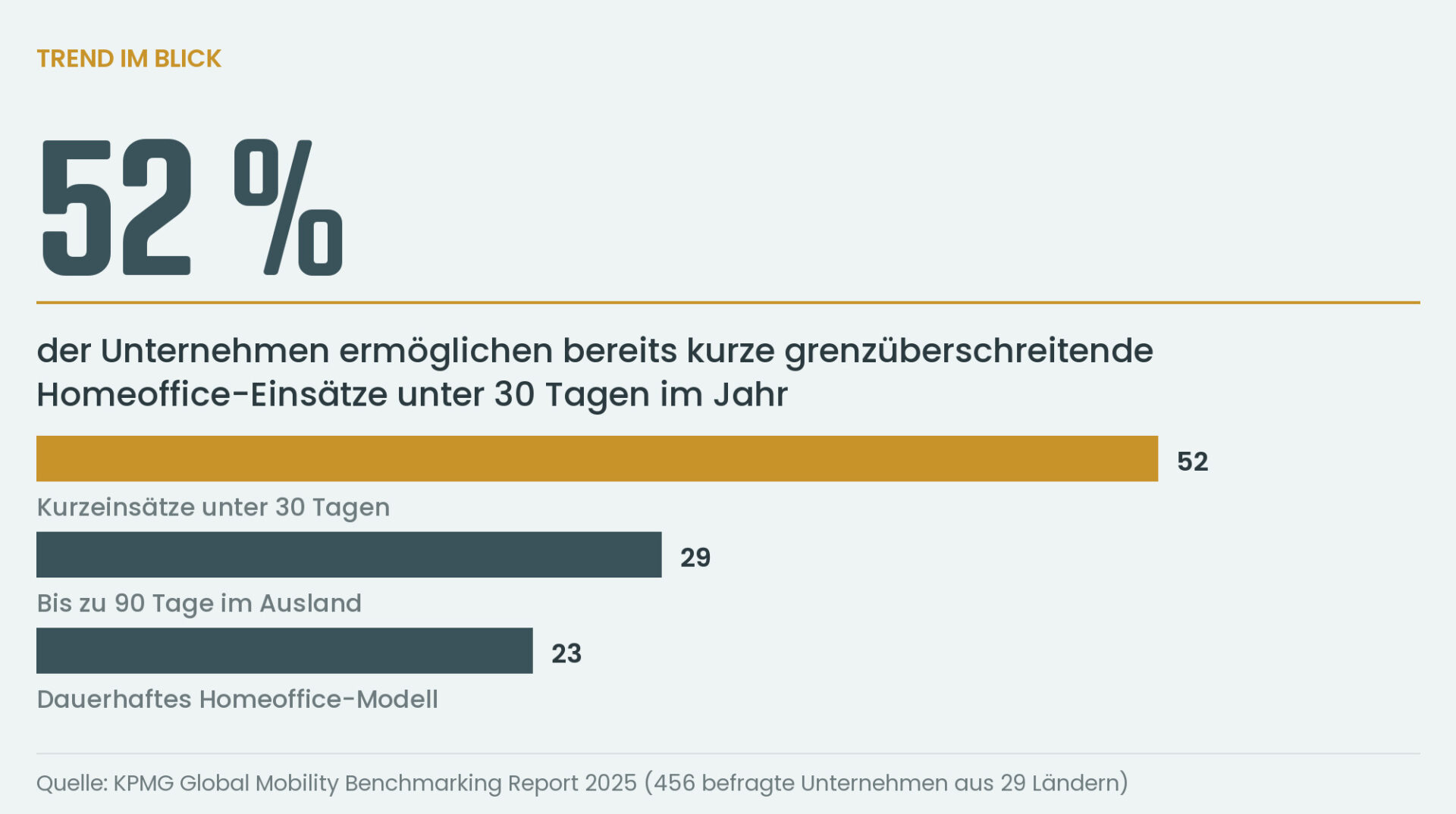
For many companies, cross-border work has long since become everyday practice rather than the exception. The scale of this shift is illustrated by the *2025 KPMG Global Mobility Benchmarking Report*, which surveyed 456 internationally active companies across 29 countries and twelve industries: 52 percent of the companies surveyed permit short cross-border work stays of under 30 days per year, 29 percent allow work abroad of up to 90 days, and 23 percent have already established permanent cross-border home office arrangements.
Figures on the trend: According to the KPMG Global Mobility Benchmarking Report 2025 (456 multinational companies surveyed across 29 countries), 23 percent of companies have already introduced permanent cross-border remote work models, with a further 29 percent permitting stays abroad of up to 90 days per year.
The more employees work permanently or regularly from abroad, the greater the likelihood that a foreign tax authority will take a closer look – and the more important a clear internal company policy becomes.
The Legal Starting Point: § 12 AO and Art. 5 OECD-MA
The concept of a permanent establishment (“Betriebsstätte”) is defined in § 12 of Germany’s Fiscal Code (Abgabenordnung, AO): a permanent establishment is any fixed place of business or facility that serves the activity of an enterprise. At the international level, Art. 5 of the OECD Model Tax Convention (OECD-MA), which shapes most German double taxation treaties, contains a substantively comparable definition: a fixed place of business through which the business of an enterprise is wholly or partly carried on.
For the scenario of interest here – a German company whose employee lives and works abroad – German law alone is usually not decisive; what matters most is the law of the state where the activity takes place and, where one exists, the applicable double taxation treaty. Because many countries’ domestic definitions of a permanent establishment closely follow Art. 5 OECD-MA, the criteria developed there are also a useful reference point for assessing situations abroad.
The central criterion for a classic permanent establishment is what is known as power of disposal: the company must be able to exercise a certain degree of actual control over the premises used – not the employee alone.
The General Rule: An Ordinary Home Office Is Usually Not Enough
For Germany, the tax authorities took an explicit position on this issue for the first time in a circular issued by the Federal Ministry of Finance (Bundesministerium der Finanzen, BMF) dated 5 February 2024 (IV D 1 – S 0062/23/10003:001): the home office of an ordinary employee generally does not constitute a permanent establishment of the employer, because the company lacks the required power of disposal over the employee’s private premises. Notably, according to the BMF, this holds true even where the employer covers ongoing costs or the equipment of the home office, a lease exists for the work space, or the employee has no other workplace provided by the company.
This clears up a common misconception: many companies assume that they avoid the permanent establishment risk simply by not paying for office equipment or not signing a lease for the home office. According to the tax authorities’ position, that is precisely not the decisive point – what matters is the lack of control over the premises as such, not the question of cost.
However, this approach – which is generally favorable for employers – is subject to three important exceptions that are regularly overlooked in practice.
Three Scenarios With a Genuine Permanent Establishment Risk
1. The Classic Place of Business – and the OECD Update of November 2025
Even though the German tax authorities’ position is anchored in the power-of-disposal test, the updated OECD Commentary on Art. 5 OECD-MA (November 2025 version) follows an additional, more activity-based approach that can become relevant when assessing the situation under the law of the foreign state where the work is carried out. At its core is a two-stage test:
- If the home office share of working time within a twelve-month period is below 50 percent, a permanent establishment is generally not assumed.
- From 50 percent or more, it is additionally examined whether there is a business reason for the activity abroad – for example, regular business contact with customers or suppliers on site. If, on the other hand, the home office arrangement is based solely on cost considerations, employee retention, or purely private motives of the employee, this alone is not considered sufficient.
For companies with employees who work permanently or predominantly from abroad, this threshold thus provides a first practical benchmark for assessing risk – but it does not replace an examination of the specific double taxation treaty and local law involved.
2. The Place-of-Management Permanent Establishment: When Decisions Are Made From Abroad
A second, particularly sharp exception in practice concerns executives. Under § 12 sentence 2 no. 1 AO, the place of management is expressly deemed to be a permanent establishment in its own right – regardless of the power of disposal otherwise required. If a managing director, an authorized signatory (Prokurist), or another person with significant decision-making authority permanently makes material business decisions from their home office abroad, a place-of-management permanent establishment can arise there – even if the company has no control whatsoever over the premises themselves. What matters here is not the power of disposal, but solely the question of where the controlling will for the company’s ongoing management is actually formed.
3. The Agent Permanent Establishment: When Employees Conclude Contracts Abroad
The third scenario, and the one most frequently overlooked in practice, concerns sales staff and other employees with customer contact. Under Art. 5 paras. 5 and 6 OECD-MA, a so-called agent permanent establishment can already arise where a person abroad habitually concludes contracts on behalf of the company, or habitually plays the principal role leading to the conclusion of contracts that are subsequently approved by the company as a matter of routine, without material modification. A formal power of attorney to conclude contracts in the civil-law sense is not required for this – what matters is the actual, regular practice. Here too, the power of disposal over the home office premises is irrelevant.
For companies, this means that particularly with sales staff, country managers, or business development personnel abroad, it is worth taking a close look at who actually conducts or concludes contract negotiations, and to what extent – regardless of what the employment contract formally states.
Table: When Does a Home Office Abroad Constitute a Permanent Establishment – and When Does It Not?
← Tabelle nach links wischen, um weitere Spalten zu sehen
| Criterion / Scenario | Generally does not constitute a permanent establishment | Typically constitutes a permanent establishment |
|---|---|---|
| Occasional, irregular home office work | Yes | No |
| Permanent home office of an ordinary employee without decision-making or contract-conclusion authority | Yes (per the BMF circular of 5 February 2024, due to the employer’s lack of power of disposal) | – |
| Home office share below 50% of working time within a 12-month period | Yes (per the 2025 OECD Commentary) | – |
| Home office share of 50% or more without a discernible business reason (e.g., pure cost savings, private motives) | Yes | – |
| Home office share of 50% or more with a business reason (e.g., regular on-site customer contact) | – | Yes |
| Material management decisions are permanently made from the home office abroad | – | Yes (place-of-management permanent establishment, § 12 sentence 2 no. 1 AO) |
| Employee habitually concludes contracts from the home office or takes the leading role in contract negotiations | – | Yes (agent permanent establishment, Art. 5 paras. 5, 6 OECD-MA) |
| Employer covers the costs/equipment of the home office, without any of the above exceptions applying | Yes (bearing the costs alone is not decisive, according to the BMF) | – |
A Hypothetical Example for Illustration
To illustrate this, consider a purely hypothetical, freely invented example with no connection to any actual client matter: a mid-sized German company employs a sales representative who, for personal reasons, lives permanently in Serbia and works from a home office there. If her activity is limited to the technical handling of existing customers without her own authority to negotiate or conclude contracts, this alone would generally not give rise to a permanent establishment. If, however, she independently negotiates new supply contracts with local customers from Serbia, and the company subsequently merely approves these as a matter of routine, the situation moves clearly in the direction of an agent permanent establishment – regardless of whether Germany and Serbia apply a double taxation treaty modeled on Art. 5 OECD-MA. Whether a permanent establishment actually arises in a given case can only be assessed on the basis of the specific circumstances.
Practical Avoidance Strategies for Employers
Companies that allow employees to work permanently or regularly from abroad should not leave the permanent establishment risk to chance:
- Home office or work-abroad agreement: The location, time allocation, and duration of the activity abroad should be set out in writing and reviewed regularly – ideally with a ceiling well below the 50-percent threshold.
- Documentation of working time shares: Ongoing, verifiable records of how much working time is actually performed abroad considerably ease the defense against foreign tax authorities.
- Clear limitation of contract-conclusion authority: Employees in a home office abroad should expressly not be granted independent authority to conclude contracts, whether in the job description or the employment contract; contract negotiations should be subject to a release requirement and substantive review by the domestic office, so that no de facto agent permanent establishment arises.
- Caution with executives: Material management decisions should not be made permanently from abroad; regular presence and documented decision-making within Germany reduce the risk of a place-of-management permanent establishment.
- Review of the business reason: If the home office is used predominantly because an employee regularly attends to customers or suppliers there, this scenario should be deliberately reviewed and, where necessary, adjusted organizationally rather than continued without reflection.
- Early legal review instead of after-the-fact remediation: Whether a permanent establishment risk actually exists in a specific case depends on the applicable double taxation treaty, local law, and the actual circumstances. A review carried out before an assignment or before agreeing to a permanent home office abroad is considerably less burdensome than a later dispute with a foreign tax authority.
- Consider alternative structures: Where a permanent, business-justified deployment abroad is planned in any case, deliberately establishing a subsidiary or a regular permanent establishment in the target country can be the clearer and more manageable solution, rather than drifting into an unintended permanent establishment.
Conclusion
Under the current position of the German tax authorities, a home office abroad does not automatically give rise to a permanent establishment of the employer – the lack of power of disposal over the employee’s private premises is generally favorable here. Companies should not, however, rely on this blindly: for executives with decision-making authority, for employees with contract-conclusion authority, and for a high, business-justified home office share under the updated OECD Commentary, the risk remains real – with potentially significant tax and administrative consequences abroad. Any company that permits international home office arrangements should therefore review the situation of its own employees specifically against these three risk areas, rather than relying on a blanket assurance that all is well.
If your company allows employees to work permanently or regularly from abroad and you would like a legal assessment of the tax-related permanent establishment risk: the law firm of attorney Johannes Fiala advises companies on cross-border home office arrangements and the related tax and contractual issues. Please get in touch to discuss your individual situation.


