

If a German national with a last residence in Spain, Switzerland or Serbia dies, the survivors initially face a very practical question, before inheritance shares or forced heirship rights can even be discussed: which court has jurisdiction over the administration of the estate at all? Can a certificate of inheritance (Erbschein) be applied for in Germany even though the deceased last lived abroad? Or must the proceedings necessarily be conducted at the last place of residence? This purely procedural question is frequently underestimated in practice – yet it determines which authority applications can even be validly filed with, and how long proceedings take. This article sets out the international jurisdiction of the probate courts (Nachlassgerichte) where the deceased had a foreign residence, with particular attention to situations outside the European Union.
The basic rule: habitual residence at death is decisive (Article 4 EU Succession Regulation)
For cases of succession with a foreign element within the European Union, the central starting point is the EU Succession Regulation (Regulation (EU) No 650/2012, “EuErbVO”), which has applied directly in all EU member states except Denmark and Ireland since 17 August 2015. Under Article 4 EuErbVO, the courts of the member state in which the deceased had their habitual residence at the time of death have jurisdiction to rule on succession – and to do so for the estate as a whole. This principle of unity of succession, or universal jurisdiction, means that a single court is in principle responsible for the entire estate, regardless of which countries individual assets are located in.
What exactly does “habitual residence” mean?
The term is not conclusively defined in the Regulation, but is to be determined, under Recitals 23 and 24 EuErbVO, by an overall assessment of the circumstances of the deceased’s life in the years before death: the duration and regularity of the stay, the circumstances and reasons for it, and family and social ties are all taken into account. What matters is the actual centre of life – not the address on the population register, and not nationality. In practice, this means: a German national who spends their retirement permanently in Portugal will, as a rule, have their habitual residence there, even if still registered in Germany. A merely involuntary stay in a foreign care home, by contrast, does not automatically establish a new habitual residence under the case law to date – an additional intention to remain is regularly required here.
The Oberle ruling: even a purely German certificate of inheritance follows the EuErbVO
One point frequently overlooked in practice: international jurisdiction under Article 4 EuErbVO applies not only to the European Certificate of Succession, but, following the case law of the Court of Justice of the European Union (Oberle, C-20/17), also to purely national certificate-of-inheritance proceedings. Anyone wishing to apply for an ordinary German certificate of inheritance at the local court (Amtsgericht) must therefore also be assessed against Article 4 EuErbVO, just as in a cross-border case. If the deceased’s last habitual residence was in France, German probate courts generally lack jurisdiction to issue a German certificate of inheritance – even if the only significant asset, say a flat, is located in Germany.
Figures on cross-border succession: According to the European Commission’s impact assessment for the 2009 regulation proposal (COM(2009) 154 final of 14 October 2009), around 450,000 cases of succession with a cross-border element were expected annually in the European Union – with an estimated total asset value of more than EUR 120 billion. This estimate, made when the regulation proposal was drafted, was one of the central reasons for introducing uniform rules on jurisdiction and recognition through the later Regulation (EU) No 650/2012.
Exception: choice of law and choice-of-court agreements (Articles 5–9 EuErbVO)
There is a practically significant exception to the basic rule in Article 4 EuErbVO. If the deceased, during their lifetime, chose the law of their home state in a disposition of property upon death under Article 22 EuErbVO – for example, a German national living in France who expressly chooses German succession law – Article 5 EuErbVO gives the parties concerned the option of concluding a written choice-of-court agreement in favour of the courts of the chosen state. Alternatively, the same jurisdiction can arise if all parties to the proceedings submit to the jurisdiction of the courts of the chosen state without contesting it (Article 9 EuErbVO). The court that would otherwise have jurisdiction under Article 4 EuErbVO at the last habitual residence can, in these cases, decline jurisdiction on request in favour of the chosen courts (Articles 6 and 7 EuErbVO).
In practice, this means: a choice of law made in a will does not automatically shift international jurisdiction – it merely opens up the possibility for the parties concerned actively to direct jurisdiction to the chosen state. Without such an agreement or unopposed submission, jurisdiction remains with the courts of the last habitual residence, regardless of which substantive law is later applied to the estate.
Where the deceased lived outside the EU: fallback and subsidiary jurisdiction
The legal position often remains unclear where the deceased’s last habitual residence was in a non-EU state – for example, Switzerland, the United Kingdom, the United States or Serbia. A common misconception is that “purely national” German procedural law automatically applies instead of the EuErbVO in such cases. In fact, the Regulation’s jurisdiction rules claim universal application, meaning they in principle also conclusively govern the international jurisdiction of German courts where the deceased’s habitual residence was outside the EU. The fallback jurisdiction and subsidiary jurisdiction of Articles 10 and 11 EuErbVO then become decisive.
Fallback jurisdiction under Article 10 EuErbVO
If the deceased’s habitual residence at the time of death was not in an EU member state, the courts of the member state in which estate assets are located nevertheless have jurisdiction if
- the deceased held the nationality of that member state at the time of death, or, failing that,
- the deceased had previously had their habitual residence in that member state, provided no more than five years have passed, at the time the application is made, since that residence was relocated.
The scope of this fallback jurisdiction depends on which of the two conditions is met – a distinction that is often lost in summaries. If the deceased was either a national of the member state concerned (Article 10(1)(a) EuErbVO) or had their habitual residence there within the five years before the application was made (Article 10(1)(b) EuErbVO), the courts there are, just as under the basic jurisdiction of Article 4 EuErbVO, competent for the entire estate, not only for assets located there. Only if neither condition is met does the considerably narrower fallback jurisdiction under Article 10(2) EuErbVO apply: in that case, the courts of the member state in which estate assets are located have jurisdiction only over those assets – separate proceedings in the relevant state where the assets are located remain necessary for assets located abroad.
Subsidiary jurisdiction under Article 11 EuErbVO
If the fallback jurisdiction does not apply either, Article 11 EuErbVO provides, as a last resort, a subsidiary jurisdiction (forum necessitatis): if, exceptionally, no court of a member state has jurisdiction under the preceding provisions, the courts of a member state may nonetheless decide if proceedings in a third state to which the case is closely connected cannot reasonably be brought or conducted, and the matter has a sufficient connection with the member state in which the court is seised. This provision is designed as a genuine exception and requires a careful account of the circumstances showing why proceedings in the otherwise more obvious third state are not possible or not reasonable.
Is there still room for purely national procedural rules?
In practice, only a narrow margin remains for purely national jurisdiction rules – for example, for cases of succession before the cut-off date of 17 August 2015, or for matters expressly excluded from the substantive scope of the EuErbVO (Article 1(2) EuErbVO), such as certain matrimonial-property or company-law questions. For the great majority of current cases of succession with a connection to a non-EU state, Articles 10 and 11 EuErbVO must be examined first, before falling back on supplementary German procedural law.
Table: jurisdiction rules depending on the residence scenario
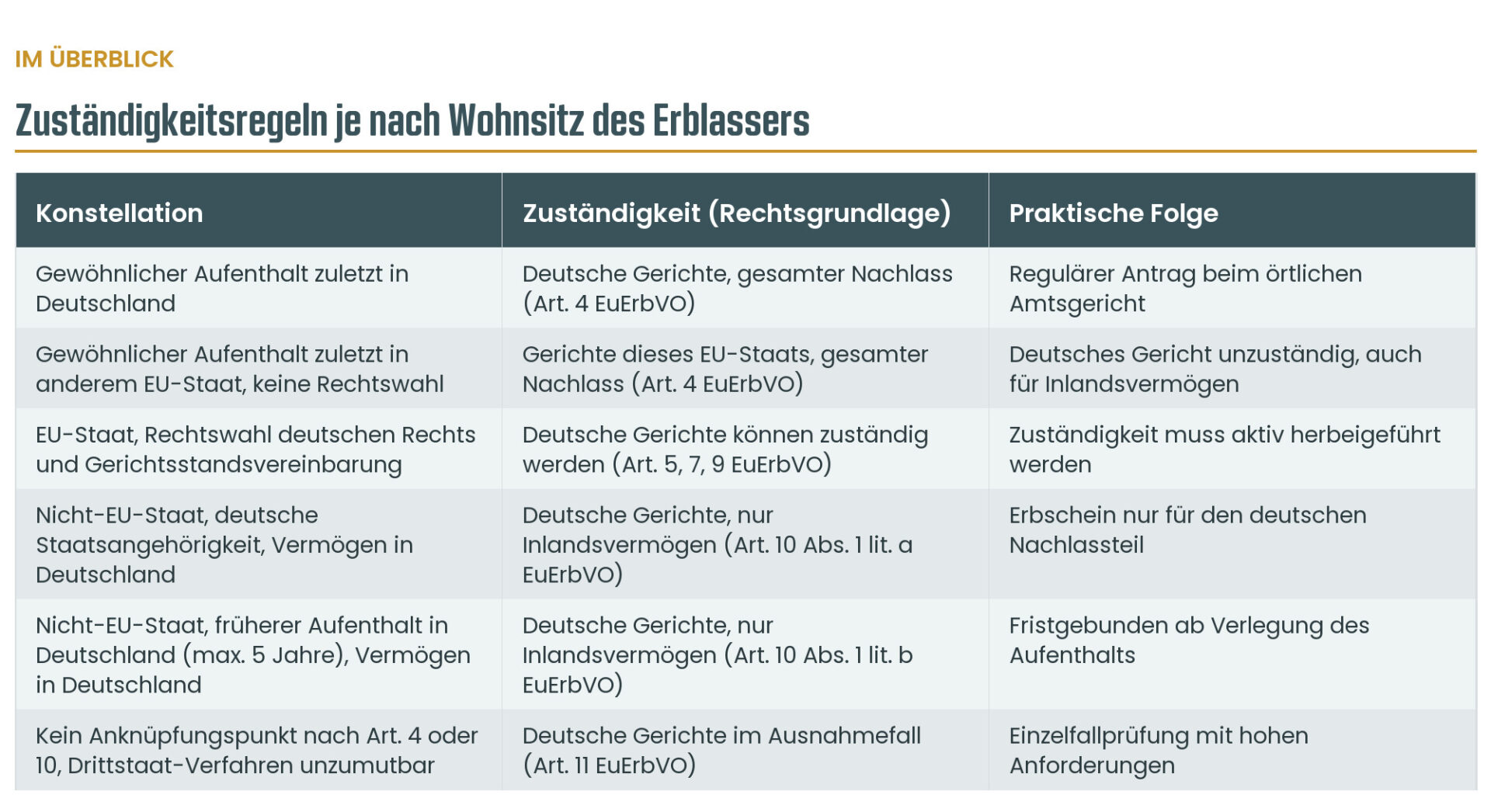
This overview does not replace an individual assessment, but shows that the question “which court has jurisdiction?” in the case of a foreign residence can never be answered categorically, but only by reference to the specific combination of habitual residence, nationality and location of assets.
Practical procedure: applying for a certificate of inheritance when the court with actual jurisdiction sits abroad
If the assessment shows that a German probate court has jurisdiction – whether under Article 4 or, exceptionally, under Article 10 EuErbVO – local jurisdiction within Germany is determined by Section 343 of the Act on Proceedings in Family Matters and in Matters of Non-Contentious Jurisdiction (Gesetz über das Verfahren in Familiensachen und in den Angelegenheiten der freiwilligen Gerichtsbarkeit, FamFG). In principle, the local court at the deceased’s last domestic residence or habitual abode has jurisdiction; if the deceased no longer had a residence there, the location of estate assets moves to the fore as a subsidiary connecting factor. As a matter of court organisation, the case is generally decided by a judicial officer (Rechtspfleger), and by a judge where contested or legally difficult questions arise.
One aspect that clearly distinguishes cases with a foreign element from purely domestic probate proceedings is the principle of ex officio investigation (Amtsermittlungsgrundsatz) under Section 26 FamFG applicable in probate proceedings. The court must establish the facts relevant to its decision of its own motion – in practice, with a foreign element, this regularly means:
- establishing the actual habitual residence at the time of death by reference to registration certificates, witness statements or information from foreign authorities,
- obtaining and translating foreign documents such as the death certificate, will or evidence of family status, often with an apostille or legalisation,
- where applicable, establishing and applying foreign substantive succession law, where this applies under Articles 21 or 22 EuErbVO even though the proceedings are conducted in Germany.
This increased investigative burden is the main reason why probate proceedings with a foreign element can take noticeably longer than purely domestic proceedings – several additional months of processing time are not unusual in more complex cases with a foreign element.
An illustrative example (hypothetical)
For illustration, a purely hypothetical example not based on any real case: a German national spends the last ten years of their life in Serbia, where they also die. In Germany they leave a let flat; in Serbia, a bank account and personal effects. Because the habitual residence was last in a non-EU state, German probate courts cannot have jurisdiction under Article 4 EuErbVO. Because of German nationality, however, a German local court can acquire jurisdiction via Article 10(1)(a) EuErbVO – and, because this condition is met, for the entire estate, including the Serbian bank balance, not just the German flat. The position would be different if the deceased had not held German nationality and had also had no earlier habitual residence in Germany within the preceding five years: then only the narrower fallback jurisdiction under Article 10(2) EuErbVO would apply, limited to the German flat – separate proceedings under Serbian law would then be required for the Serbian account. Such a case shows how strongly the scope of jurisdiction depends on the exact condition on which it is based.
Conclusion: clarify jurisdiction first, before filing applications
Where the deceased had a foreign residence, the question of which probate court has jurisdiction is not a side issue, but the necessary first step in any administration of an estate. Within the EU, Article 4 EuErbVO provides a clear, though in individual cases interpretation-dependent, connecting factor with habitual residence, which has, since the ECJ’s Oberle ruling, also applied to purely German certificate-of-inheritance proceedings. Where residence was outside the EU, the fallback and subsidiary jurisdictions of Articles 10 and 11 EuErbVO come into play, which are often overlooked but are practically significant, particularly for German nationals with domestic assets. Anyone who hastily files an application with the “obvious” local court without examining international jurisdiction risks losing time and incurring additional costs because of a court that lacked jurisdiction from the outset.
Rechtsanwalt Johannes Fiala and the firm have published extensively on international succession law and help clients establish international jurisdiction in cases of succession with a foreign element and file applications with the court that actually has jurisdiction. If a case of succession involves a foreign residence, get in touch with the firm early to discuss your individual situation in an initial consultation.


