

Anyone planning to emigrate and who owns property in Germany will sooner or later face a decision with tax consequences: sell before the move – or only afterwards? This is not a mere formality. When selling property before emigrating, the tax outcome depends largely on how long the property has already been held, whether it was owner-occupied, and exactly when the sale actually takes place. This article sets out the key rules and shows what matters for the timing.
Why selling property before emigrating matters for tax purposes
Many people relocating the centre of their lives abroad assume that emigrating automatically ends all tax ties to Germany. For an owner-occupied or let property, that is only partly true. Two separate questions come into play here:
- Is the sale profit taxable at all – regardless of whether the sale takes place before or after emigrating?
- Does emigrating change anything about how Germany taxes this profit?
The answer to the first question is provided by the so-called speculation period (Spekulationsfrist) under Section 23 of the German Income Tax Act (Einkommensteuergesetz, EStG). The answer to the second lies in the distinction between unlimited and limited tax liability – and this is exactly where most misunderstandings arise in practice.
The ten-year period under Section 23 EStG
Under Section 23(1) sentence 1 no. 1 EStG, the sale of a property is treated as a private disposal transaction (privates Veräußerungsgeschäft) if no more than ten years elapse between acquisition and disposal. Within this period, any increase in value realised is in principle subject to income tax. If the sale takes place outside the ten-year period, the profit – exceptional cases aside – remains tax-free. For planning an emigration, this means: the date the property was purchased is the first reference point for determining whether a sale could become a tax problem at all.
The exception for owner-occupation
Independent of the ten-year period is the exception for owner-occupied residential property. If the property was used for the owner’s own residential purposes in the year of sale and in the two preceding years, the disposal profit remains tax-free even within the ten-year period. This exception is one of the most important levers when planning an emigration: anyone who has lived in the property themselves until shortly before the move can sell under this condition without any increase in value being subject to income tax. The precise requirements as to the duration and period of owner-occupation must be examined in the individual case – it is worth looking closely at one’s own residential history before concretely preparing a sale.
An important limitation: only for private assets held by natural persons
The ten-year exemption under Section 23 EStG applies exclusively to private disposal transactions by natural persons holding the property as private assets. If the property is instead held within a corporation – for example, a GmbH or a holding company – or within an opaque foreign structure such as a trust or a foundation (in the case of a foreign LLC, it depends on the specific classification as transparent or opaque), the ten-year exemption never applies, regardless of how long the property has been held. In these cases, the disposal profit is subject on an ongoing basis to corporate income tax and trade tax, or to the corresponding foreign rules. This is particularly important to know because holding property through a company circulates in emigrant circles as a supposed tax trick – in fact, this structure closes off access to the ten-year exemption entirely, rather than improving it.
Emigrating itself does not yet trigger tax on property
One point regularly causes confusion in practice because it is conflated with a different, considerably stricter regime: the so-called exit taxation (Wegzugsbesteuerung) under Section 6 of the German Foreign Tax Act (Außensteuergesetz, AStG). This provision concerns shares in corporations, such as GmbH shares. Anyone holding such a shareholding who moves abroad can trigger a deemed disposal by the move itself – the hidden reserves are taxed even though no actual sale has taken place.
No such rule exists for property. Emigrating as such – that is, the mere fact that someone relocates their residence or habitual abode abroad – does not trigger automatic taxation on a domestically located property. There is no deemed disposal, and no immediately due tax liability arises merely from the move. The property can in principle continue to be held, let or occupied unchanged, without the move itself constituting a taxable event.
But beware: limited tax liability continues to apply
That does not, however, settle the matter. Anyone who, after emigrating, relocates their residence and habitual abode entirely abroad generally becomes subject only to limited tax liability on their German-source income. This means that Germany no longer taxes worldwide income, but only certain, statutorily defined domestic income.
Profits from private disposal transactions involving domestic real property – i.e. from the sale of a property located in Germany – fall precisely within this domestic income under Section 49(1) no. 8 EStG. Anyone who sells within the ten-year period after emigrating, without owner-occupation in the sense described applying, therefore remains liable to tax on the sale profit in Germany – despite residing abroad. Emigrating therefore does not protect against German taxation of the property gain in this case; it merely changes the form the tax liability takes.
Selling property before or after emigrating, compared
Whether it is better to sell a property before or after emigrating cannot be answered across the board. It depends on the holding period, any owner-occupation, the future country of residence, and the double taxation treaty (DBA) that country has with Germany. The following overview shows the key differences:
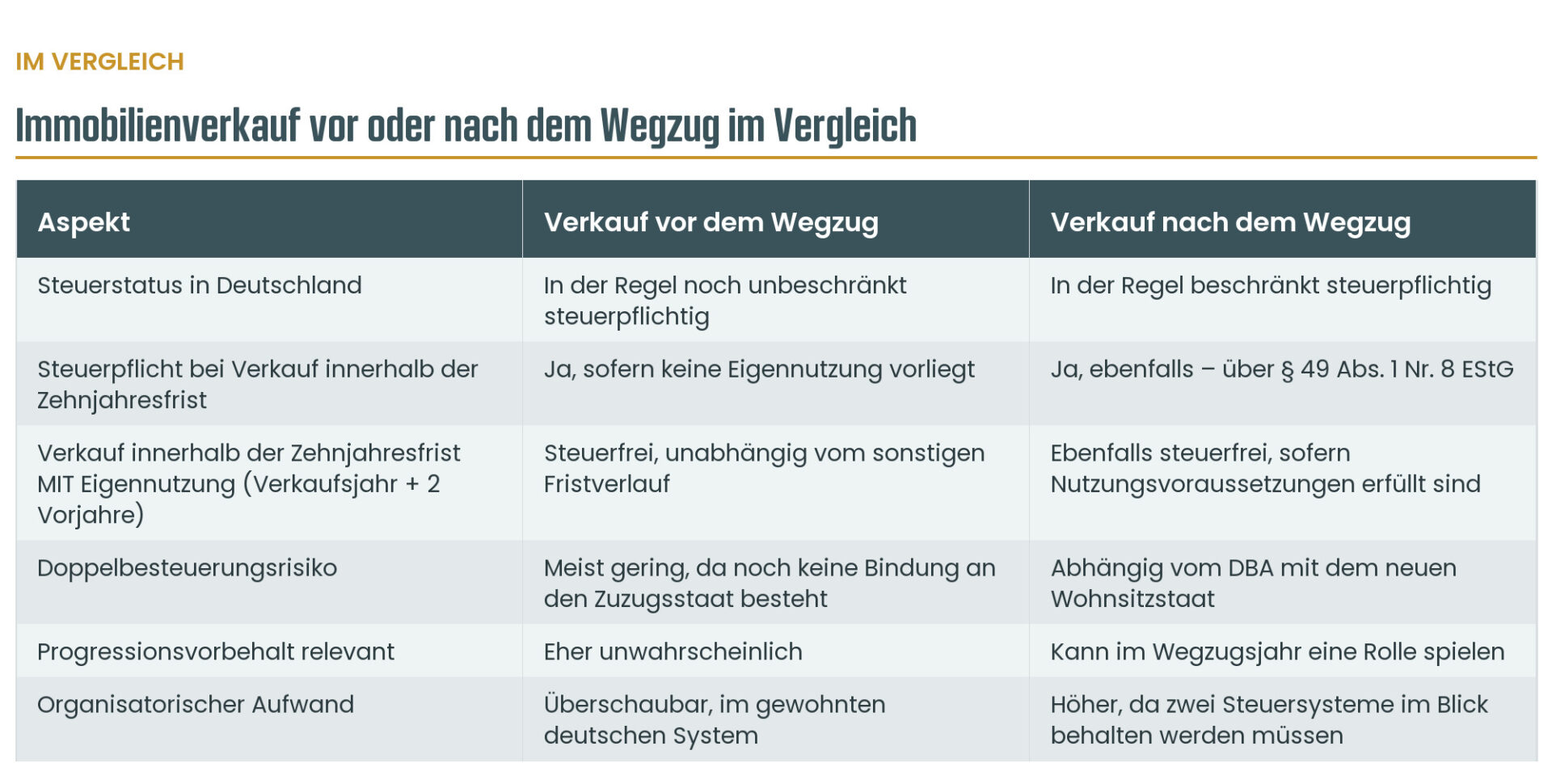
Most German double taxation treaties provide that, for profits from the sale of real property, the state in which the property is located retains the right to tax. That tends to protect against double taxation, but it also means that the country of arrival may still take the profit into account when determining its own tax rate, or impose its own reporting obligations. Exactly how this plays out in a specific case depends on the relevant treaty and the tax law of the destination country, and should be checked before the sale.
Practical timing considerations
Example (purely hypothetical, for illustration): A person plans to move abroad permanently within a few months and owns a let flat in Germany, acquired six years earlier. There is no owner-occupation, so the ten-year period has not yet expired. In this invented example, exactly the question arises that concerns many prospective emigrants: is it worth selling before the move, while the tax position in Germany is still straightforward and clearly one of unlimited liability? Or is it better to wait with the sale, for example because more favourable conditions are expected in the new country of residence? There is no blanket answer – it depends on the specific circumstances, the destination country and individual wealth planning.
Regardless of the individual case, some general considerations can be noted:
- Clarity over complexity. A sale handled entirely within the German tax system is generally easier to plan than one touching two legal systems.
- The date of emigration itself is not a tax deadline. As described, moving abroad does not trigger a separate tax liability for property. It does, however, change the tax status under which a later sale is treated.
- The progression proviso (Progressionsvorbehalt) can become relevant in the year of emigration if both domestic and foreign income arise in the same year. This does not directly affect the property gain itself, but can influence the overall tax burden in the year of transition.
- The double taxation treaty with the destination country deserves its own look. Some countries tax new arrivals more generously, others more strictly. Without this check, it is hard to seriously assess whether deferring the sale is actually advantageous.
Why early planning pays off
In practice, the biggest tax disadvantage rarely arises from a wrong decision, but from a lack of time to make an informed one. Anyone who only starts looking into the speculation period, the owner-occupation rule and the destination country’s double taxation treaty shortly before the move easily comes under time pressure – and then makes decisions that turn out to be costly in hindsight. A spontaneous sale shortly before departure, without checking deadlines and alternatives, often forfeits scope for planning that would still have been available with timely preparation.
It is therefore advisable to factor the tax assessment of a property sale into emigration planning as early as possible – ideally as soon as a move abroad is even being seriously considered. That provides time to properly document the ten-year period and any owner-occupation, to assess the tax law of the destination country, and to choose the timing of the sale deliberately rather than reactively.
Conclusion
Selling property before emigrating raises different tax questions than emigrating itself. While the move – unlike shares in a corporation – does not trigger a separate tax liability for property, a later sale within the ten-year period remains relevant in Germany via limited tax liability. Whether a sale makes more sense before or after emigrating depends on the holding period, any owner-occupation and the tax law of the destination country. These questions are best answered before the move is imminent – not once the bags are already packed.
The Fiala law firm, based in Munich, advises on tax law and international law in matters relating to emigration, property ownership and cross-border wealth planning. Anyone planning a move abroad while owning German property can contact the firm for an individual assessment of their situation – ideally as early as possible, to keep all planning options open.


