

Anyone leaving Germany who sells assets, or plans to do so in the years before or after emigrating, will almost inevitably encounter Section 23 of the German Income Tax Act (Einkommensteuergesetz, EStG) – § 23 EStG. The provision governs the so-called speculation period (Spekulationsfrist) for private disposal transactions – and it covers far more than just real estate. Works of art, precious metals, cryptocurrencies, and other movable assets can also fall within its scope, albeit with considerably shorter periods than for land. Anyone who misjudges the system, or fails to correctly determine the date of acquisition and disposal, risks an unexpected tax liability – regardless of whether their residence is still in Germany at the time of sale. This article explains the basic mechanics of the speculation period, the periods applicable to different assets, and what emigration changes for enforceability under tax law – and what it does not.
Section 23 EStG: The Statutory Basis of the Speculation Period
§ 23 EStG covers so-called private disposal transactions (private Veräußerungsgeschäfte). This refers to gains that arise where an asset forming part of private wealth is sold again within a certain period after acquisition. The legislature essentially distinguishes two periods:
- For land, rights equivalent to land, and buildings, the period is ten years.
- For other assets – for example movable items – the period is, in principle, one year.
Where an asset that would otherwise be subject to the short one-year period is used to generate income, the period is statutorily extended to ten years. This extension is frequently overlooked in practice, because it is not among the supposedly familiar basic rules.
Important for context: § 23 EStG is not an exit tax (Wegzugsbesteuerung) in the narrower sense. Anyone holding shares in a corporation, for example, may additionally be subject on emigration to the separate rules on exit taxation under German foreign tax law – that is legally a distinct regime, separate from the speculation period for private disposal transactions. Conflating the two readily leads to false assumptions about one’s own situation.
How the Speculation Period under § 23 EStG Is Calculated
For calculating the period, what matters is not the day of the transfer of ownership or handover, but the date of the binding obligating transaction (obligatorisches Verpflichtungsgeschäft) – usually the day the contract is concluded. Both the start of the period (acquisition) and its end (disposal) are determined on this basis:
- Start of the period: the date of the binding obligating transaction on acquisition, for real estate generally the notarised purchase contract.
- End of the period: the date of the binding obligating transaction on sale.
Because what matters is the date the contract under the law of obligations is concluded, and not the flow of payment, handover, or registration, the actual economic transfer of an asset can occur considerably later than the date decisive for calculating the period. Anyone seeking to make full use of a period should be aware of this distinction – in borderline cases, a matter of individual days can decide whether tax is payable.
The Period Runs to the Day, Not by Calendar Year
A misunderstanding that regularly arises: that the speculation period runs by calendar year, so that an asset acquired in January can be sold tax-free from the following 1 January onwards. That is not correct. The calculation of the period follows Section 108(1) of the German Fiscal Code (Abgabenordnung, AO) – § 108 Abs. 1 AO – which refers to the general rules on time limits in Sections 187 et seq. of the German Civil Code (Bürgerliches Gesetzbuch, BGB). Under Section 188(2) BGB – § 188 Abs. 2 BGB – the period ends on expiry of the day that, by its designation, corresponds to the day on which the period began. Anyone acquiring a movable asset on 15 March must therefore wait until 15 March of the following year – a sale on that exact day still falls within the one-year period. The same system applies to the ten-year period for land, over a correspondingly longer time span.
The Bundesfinanzhof (Federal Fiscal Court) clarified and, at the same time, qualified this principle in its judgment of 25 March 2021 (IX R 10/20): where not all contracting parties are yet bindingly obligated at the time the contract is concluded, what matters is the event that brings about the binding effect, or full effectiveness, of the contract. Where official approval is reserved, or where a party acts without authority to represent another, the point in time that triggers the period can therefore differ from the date of the contract.
Carrying Over the Period on Inheritance and Gift
Anyone acquiring an asset without payment does not start a new period: under Section 23(1), third sentence, EStG – § 23 Abs. 1 Satz 3 EStG – the acquisition by the predecessor in title is attributed to the individual legal successor. Inherited or gifted assets carry forward the period that began with the deceased or the donor – which can work in either direction. Anyone wishing to liquidate inherited assets before emigrating should therefore not rely on their own date of acquisition, but on that of their predecessor in title, and should obtain the relevant documentation while access to it is still straightforward.
Not Just Real Estate: Periods for Other Assets
In public perception, § 23 EStG is often reduced to sales of real estate. In fact, the provision covers a considerably broader range of assets – with correspondingly shorter periods. The following overview shows the most important categories:
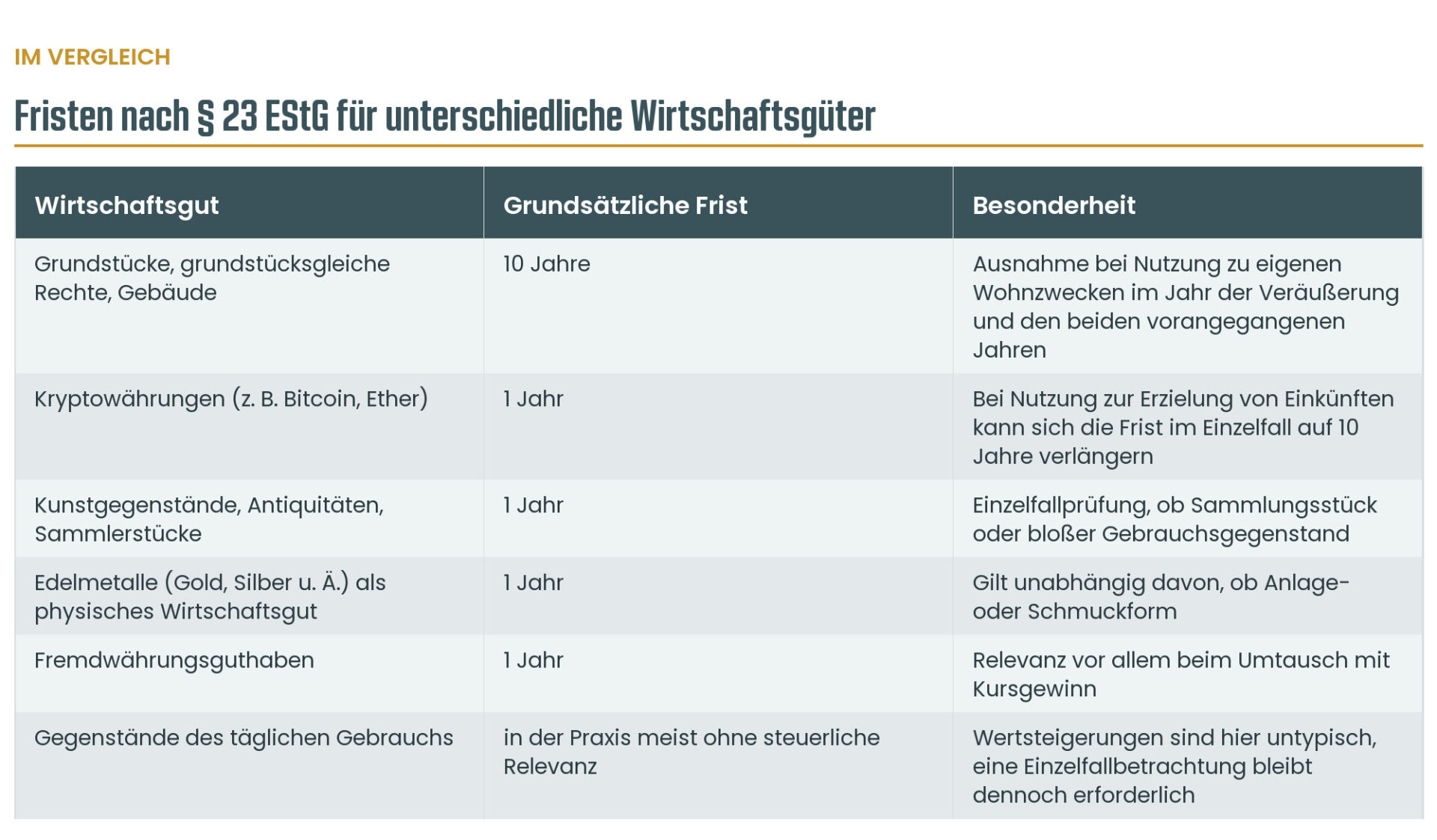
For context: shares and comparable securities generally do not fall under § 23 EStG, but are instead covered by the rules on investment income – that is a separate system of taxation with its own rules, which is not examined further here.
Special Case Cryptocurrencies: Holding Period, Exchange, and Order of Use
Crypto assets are the area in which most misconceptions persist. The Bundesfinanzhof held, in its judgment of 14 February 2023 (IX R 3/22), that units of a virtual currency constitute other assets within the meaning of Section 23(1), first sentence, No. 2 EStG – § 23 Abs. 1 Satz 1 Nr. 2 EStG. The one-year period therefore applies to them.
A particularly persistent assumption is that staking or lending extends the holding period to ten years. This relates to Section 23(1), first sentence, No. 2, fourth sentence, EStG – § 23 Abs. 1 Satz 1 Nr. 2 Satz 4 EStG – under which the period is extended to ten years where income is generated from using an asset as a source of income in at least one calendar year. The tax authorities had taken this view at draft stage, but did not maintain it in the published circular. Under the current administrative view, most recently confirmed in the Federal Ministry of Finance (Bundesministerium der Finanzen, BMF) circular on individual questions concerning the income tax treatment of crypto assets of 6 March 2025, the extension does not apply to virtual currencies. The one-year period continues to apply even where the holdings were lent or staked in the meantime; the income generated from this is recorded separately.
Two further points are significant for emigration cases. First, exchanging one cryptocurrency for another already counts as a disposal of the asset given up and an acquisition of the asset received – anyone restructuring their portfolio shortly before emigrating thereby starts a new one-year period. Second, under the same BMF circular, a tiered order of use applies for determining which units were sold: the specific unit disposed of must primarily be individually identified (a wallet-specific individual assessment); where this is not possible, the simplification rule applies instead, under which, for purposes of the holding period, the crypto assets of a given trading designation acquired first within the same wallet are deemed to have been disposed of first (FIFO). Anyone who has bought in tranches over several years cannot therefore assess the tax liability by reference to the overall holdings, but only by reference to a traceable transaction history – which should be secured before moving abroad, while access to exchanges and wallets still exists.
Exceptions: When § 23 EStG Does Not Apply Despite a Running Period
Not every disposal within the period triggers a tax liability. The law contains several exceptions that should be examined before emigrating:
- Items of everyday use are excluded under Section 23(1), first sentence, No. 2, second sentence, EStG – § 23 Abs. 1 Satz 1 Nr. 2 Satz 2 EStG. The Bundesfinanzhof clarified, in its judgment of 27 January 2026 (IX R 4/25), that even high-value assets can fall within this category where they are objectively subject to a loss in value or cannot be expected to increase in value, and do not primarily serve as a capital investment – the value of the asset alone is not a suitable criterion for delimitation. The case decided concerned a motorhome acquired for around EUR 323,000 and later sold at a profit, which, despite its high value, was classified as an item of everyday use; the gain therefore remained tax-free. Under the system of the provision, the exception applies in both directions: it exempts gains from tax, but likewise excludes the deduction of losses – that is a general consequence of the provision, not the subject of this particular decision, which concerned a case of gain.
- For land, the exception for property used by the owner for their own residential purposes applies under Section 23(1), first sentence, No. 1, third sentence, EStG – § 23 Abs. 1 Satz 1 Nr. 1 Satz 3 EStG – either where the property has been continuously self-occupied since acquisition or completion, or where it was self-occupied in the year of disposal and in the two preceding years. This must be examined particularly carefully in the case of emigration, since an intervening period of letting can jeopardise the exception.
- Losses from private disposal transactions may, under Section 23(3) EStG – § 23 Abs. 3 EStG – only be offset against gains from transactions of the same kind, not against other types of income; even a carry-back or carry-forward remains restricted to the same source of income.
The De Minimis Threshold under Section 23(3), Fifth Sentence, EStG
Gains from private disposal transactions remain tax-free where the total gain achieved from such transactions in the calendar year does not exceed a certain de minimis threshold (Freigrenze) – currently EUR 1,000. What matters here is the concept of a de minimis threshold, as distinct from a tax-free allowance (Freibetrag): if the threshold is exceeded, the entire gain is, in principle, taxable, not merely the amount exceeding it. This distinction is frequently confused in practice and can lead to an unpleasant surprise where several smaller disposal transactions coincide in the same year.
Emigration and § 23 EStG: Does the Tax Liability Change?
A widespread misconception holds that anyone leaving Germany is automatically outside the scope of the speculation period. That is not correct as a blanket statement. The period itself continues to run regardless of residence – it is linked to the individual asset, not to the residence of the person disposing of it. Whether Germany may actually tax the resulting gain depends on several factors:
- Whether, at the time of disposal, unlimited or at least limited tax liability in Germany still exists.
- How an applicable double taxation agreement (DBA) with the new state of residence allocates the taxing right.
- Whether the assets have a domestic connection that permits taxation in Germany even where the person is resident abroad.
A special rule applies for the year of emigration: where unlimited tax liability ends during the calendar year, the income received before that point and the domestic income within the meaning of § 49 EStG subsequently received must be combined in a single assessment under Section 2(7), third sentence, EStG – § 2 Abs. 7 Satz 3 EStG. There is therefore no clean split into two tax years – a disposal gain realised in the year of emigration also affects the applicable tax rate.
After emigration, by contrast, Germany’s reach narrows considerably. For persons with limited tax liability, Section 49(1) No. 8 EStG – § 49 Abs. 1 Nr. 8 EStG – covers private disposal transactions only to the extent that they concern domestic land, or domestic rights subject to the provisions of civil law relating to land. Movable assets such as crypto assets, precious metals, or works of art are not covered. This is consistent with the system of double taxation agreements: following the model of Article 13 of the OECD Model Convention, the state where the property is situated may tax gains from the disposal of immovable property, while the residual rule for other assets allocates the taxing right to the state of residence.
What matters, therefore, is not the expiry of the period alone, but the interaction of the period, tax liability status at the time of disposal, and treaty law. There may also be an extended limited tax liability under Section 2 of the German Foreign Tax Act (Außensteuergesetz, AStG) – § 2 AStG: this can apply to German nationals who were subject to unlimited tax liability for at least five years within the last ten years before emigrating, move to a low-tax territory, and continue to hold substantial economic interests in Germany – and then covers, in the year of emigration and the following ten years, an extended catalogue of domestic income. Whether this applies in an individual case can only be assessed on the basis of the specific circumstances.
How the Tax Office Finds Out about Sales Made Abroad
A key question that is frequently underestimated: how does the German tax administration find out at all about a sale that takes place after someone has emigrated? International information exchange between tax authorities has increased considerably in recent years and operates through several channels.
Automatic Exchange of Information on Financial Accounts
Banks and financial institutions in numerous states automatically report account data and certain transaction information to the tax authorities of the account holder’s state of residence, and this information is exchanged between the states involved. Anyone who believes that sale proceeds held in a foreign account remain invisible is taking a considerable risk.
Reporting Obligations and Cross-Checking Notices
In real estate transactions, notaries and land registries are in any case subject to reporting obligations. There are also opportunities, as part of administrative assistance under double taxation agreements, for German and foreign authorities to obtain specific information on individual matters.
Reporting Obligations Connected with Emigration Itself
Even the deregistration or re-registration of a residence, together with certain reporting obligations to the tax office on establishing economic relations abroad, can mean that the tax administration is informed of an emigration at an early stage and subsequently traces later disposal transactions through cross-checking notices.
Taken together, this means that emigrating provides no practical protection against a disposal gain realised within the speculation period becoming known to the German tax office. Anyone relying on remaining undetected takes a risk that goes beyond the tax payment itself – potentially as far as an allegation of tax evasion, for which its own, considerably longer time limits apply than for the speculation period itself.
Example: Speculation Period on Emigration
For illustration, a purely hypothetical, entirely fictional example that does not depict an actual situation: a person acquires cryptocurrency and emigrates eight months later. Ten months after acquisition, they sell the cryptocurrency – by which time they no longer live in Germany. The one-year period under § 23 EStG for other assets has therefore not yet expired. Whether Germany may tax the gain is not decided by the period alone in this case, but by whether German tax liability still existed at all at the time of disposal, whether the transaction falls within the year of emigration, and whether an extended limited tax liability comes into consideration. If the sale is instead postponed by a few months beyond the one-year period, the question is already resolved at the level of § 23 EStG – a difference that regularly makes a case-by-case review before emigrating more sensible than a correction afterwards.
What You Should Check Before Emigrating
- For each relevant asset, cleanly document the precise date of acquisition, i.e. the date of the obligating transaction.
- Check whether a planned disposal falls within or outside the relevant period, and whether an extension to ten years comes into consideration because of income generation.
- Clarify which double taxation agreement applies with the future state of residence, and how it allocates the taxing right for the assets concerned.
- Fulfil reporting obligations connected with emigration promptly and completely, rather than relying on going unnoticed.
- Where several disposal transactions are planned in the same year, keep the de minimis threshold in mind.
Conclusion
§ 23 EStG covers far more than the classic sale of real estate – from cryptocurrencies to works of art to precious metals, distinct, often considerably shorter periods apply than for land. Emigration does not automatically change these periods, and does not protect against disposal transactions becoming known to the German tax office through international information channels. Anyone holding or intending to sell assets before emigrating should have the time-limit position reviewed at an early stage, and separately for each asset.
The Fiala law firm has published extensively on tax questions connected with emigration and cross-border asset matters, including on the application of § 23 EStG to different types of assets. Johannes Fiala, lawyer, has many years of experience advising clients on international tax and asset questions. Contact the firm if you would like your individual situation assessed from a legal perspective before a planned emigration.


