

Those who relocate their residence abroad rarely think of their will first. Yet relocating abroad raises central questions: which succession law actually applies when a German national lives permanently in Spain, Dubai, or the United States? Does German forced share law (Pflichtteilsrecht) continue to apply? And is a will drawn up in Germany even formally valid abroad? These are not academic subtleties – they determine who receives which share of the estate in the event of death, and whether your actual last wishes are ultimately carried out. A legally sound will for those resident abroad therefore calls for an early, individual review.
Why a Will Requires Special Care When You Are Resident Abroad
Within Germany, the legal situation in the event of death is usually straightforward: German succession law applies, the rules on the forced share (Pflichtteil) are well established, and the competent probate court (Nachlassgericht) is clear. As soon as habitual residence abroad enters the picture, however, different legal systems collide. This is especially true where assets are additionally held in several countries – for example, a property in Germany, a bank account in Switzerland, and a company shareholding in the United States.
In such situations, the following questions regularly arise:
- Which substantive succession law applies – that of the last state of residence, that of nationality, or does a separate law apply to individual assets?
- Does an existing will remain valid after the move?
- How does foreign succession law affect the forced share claims of children or a spouse?
Anyone who leaves these questions unresolved risks that, in the end, it is not their own wishes but a legal system applied by chance that decides how their assets pass on.
Which Succession Law Applies – and What That Means for the Form of Your Will
For cross-border succession cases within the European Union, the central legal framework is the EU Succession Regulation (Regulation (EU) No 650/2012, commonly referred to by its German abbreviation “EuErbVO”); it applies directly in most EU member states, with Denmark and Ireland not participating. Under the basic rule, the law of the state in which the deceased had their habitual residence at the time of death applies (Art. 21 EuErbVO) – not the deceased’s nationality. Anyone who moves permanently to Portugal or France is therefore, as a rule, automatically subject to the succession law of that country, even where German forced share law would produce a different result. Under Art. 22 EuErbVO, however, any person may instead choose the law of their own nationality by way of a testamentary disposition – meaning a German national living elsewhere in the EU can specify that German succession law is to apply. The detailed requirements for this choice of law and its effect on forced share claims are examined in depth in our article on German succession law for those resident abroad.
Outside the scope of the EuErbVO, many countries – in particular classic common law jurisdictions such as the United States or the United Kingdom – do not follow the principle of unity of succession, but instead distinguish between movable assets (governed by domicile) and real estate (governed by the location of the property). The result is what is known as scission of the estate – the splitting of the succession into parts governed by different laws, so that several legal systems apply side by side to one and the same estate.
A special case that cannot simply be assigned to this classic model is the United Arab Emirates: since Federal Law No. 41/2022 on Civil Personal Status (in force since 1 February 2023), non-Muslims are subject to a distinct civil succession regime with freedom of testation and a statutory default order of succession, while for Muslims – both Emirati nationals and foreign residents – Islamic succession law (Sharia) continues to apply. In addition, non-Muslim residents or asset holders may have their will registered with the DIFC Wills Service on common law principles. Which of these three regimes applies in a given case depends on religious affiliation and the form of registration chosen, and should be examined separately rather than simply grouping the UAE together with the US and the UK.
For the drafting of a will, the scission of estates typical of common law jurisdictions is relevant because a single will may, under certain circumstances, not be sufficient to govern the entire estate uniformly – independently of this, however, as shown below, the *form* of a will once made is generally secured on its own terms through the Hague Convention on the Form of Testamentary Dispositions.
For orientation, a simplified overview of the basic connecting-factor models:
← Tabelle nach links wischen, um weitere Spalten zu sehen
| Aspect | EU Succession Regulation (choice-of-law model) | Lex situs / scission of the estate (typical in common law jurisdictions) |
|---|---|---|
| Basic principle | Unity of succession – one law for the entire estate | Division by asset type and location |
| Connecting factor | Habitual residence at death, or nationality by choice | Domicile for movable assets, location of the asset for real estate |
| Choice of law possible? | Yes, in favor of the law of one’s own nationality (Art. 22 EU-ErbVO) | Generally not provided for, or only to a limited extent |
| Countries affected (examples) | EU member states except Denmark and Ireland | Numerous common law jurisdictions, including parts of the US and the United Kingdom (UAE: its own hybrid system, see text) |
| Practical consequence | One will can govern the entire estate | Multiple country-specific wills may be advisable |
This overview does not replace a case-by-case review, but it shows why the question “Which law applies to my assets?” cannot be answered categorically, and instead depends on the type and location of each individual asset.
Formal Validity: Is My Will Even Valid Abroad?
Besides the question of which substantive succession law applies, a second, often underestimated question arises: is the chosen form of the will even recognized abroad?
The Hague Convention on the Form of Testamentary Dispositions
This is where the Hague Convention of 5 October 1961 on the Conflicts of Laws Relating to the Form of Testamentary Dispositions helps, to which Germany is also a contracting state. It considerably facilitates the recognition of wills with a cross-border element by providing several alternative connecting factors for formal validity: a will is formally valid if it complies with the law of the place where it was executed, the law of the testator’s nationality, domicile, or habitual residence – at the testator’s choice, either at the time of execution or at the time of death. For real estate, the law of the place where the property is located may additionally apply. What matters about this list is that it applies in the alternative, not cumulatively: it is enough for the will to comply formally with just one of these legal systems for it to be recognized as formally valid overall.
In practice, this generous rule means that a will validly executed in Germany usually remains formally valid even after a move abroad – even where the substantive succession law at the new place of residence has since become an entirely different one. This distinction is frequently overlooked in practice: the *form* of a will (handwriting, notarial execution, witnesses) and the *applicable substantive law* (who inherits, how large the forced share is) are assessed under different sets of rules and can therefore legally diverge. A will can be formally valid without its content still fitting the new life situation – for example, because it did not include a choice of law and a law with no concept of a forced share now applies, or because assets have since been acquired in a state with scission of the estate that the original will never took into account.
Notarial vs. Holographic Will Abroad
Anyone drafting a new will or updating an existing one regularly faces the choice between a notarial will and a holographic (handwritten) will. Under German law, both forms are in principle of equal standing, but they differ in practical handling in a cross-border context:
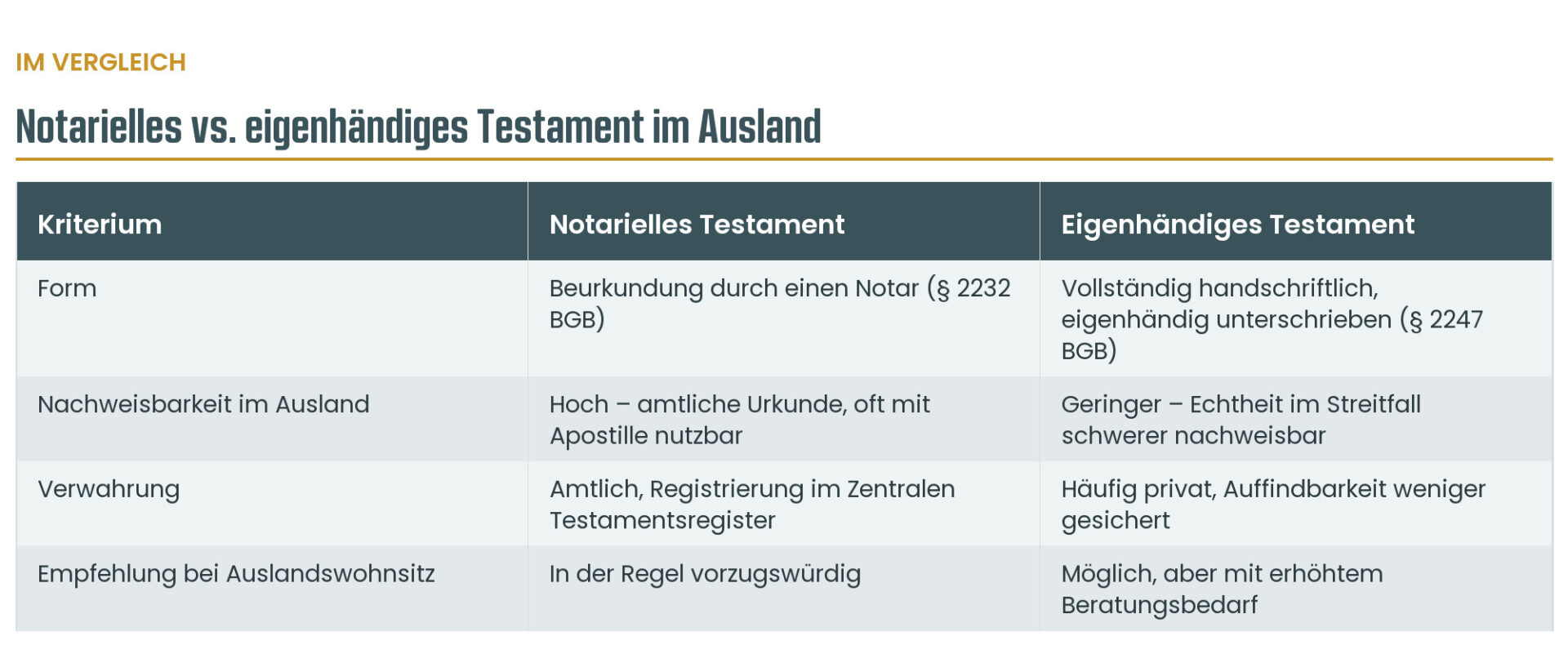
Particularly where asset situations are more complex and have a cross-border element, the greater legal certainty often favors a notarial will – combined with prior legal advice on its substantive drafting, in particular on the choice-of-law clause.
Hypothetical example for illustration (not an actual client matter): A German national draws up a holographic will under German law (§ 2247 of the German Civil Code, BGB) before moving, and subsequently relocates permanently to Spain. Years later, he dies there. The will remains formally valid because it complies with the law of his nationality at the time it was made – the Hague Convention on the Form of Testamentary Dispositions is satisfied by this single connecting factor being met, regardless of the fact that Spanish law imposes partly different requirements for holographic wills. In terms of content, however, in the absence of an explicit choice of law under Art. 22 EuErbVO, Spanish succession law applies in principle under the basic rule of Art. 21 EuErbVO, with its own rules on the “legítima” – the Spanish forced share – a result the testator may not have considered at all when the will was drawn up. This example vividly shows why formal validity and the law actually applicable must be examined separately.
Practical Recommendations for Expatriates and Entrepreneurs with Assets Abroad
The foregoing gives rise to several practical consequences for anyone planning to move abroad or already living there:
Include a choice-of-law clause early. Anyone who wants to ensure that, for example, German succession law is applied should record this expressly and in the required form in the will – not only after the move, but ideally already before or immediately after relocating.
Have existing wills reviewed after the move. A will drawn up earlier may remain formally valid while no longer suiting the new life situation in substance, for example because assets have since been acquired in a common law jurisdiction.
Consider multiple legal systems where assets are international. In particular, real estate or company shareholdings outside the EU may make an additional, country-specific testamentary disposition advisable, so as to avoid contradictory arrangements.
Seek advice before you leave. The course for your later succession situation is often already set with the decision on your new place of residence. A legal review before the move – not only afterward – creates the greatest scope for planning.
A typical example for illustration: suppose a German entrepreneur permanently relocates his habitual residence to Dubai while also holding a rented property in Germany and a securities portfolio in Switzerland. Without an express choice of law, a different legal system could, under certain circumstances, apply to his movable assets than to the German property – with the risk that the succession does not reflect his actual wishes. An early choice-of-law clause, together with testamentary drafting tailored to the individual assets, can prevent such a divergence.
Conclusion: Legal Certainty for Your Estate Begins Before You Leave
A will made while resident abroad is subject to more complex rules than a purely nationally drafted last will. The EU Succession Regulation, with its option to choose the law of one’s own nationality, offers an important planning tool, but it does not automatically resolve every question – in particular not where assets are located in non-EU states that follow the principle of scission of the estate. Formally, a will drawn up in Germany generally remains valid abroad as well, thanks to the Hague Convention on the Form of Testamentary Dispositions; in substance, however, it should nonetheless be reviewed regularly and adapted to the individual’s asset situation and place of residence.
The Fiala law firm has published extensively on international succession law and asset protection and supports clients in aligning their will with a change of residence abroad in a legally sound manner – from the choice-of-law clause to coordination with foreign assets. Feel free to contact the firm without obligation to discuss your individual situation in an initial consultation.


