

Anyone emigrating often assumes that membership in the German statutory health insurance scheme (gesetzliche Krankenversicherung, GKV) automatically ends when they move abroad. That is only true for part of the insured population – and it is precisely this grey area that leads to two typical mistakes in practice. Voluntarily insured members go on paying contributions for months or years to a fund they no longer use abroad. Alternatively, the membership is indeed terminated, but so poorly documented that it becomes unclear on what terms re-entry is possible if the person later returns to Germany. This article sets out when statutory health insurance actually ends on emigration, what form and deadlines apply to cancellation, and what to bear in mind on a later return.
The decisive first step: compulsory insurance or voluntary insurance?
Whether active cancellation is even necessary before emigrating depends largely on the insured person’s status. The law draws a clear distinction between two scenarios here.
Compulsorily insured members: membership does not simply end, but continues as an obligatory voluntary policy
For employees who are compulsorily insured, compulsory insurance formally ends, under Section 190(2) of Book V of the Social Code (Sozialgesetzbuch V, SGB V), at the end of the day on which the insurable employment relationship ends. That does not mean, however, that membership as a whole ends: since the 2013 reform, Section 188(4) SGB V provides for what is known as obligatory continued insurance (obligatorische Anschlussversicherung) – membership automatically continues as voluntary insurance if there is no other cover in the event of illness. No separate cancellation is required to end compulsory membership itself, but for that very reason it does not automatically prevent the obligation to pay contributions, which continues under the continued insurance.
Anyone who does not want this automatic transition must actively object: the health fund draws attention to the continued insurance, and a two-week objection period runs from that notice. The withdrawal only takes effect, however, once alternative cover in the event of illness is proven – for emigrants, typically foreign health insurance at the new place of residence. Anyone who emigrates and simply assumes that membership ends “automatically” on termination of the employment relationship therefore risks exactly the same outcome as voluntarily insured members: an ongoing, unwanted obligation to pay contributions to the German fund.
Voluntarily insured members: membership continues without cancellation
The position is different for voluntarily insured members – for example, the self-employed, higher earners above the annual income threshold (Jahresarbeitsentgeltgrenze), or people who opted to continue insurance voluntarily after a period of compulsory insurance ended. Under Section 191 SGB V, voluntary membership ends only on the death of the member, the start of new compulsory membership, cancellation taking effect under Section 175(4) SGB V, or – as a narrowly framed exception – retroactively after at least six months without payment of contributions, provided no benefits were claimed and the fund was unable to establish a domestic place of residence. A voluntarily insured person who emigrates and simply does nothing therefore formally remains a member – with an ongoing obligation to pay contributions, even if no benefit is ever claimed abroad.
Form and deadline for cancellation under Section 175(4) SGB V
For voluntarily insured members, the standard route is cancellation under Section 175(4) SGB V. As a rule, a minimum tie-in period of twelve months applies to the chosen health fund; after that, membership can be cancelled with effect from the end of the month after next, calculated from the month in which the cancellation is declared.
In practice, many health funds handle cancellation more generously in the case of permanent emigration, since the basis for voluntary insurance also falls away once the domestic residence ends – a shortened special right of termination with effect from the actual date of departure is common at many funds, though it is not applied uniformly and should therefore be checked in writing with the specific fund in good time. Anyone who relies solely on a general statement from a forum or comparison website risks their own fund applying a different deadline than assumed.
Cancellation itself is not tied to any particular form, but for evidential purposes should always be made in writing and should include at least the following details: full name and insurance number, planned date of departure, new country of residence, and an explicit request for written confirmation of the date of termination.
Checklist: cancellation steps when emigrating
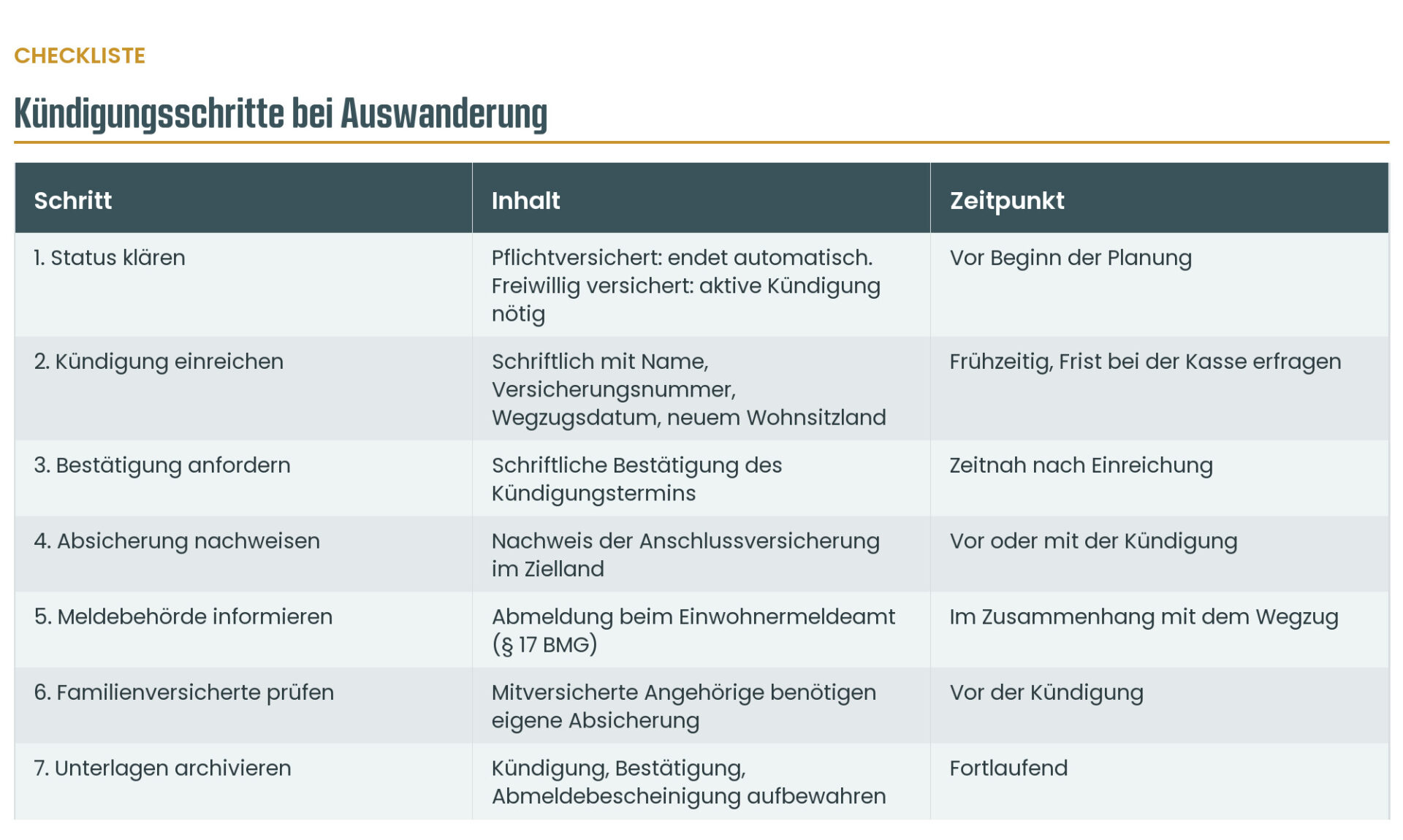
An alternative to cancellation: dormant cover (Anwartschaftsversicherung) under Section 240(4b) SGB V
Cancellation is not the only option – and for emigrants with an uncertain prospect of return, it is often not the most practical one. Contrary to a widespread assumption, dormant cover exists not only in private health insurance but also in the statutory scheme: under Section 240(4b) SGB V, a reduced contribution can be agreed while entitlement to benefits is suspended, formally maintaining the existing GKV membership without the full contribution rate falling due during the stay abroad.
The practical advantage over cancellation: on a later return, there is no need to re-examine prior insurance periods under Section 9(1) SGB V (see below), because membership was never legally interrupted – re-entry takes place without a waiting period. For stays abroad that are planned to last longer, or whose duration is still uncertain, dormant cover is therefore often the economically and legally lower-risk instrument for keeping GKV membership at a reduced cost, rather than cancelling it and having to re-establish it, with attendant risk, on return. Whether it makes sense in an individual case depends on the expected length of stay, the destination country and the personal contribution burden, and should be discussed with the health fund before departure.
Only a temporary stay abroad: membership often remains in place
Not every stay abroad amounts to emigration in the legal sense. Anyone who stays abroad only for a limited period – for example, a fixed-term sabbatical, a semester abroad, or a secondment with a firmly planned return – without permanently relocating the centre of their life, will as a rule retain voluntary GKV membership, as long as it is not actively cancelled. This has an important flip side: the obligation to pay contributions continues throughout this period, regardless of whether benefits from the German fund can actually be accessed abroad.
Within the EU, the EEA and states with social security agreements, at least limited entitlement to benefits on the spot may exist during a temporary stay via the European Health Insurance Card or corresponding reciprocal agreements. In third countries without such an agreement, however, this protection does not apply – anyone living there pays contributions to Germany without being able to access GKV benefits locally, while also having to arrange independent cover in the country of residence. This precise combination – an obligation to pay contributions without being able to use the cover – is one of the points most frequently overlooked when planning a longer stay abroad.
When exactly does habitual residence shift?
If the move takes place over more than a year and a German and a foreign home exist in parallel for a time, the point at which the centre of life shifts abroad cannot be determined schematically. Unlike in tax law, social security law has no fixed day threshold – under Section 30 of Book I of the Social Code (SGB I), an overall assessment is decisive: according to the case law of the Federal Social Court (Bundessozialgericht, BSG), a person has their habitual residence where they stay under circumstances indicating that they are not merely staying there temporarily; what matters is whether the local focus of their living circumstances is factually permanently within Germany – permanent in this sense means a stay that is not designed to end, i.e. one that remains open-ended (BSG, judgment of 30 January 2013 – B 4 AS 54/12 R). The overall assessment takes into account, alongside the predominant actual duration of the stay, whether the German home is genuinely given up or merely becomes a secondary residence, the relocation of employment and family ties, and the intention to return. Deregistration or re-registration with the residents’ registration office is only one indicator here, not decisive.
Anyone wanting to avoid double contributions should document their own case comprehensively: registration certificates from both states, evidence of termination or subletting of the German home, a foreign tenancy and employment contract, proof of border crossings or flights, and tax assessments from both states. In practical terms, it is also advisable to coordinate with the health fund before the move and, during the transitional period, to use the dormant cover described above under Section 240(4b) SGB V to keep membership suspended and low-cost rather than terminating it with attendant risk. If the health fund later classifies the turning point differently from the insured person, retrospective demands for back-payment of contributions may follow – or, conversely, claims for reimbursement; there is no settled, universally applicable formula for the exact point in time.
Important – health insurance is not the same as tax liability: In practice it is frequently confused that giving up a tax residence with the tax office and the end of habitual residence for GKV purposes are two independent assessments applying different standards, which in practice often do not fall on the same date. While social security law under Section 30 SGB I applies an overall assessment with no fixed day threshold, a tax residence (Wohnsitz) under Section 8 of the Fiscal Code (Abgabenordnung, AO) does not even require a minimum period of stay – merely keeping a usable home available is already sufficient. Habitual residence (gewöhnlicher Aufenthalt) within the meaning of Section 9 AO, in turn, has an explicit six-month threshold for a continuous stay. Anyone who bases their move solely on giving up their tax residence may still be regarded by the health fund as resident in Germany – and vice versa.
Risk of double cover and double contributions
The combination of continuing GKV membership and newly taken-out foreign health insurance creates a risk that is regularly underestimated in practice: the double obligation to pay contributions. Anyone who takes out private or local health insurance in the destination country without cleanly and verifiably ending German GKV membership effectively pays for two forms of cover in parallel – for voluntarily insured members, on the basis of the statutory minimum assessment base even where no income at all is still earned in Germany.
If contributions remain unpaid over a longer period, arrears together with late-payment surcharges may also accrue, which the health fund can, if necessary, enforce – including against people who have long since actually been living abroad. Because compulsory long-term care insurance under Section 20(3) of Book XI of the Social Code (SGB XI) is accessory to GKV membership, such arrears in practice affect both branches of insurance at once. In the event of persistent default, the fund can hand the matter to the Hauptzollamt (main customs office) as the competent enforcement authority; no blanket, reliable statement can be made about cross-border enforcement under EU law, and it depends heavily on the destination country. Importantly, to avoid unnecessary alarm: an individual insured person does not commit a criminal offence merely by failing to pay contributions – Section 266a of the German Criminal Code (Strafgesetzbuch, StGB) applies exclusively to employers who fail to remit contributions withheld from wages, not to the insured person themselves. The retroactive termination after six months without payment of contributions provided for in Section 191 No. 4 SGB V is not a reliable way out: it only applies if, in addition, no benefits were claimed and the fund, despite its efforts, was unable to establish a domestic place of residence – a narrow exception, not an arrangeable shortcut. The only legally secure approach remains active, documented cancellation confirmed by the health fund.
For completeness, a related but separate point should be briefly noted: deregistering a residence with the local residents’ registration office under Section 17 of the Federal Registration Act (Bundesmeldegesetz, BMG) does not replace cancelling health insurance, and vice versa – the two processes are handled by different authorities and must be dealt with separately. This topic is covered in detail elsewhere and is deliberately not repeated here.
Right of re-entry on returning to Germany
Anyone who moves back to Germany after years abroad faces the question of how to re-enter the GKV – and here, too, the status held before emigrating makes a considerable difference.
Former compulsorily insured members: generally unproblematic
Anyone who was last compulsorily insured and, after returning, takes up insurable employment in Germany again regularly becomes a compulsory GKV member once more without major obstacles. If, exceptionally, there is no new employment and no other cover exists either, the fallback compulsory insurance under Section 5(1) No. 13 SGB V applies as a safety net: it covers people with no other entitlement to cover in the event of illness who were last statutorily insured, thereby preventing a gap in cover on return.
For a return at a more advanced age, it should be noted that statutory pensioners’ health insurance (Krankenversicherung der Rentner, KVdR, Section 5(1) No. 11 SGB V) does not automatically apply: it requires a so-called nine-tenths prior insurance period (Neun-Zehntel-Vorversicherungszeit), which is often not met after a stay abroad that ended some time ago. In these cases, it is regularly the fallback compulsory insurance under Section 5(1) No. 13 SGB V described above that applies, not the KVdR. This prior-insurance-period hurdle only affects returnees who are close to or already entitled to a pension – for younger returnees not yet drawing a pension, the KVdR question does not arise in the first place.
Former voluntarily insured members: mind the prior insurance periods
Return is more demanding for former voluntarily insured members without new compulsory insurance. Joining voluntary insurance requires certain prior insurance periods under Section 9(1) SGB V: eligible, in particular, is anyone who was statutorily insured for at least twenty-four months in the five years before leaving compulsory insurance or family insurance, or continuously for at least twelve months immediately beforehand. Anyone who does not meet these periods – for example, because the stay abroad lasted a very long time or the last domestic insurance dates back years – may not be able to rejoin the GKV voluntarily without further ado, and instead has to rely on new insurable employment or private cover. Joining must, in principle, also be notified to the health fund within three months.
This interplay of prior insurance periods, joining deadlines and fallback provisions shows why a cleanly documented cancellation on departure is not merely a formality: it is also the foundation for being able to demonstrate one’s insurance status comprehensibly at all in the event of a possible later return.
Figures on statutory health insurance in Germany
74.63 million people were insured under the statutory health insurance scheme as of 1 January 2025 – of whom 58.69 million were contribution-paying members and 15.93 million were family members co-insured free of charge. This means the GKV covers around nine out of ten people subject to statutory health insurance obligations in Germany. *Source: German Federal Ministry of Health, KM1 statistics of statutory health insurance*
Given the scale of this membership, it is unsurprising that cancellations connected with emigration are a recurring but, relative to the total membership, statistically small matter in the administrative practice of the health funds – which is precisely why it is worth documenting your own individual case carefully rather than relying on general anecdotal reports.
Conclusion
Whether statutory health insurance actually has to be actively cancelled on emigration depends on the insured person’s status: for compulsorily insured members, compulsory membership ends with the end of employment, but without an active objection it automatically continues as voluntary continued insurance under Section 188(4) SGB V; voluntarily insured members have to cancel themselves in any case – under Section 175(4) SGB V in conjunction with Section 191 SGB V, in practice often with a shortened special right of termination offered by the respective fund, or alternatively by putting membership into dormant cover under Section 240(4b) SGB V. Anyone who misses this step, or only deals with it verbally, risks double obligations to pay contributions and uncertainty on later re-entry. Anyone who instead cancels in writing early on, has the termination confirmed, and keeps an eye on their own prior insurance periods lays the groundwork for a legally secure exit – and, in the event of a return, for an equally smooth re-entry.
Individual advice on cancelling statutory health insurance
The right approach depends heavily on the individual case – from the insured person’s status, through the destination country, to a possibly already concretely planned return to Germany. The law firm of Rechtsanwalt Johannes Fiala, which focuses on international social security and tax law, helps clients structure the cancellation of statutory health insurance in a legally secure way and clarify possible follow-up questions at an early stage. If you have any uncertainty about your personal situation, please get in touch with the firm in good time.


