

Relocating a company’s registered office abroad is a question that has long since ceased to concern only large corporations. Sole traders, freelancers, and partners in partnerships are increasingly examining whether a change of location makes economic sense as well. Unlike a pure GmbH relocation, where company-law questions such as the real seat theory and the incorporation theory take centre stage, it is generally something else that decides success or failure on the fundamental business question of “relocating the company’s registered office”: the overall tax consequences. Anyone who underestimates these risks a substantial, often unexpected tax burden – regardless of whether the business is organised as a sole proprietorship, a partnership, or a corporation. This article sets out the key tax considerations and provides a checklist for practical implementation.
Who Is Affected? Not Only the GmbH
Relocating the registered office of a company raises very different tax issues depending on the legal form under which the business is conducted:
- Sole proprietorships: here, relocating the business generally coincides with the entrepreneur’s own emigration. What matters for tax purposes is where the permanent establishment will in future be located, and whether any connecting factor to Germany remains.
- Partnerships (GbR, OHG, KG): taxation is transparent at the level of the partners. Where the partnership relocates its registered office, the tax consequences must, in principle, be considered separately for each partner – depending on their residence and shareholding.
- Corporations (GmbH, UG, AG): here, two levels must be distinguished – the company itself and the shareholders personally. Both can trigger tax consequences independently of one another.
Whether a company continues to exist in its previous legal form in the destination state at all after the move depends additionally on international company law – keywords being the real seat theory, the incorporation theory, and the relevant case law of the European Court of Justice. This company-law dimension is particularly relevant for a GmbH and is examined in more depth in a separate article on relocating a GmbH’s registered office abroad. This article, by contrast, focuses on the tax side of the location decision, which applies to all legal forms.
The Four Core Tax Consequences at a Glance
1. Exit Taxation of Hidden Reserves
Where Germany loses its taxing right over the hidden reserves (stille Reserven) of an asset as a result of relocating the company’s registered office – for example because a machine, stock of goods, customer base, or patent leaves the country without a domestic permanent establishment remaining – so-called exit taxation of assets (Entstrickungsbesteuerung) applies. The legal basis is Section 4(1), third and fourth sentences, of the German Income Tax Act (Einkommensteuergesetz, EStG) – § 4 Abs. 1 Satz 3 und 4 EStG – for sole proprietorships and partnerships, and the corresponding provision in Section 12(1) of the German Corporation Tax Act (Körperschaftsteuergesetz, KStG) – § 12 Abs. 1 KStG – for corporations. In both cases, the transfer of the asset abroad is treated as a notional disposal at fair market value – even though no actual sale, and therefore no liquidity inflow, takes place. Particularly for businesses with high intangible values (brand, customer base, software, goodwill), this can result in a considerable tax burden falling due immediately.
An important relief applies to the relocation of individual assets to a permanent establishment within the EU or the EEA: under Section 4g EStG – § 4g EStG – a compensatory item can, on application, be created that spreads the exit taxation gain evenly over five financial years, instead of taxing it immediately in full. For a relocation to a third state outside the EU/EEA, this option to spread the tax generally is not available – the tax then falls due in full in the year of relocation.
2. Exit Taxation of Shareholders (Corporations Only)
Where a natural person with a substantial shareholding in a corporation (from 1 percent) relocates their residence abroad, Section 6 of the German Foreign Tax Act (Außensteuergesetz, AStG) – § 6 AStG – additionally applies. The shareholding is then treated as having been sold at market value, even though no sale has taken place. Since the Act implementing the EU Anti-Tax Avoidance Directive (ATAD-Umsetzungsgesetz), the previously available unlimited, interest-free deferral no longer applies; the tax generally falls due, but can, under certain conditions, be paid in instalments. For 2026, the Federal Ministry of Finance has additionally introduced a new electronic reporting form (“ASt – notification under § 6 AStG”), which formalises the reporting and evidencing obligations on emigration and enables the tax administration to record emigration cases more systematically.
3. Loss of German Trade Tax – And What Follows
Liability to trade tax (Gewerbesteuer) in Germany is linked to the existence of a domestic permanent establishment (§ 2 GewStG – § 2 GewStG). Where the company’s registered office is fully relocated and no permanent establishment remains in Germany, the substantive liability to trade tax ends as from the date of relocation. This sounds at first like a relief, but does not automatically mean a lower overall tax burden: comparable local business taxes frequently apply in the destination country, differing in level and basis of calculation from German trade tax. Where only part of the business is relocated and permanent establishments remain in several German municipalities, the trade tax apportionment under Sections 28 et seq. GewStG – §§ 28 ff. GewStG – also changes: the trade tax assessment amount is then apportioned pro rata among the remaining locations.
4. VAT Registration Obligations in the New Seat State
An aspect that is regularly underestimated in practice: as soon as a permanent establishment or place of management relevant for VAT purposes arises in the destination country, a separate VAT registration is generally required there – regardless of any continuing registration in Germany. Where goods or fixed assets are moved from Germany to another EU state as part of the relocation, this is treated for VAT purposes as a so-called intra-Community transfer: it is treated as a VAT-exempt intra-Community supply in Germany and, mirroring this, as an intra-Community acquisition in the destination country (Section 3(1a) of the German VAT Act (Umsatzsteuergesetz, UStG) – § 3 Abs. 1a UStG). This requires a valid VAT identification number in the destination country and a correctly filed EC Sales List (Zusammenfassende Meldung) – oversights here quickly lead to formal objections, even where, economically, no “sale” has taken place.
The Permanent Establishment Problem: When Does a Tax Connecting Factor Remain in Germany?
A full relocation is only given for tax purposes where no permanent establishment within the meaning of Section 12 of the German Fiscal Code (Abgabenordnung, AO) – § 12 AO – or of the relevant double taxation agreement, actually remains in Germany. In practice, however, a remnant frequently remains: a stock of goods, a sales employee with authority to conclude contracts, a server, or even just an office that continues to be used. Each of these connecting factors can establish a domestic permanent establishment – with the result that Germany retains a (proportionate) right to tax, and an allocation of permanent establishment profits under the relevant DBA becomes necessary. Anyone who does not draw a clean line here risks a duplicate obligation to keep accounts and file returns in two states, without this automatically avoiding double taxation.
Also to be examined is the so-called controlled foreign company taxation (Hinzurechnungsbesteuerung) under Sections 7 et seq. of the German Foreign Tax Act (Außensteuergesetz, AStG) – §§ 7 ff. AStG: where the foreign company becomes resident in a state with a tax burden on profits below 15 percent and earns predominantly passive income, its profits can, under certain conditions, still be attributed proportionately to the German shareholder as their own income – in which case the hoped-for tax relief falls away in whole or in part.
Destination Countries: What Matters for the Tax Choice of Location
When choosing the destination state, three factors are chiefly relevant from a tax perspective: the existence of a double taxation agreement with Germany, the level of the local tax burden on profits in relation to the low-tax threshold under Section 8(5) AStG – § 8 Abs. 5 AStG – and whether genuine economic substance can, and is intended to, be built up in the destination country. Serbia, for example, is among the countries offering a robust structure for business relocations: a double taxation agreement with Germany exists, the corporate income tax rate is 15 percent and thus at the threshold of the AStG low-tax rule, which generally does not trigger controlled foreign company taxation. Such framework conditions are purely factual matters to be assessed; whether a destination country is suitable in an individual case always depends on the specific corporate structure, the substance planned locally, and the shareholders’ personal circumstances.
Facts and Figures: How Many Businesses Actually Relocate?
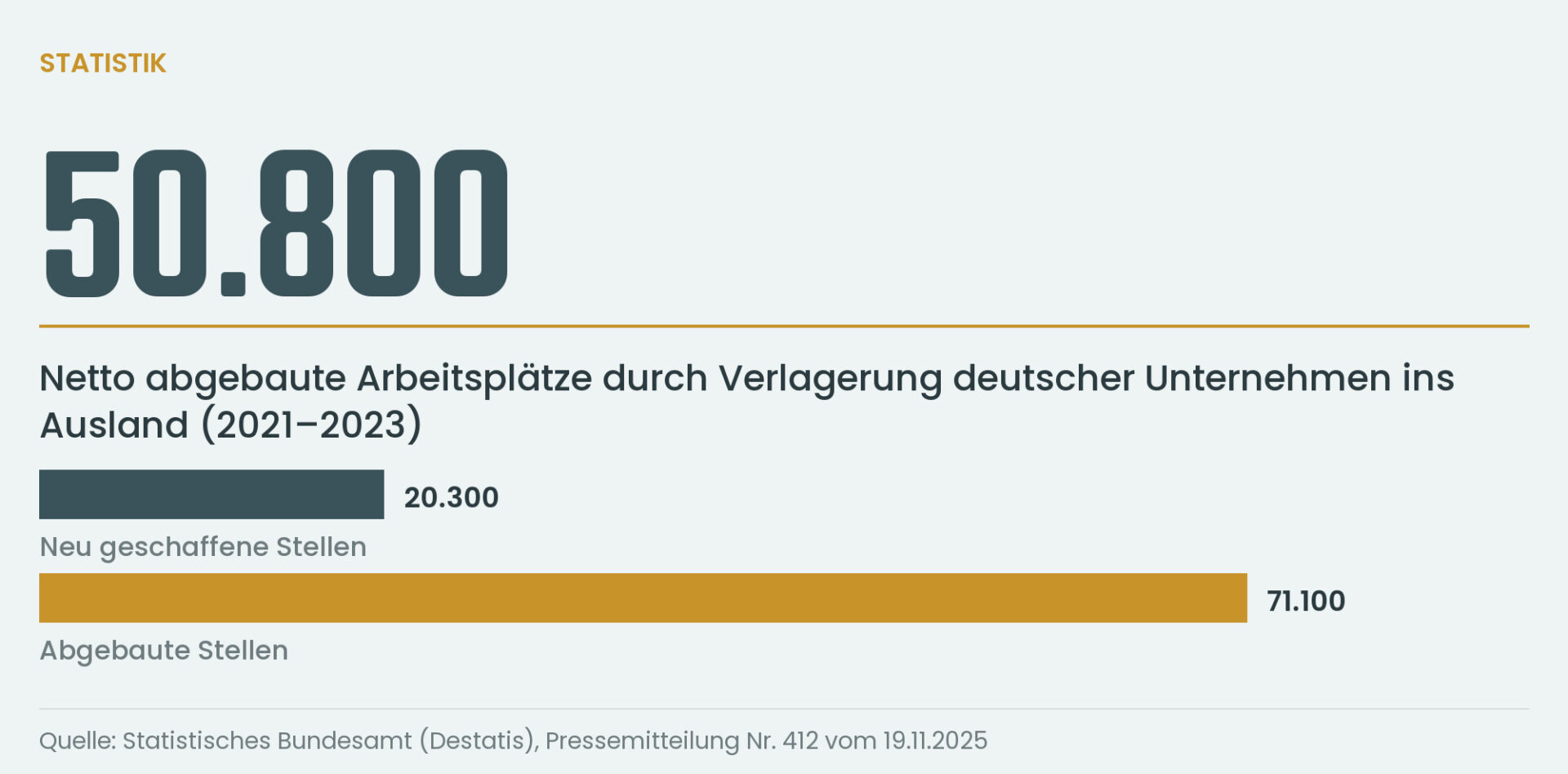
Between 2021 and 2023, around 1,300 German businesses with 50 or more employees relocated business functions wholly or partly abroad – corresponding to a relocation rate of 2.2 percent within this size category. Of these, 900 businesses chose a destination within the EU, and 700 a location outside the EU; the subtotals overlap, since some businesses relocated both within and outside the EU and are therefore counted in both figures.
Checklist: Tax Steps When Relocating a Company’s Registered Office
| Step | Content | Typical timing |
|---|---|---|
| 1. Legal form and seat analysis | Clarify which levels (company/shareholders) are affected | Before planning begins |
| 2. Valuation of hidden reserves | Determine the exit taxation gain under § 4(1) EStG / § 12 KStG | 6–12 months before the move |
| 3. Review of § 4g EStG | Apply for a compensatory item on relocation within the EU/EEA | In the year of relocation |
| 4. Shareholder exit taxation | Calculate under § 6 AStG, examine instalment payment, prepare the ASt notification | Before the change of residence |
| 5. Trade tax deregistration/apportionment | Notify the tax office and municipality, apportion in the case of partial relocation | On completion of the relocation |
| 6. VAT registration | Apply for a VAT ID in the destination country, document the intra-Community transfer | Before moving goods |
| 7. Permanent establishment review | Identify remaining domestic connecting factors and clarify DBA allocation | Ongoing |
| 8. Review of controlled foreign company taxation | Compare the destination country’s tax burden against the 15 percent threshold under § 8(5) AStG | Before choosing the destination state |
| 9. Reporting obligations to the tax office | Notification of foreign relations under § 138 AO, 2026 ASt notification | After completion |
| 10. Coordination with foreign advice | Coordinate reporting obligations in both states | Ongoing |
Hypothetical Example
Purely for illustration, with no connection to an actual client matter: a sole trader operates an online retail business with their own stock of goods in Germany and is considering relocating both residence and stock of goods entirely to another EU state. Without a prior review, they would overlook the fact that the hidden reserves tied up in the stock of goods can trigger exit taxation, that moving the goods requires VAT registration in the destination country, and that a remaining German returns warehouse can continue to establish a permanent establishment. Only advance tax planning – including examining a compensatory item under § 4g EStG – makes the move calculable.
Conclusion
Anyone wishing to relocate their company’s registered office abroad should factor in the tax consequences from the outset, not only after the move – regardless of whether the business is a sole proprietorship, a partnership, or a corporation. Exit taxation of assets, exit taxation of shareholders, the loss of German trade tax, and new VAT registration obligations in the destination country frequently apply simultaneously, and can only be properly managed through coordinated planning on both sides of the border.
Johannes Fiala, lawyer, and the firm, with a focus on international tax and company law in Munich, support entrepreneurs in the tax planning of a relocation of their company’s registered office abroad – from valuing hidden reserves to coordinating with foreign tax advice. Please feel free to contact the firm on a non-binding basis to discuss your plans in an initial consultation.


