

Anyone who inherits assets abroad, or who owns assets abroad that are later meant to pass to heirs in Germany, frequently encounters a problem that is easily underestimated in international tax law: for inheritance tax, no double taxation agreement (Doppelbesteuerungsabkommen, DBA) exists between Germany and most countries in the world. Unlike income tax, where Germany has concluded such agreements with well over 90 countries, only a handful of standalone agreements exist in the field of inheritance and gift tax. For all other countries, the only remaining option is generally the unilateral crediting of foreign tax under Section 21 of the German Inheritance and Gift Tax Act (Erbschaftsteuer- und Schenkungsteuergesetz, ErbStG) – § 21 ErbStG – a mechanism that prevents genuine double taxation only to a limited extent and is subject to a narrow time limit. This article sets out which countries actually have an inheritance tax double taxation agreement with Germany, what applies to all other countries, and what practical points must be considered in a cross-border inheritance case.
Why There Are So Few Double Taxation Agreements for Inheritance Tax
In international tax law, it is often assumed that an existing double taxation agreement with a given country automatically also covers inheritance tax. This is a misconception. Most of Germany’s numerous double taxation agreements govern only taxes on income and on capital – not inheritance and gift tax. For that area, a separate, independently negotiated agreement is required.
There are several reasons why so few such agreements exist. First, a number of countries levy no inheritance tax at all, or no comparable system, so that from their perspective there is no need to negotiate. Second, national inheritance tax systems differ so substantially from one another – for example, on the question of whether tax liability attaches to the deceased’s place of residence, the heir’s place of residence, or the location of the assets – that coordination is considerably more complex than for income tax. The result: while Germany’s network of income tax agreements is nearly comprehensive, its network of inheritance tax agreements remains patchy.
These Countries Have an Inheritance Tax Double Taxation Agreement with Germany
Facts and figures: Germany currently has a standalone double taxation agreement in the field of inheritance and gift tax with only six countries – compared with well over 90 double taxation agreements in the field of income tax. Put differently: a genuine, treaty-based avoidance of double taxation on inheritance is provided for only a handful of countries; for all other countries – including many popular emigration destinations and second-home countries – no such network exists.
The countries with an inheritance tax DBA include the United States, Switzerland, France, Sweden, Greece, and Denmark. The following overview places this in context:
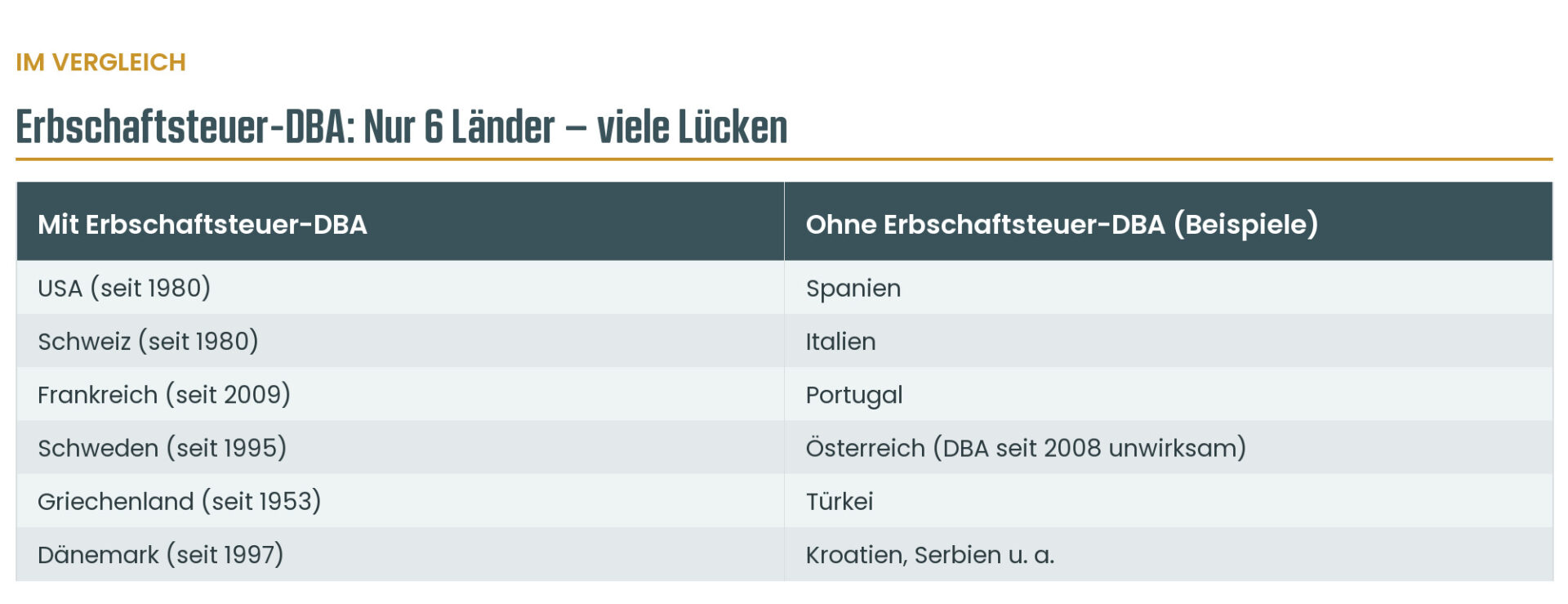
The right-hand column is particularly noteworthy: many countries with which Germany is closely linked economically and personally – for example through holiday properties, emigration, or family ties – have an income tax double taxation agreement but no separate agreement for inheritance tax. This affects, for example, assets in countries such as Serbia: while an agreement for the avoidance of double taxation on income and capital exists with Serbia (as the legal successor state to the former agreements with Yugoslavia), it does not extend to inheritance and gift tax. For inheritance cases involving assets connected to Serbia – as with numerous other countries without a standalone inheritance tax DBA – attention must therefore turn to Germany’s unilateral crediting rule.
What Applies for Countries Without an Inheritance Tax DBA? Unilateral Crediting under § 21 ErbStG
The absence of a double taxation agreement does not necessarily mean that a double tax burden must simply be accepted in full. German law provides, in § 21 ErbStG, a one-sided – unilateral – substitute mechanism: the crediting of foreign inheritance tax against German inheritance tax.
In essence: if a beneficiary subject to unlimited inheritance tax liability in Germany is also assessed abroad, in respect of their foreign assets, to a tax corresponding to German inheritance tax, they may apply to have the foreign tax credited against the German inheritance tax, provided that tax has been assessed, is attributable to them, has actually been paid, and is no longer subject to any right of reduction. This provides relief only to the extent that German inheritance tax is actually attributable to the foreign assets concerned – and no further.
Important practical limits of this mechanism:
- Credit limited to the proportionate German tax. The foreign tax is not refunded or credited in full, but only up to the amount that, under German law, is proportionately attributable to the foreign assets. If the foreign tax burden exceeds the proportionate German tax, the difference generally remains uncredited.
- Credit only upon application. Unlike under a DBA, relief is not granted automatically; it must be actively applied for with the competent tax office and substantiated with documentation of the foreign tax assessment – where applicable, with a certified translation.
- Only for “comparable” foreign taxes. The foreign levy must correspond, in nature, to German inheritance tax. Where foreign tax systems differ substantially, this comparability itself can already be disputed.
The Five-Year Time Limit: A Practical Trap
One of the requirements most frequently overlooked in practice is the time limit built into § 21 ErbStG: the foreign tax can only be credited if the German inheritance tax for the foreign assets concerned arose within five years of the foreign inheritance tax arising.
This time limit appears unremarkable but can prove to be a trap in several respects. If a foreign probate or tax assessment procedure – for example because of complex land registry or probate proceedings abroad – drags on for several years, the deadline may expire before the foreign tax has even been finally determined and paid. Staggered or subsequently amended foreign tax assessments can likewise make the timing difficult to allocate correctly. Anyone who does not prepare for this at an early stage risks losing the ability to obtain a credit despite having actually paid the foreign tax – resulting in genuine, no-longer-correctable double taxation.
Practical Example: A Deceased with Assets in a Country Without an Inheritance Tax DBA
Hypothetical example for illustration purposes (not an actual client situation): A deceased person resident in Germany leaves their heirs, who live in Germany, not only domestic assets but also a property and a bank balance in a country with which Germany has no inheritance tax double taxation agreement – for example, Serbia or another Balkan country. Under German law, the heirs are subject to unlimited inheritance tax liability and must, in principle, pay tax in Germany on their entire worldwide acquisition, including the foreign property and balance. At the same time, the country where the assets are located levies its own inheritance-tax-like charge on the same property and the same balance under its own law.
In the absence of a double taxation agreement, only § 21 ErbStG applies here: the heirs can apply to have the tax actually assessed and paid abroad credited – limited to the amount that, under German law, is proportionately attributable to the foreign assets, and only if the German tax arises within the five-year time limit. If the foreign tax exceeds the creditable German portion, or if the deadline is missed, an economic double burden remains.
Purely to illustrate the calculation mechanism, without claiming to reflect any actual case: if a certain proportion of the total German inheritance tax is mathematically attributable to the foreign assets, because those assets make up a corresponding share of the total taxable acquisition, then at most this proportionate German amount can be offset by the tax actually paid abroad – not the full amount paid abroad, and no more than the German tax that would in any case be attributable to precisely these assets. If the foreign tax burden exceeds this proportionate German amount – for instance because the country where the assets are located applies higher rates or lower allowances – the difference remains an economic burden on the heirs. This example shows that inheritance cases involving assets in non-DBA countries – a group that extends far beyond exotic destinations and also includes, for example, popular holiday and emigration countries as well as countries such as Serbia – require careful, early tax planning.
Approaches to Avoiding or Mitigating Double Taxation
Even without a double taxation agreement, the risk of genuine double taxation can, in many cases, at least be mitigated through early planning:
- Review of the foreign legal position. It is worth examining not only the German side but also whether the foreign country, for its part, provides for a credit of the German tax or other relief mechanisms.
- Managing the timing of proceedings. Where legal scope exists, deliberately managing the proceedings can help meet the five-year time limit under § 21 ErbStG – for example, through prompt applications and documentation abroad.
- Complete documentation. Since the credit is granted only upon application and against evidence, foreign tax assessments, proof of payment, and, where applicable, certified translations should be carefully preserved from the outset.
- Lifetime structuring instead of pure estate administration. In some situations, addressing the cross-border asset structure early, during the owner’s lifetime – for example through a will, an inheritance contract (Erbvertrag), or anticipated succession of assets – can help make the tax consequences of a later inheritance more transparent and allow them to be reviewed in good time.
These measures are no substitute for individual legal advice, but they show that the absence of an agreement does not automatically result in full double taxation if those involved act in good time.
When Is Legal Advice Worthwhile?
Whether an inheritance tax double taxation agreement exists for a particular country can, admittedly, be established by checking a list. The real challenge, however, lies in applying the rules to the individual case: How is the foreign asset to be valued? Which foreign tax is specifically creditable? How can the five-year time limit be met? And what evidence does the competent German tax office specifically require? Particularly where assets are located in countries without a standalone inheritance tax DBA – for example, in many southern and southeastern European countries – this review should not be left until after the inheritance has occurred, but should, wherever possible, already form part of forward-looking estate planning.
Johannes Fiala is an attorney with experience in international inheritance tax matters and in advising on cross-border assets. The firm, which focuses on international tax and inheritance law, helps clients accurately classify their personal asset situation with a foreign connection and identify potential double taxation risks at an early stage.
Have you inherited assets abroad, or are you planning to arrange your estate with a foreign connection? Contact the Fiala law firm to have your individual situation assessed from a legal perspective before deadlines expire or foreign tax assessments become final.


