
The laptop fits in any suitcase, and video calls work just as well with a view of palm trees or mountains – so more and more employees are asking their German employer whether they can work from abroad for a few weeks or months. What sounds at first like a minor organisational detail raises two legally separate questions: where must the salary be taxed if the work is no longer performed in Germany but abroad? And is the employer actually entitled to allow – or to refuse – working from home abroad?
This article consistently frames both questions from the perspective of an employed member of staff who continues to work for their German employer – not from the perspective of the self-employed or business owners, to whom different tax principles apply. One key point up front: the so-called 183-day rule decides, in many double taxation treaty (Doppelbesteuerungsabkommen, DBA) cases, whether the right to tax exceptionally remains with Germany despite the work being carried out abroad – if the stay in the state of work remains under 183 days within a twelve-month period and further conditions are met, this reverse exception to the otherwise applicable place-of-work principle applies. It is only briefly outlined below; a detailed treatment can be found in a separate article on this blog. Social security is also only touched on here, since it follows its own rules, which are covered in a separate article.
The basic principle: the place-of-work principle governs the right to tax
Anyone with a residence or habitual abode in Germany generally remains subject to unlimited income tax liability there – even during a stay abroad. That does not automatically mean, however, that Germany also retains the right to tax the specific salary earned. If a double taxation treaty exists with the country where the work is carried out, that treaty determines which state may tax the income from employment.
The place-of-work principle under Article 15 of the OECD Model Convention
Most German double taxation treaties follow the basic structure of the OECD Model Tax Convention. Under Article 15(1), the right to tax income from employment generally belongs to the state in which the work is actually physically carried out – the so-called place-of-work principle. The location of the employer’s registered office or the employee’s nationality is initially irrelevant. Anyone who works for several weeks from a holiday flat in Spain is, during that period, physically performing their work in Spain – with the result that, under the basic principle, Spain can claim the right to tax the salary attributable to that period.
The 183-day reverse exception in overview
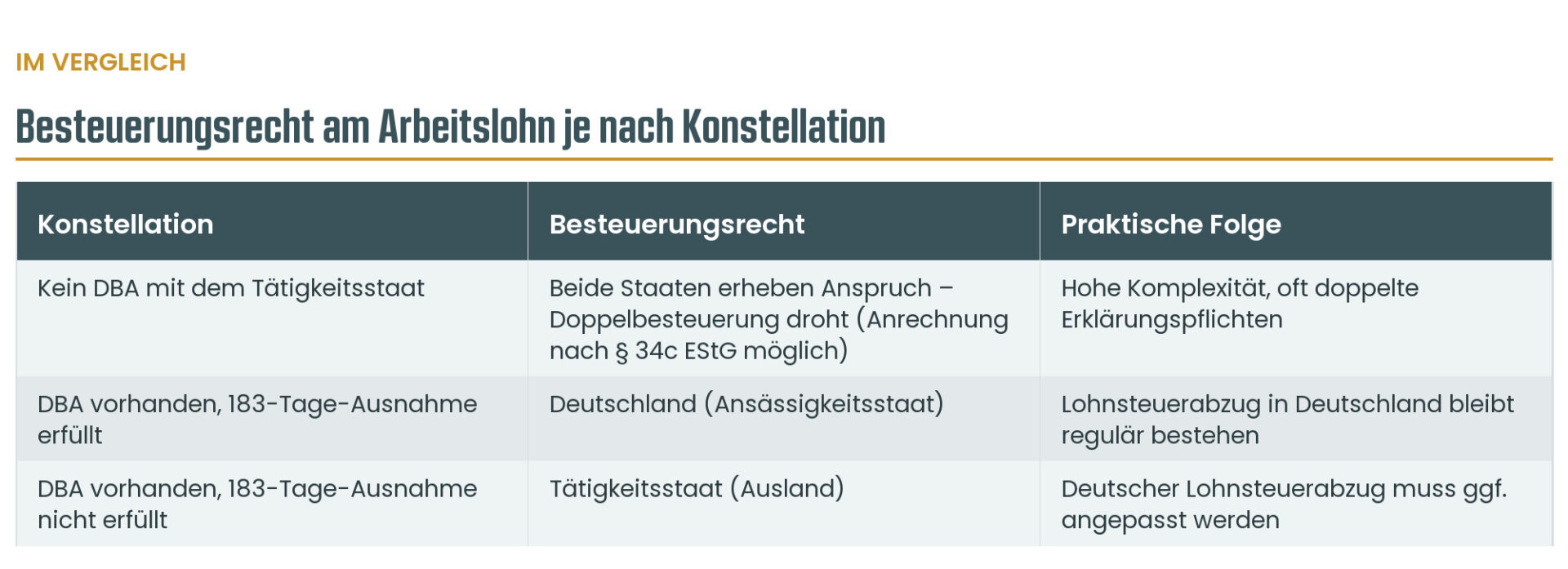
There is a practically significant reverse exception to this principle, contained in most German double taxation treaties in line with Article 15(2) of the OECD Model Convention: if three conditions are met cumulatively – a stay in the state of work of no more than 183 days within a twelve-month period, salary paid by an employer not resident in the state of work, and no cost-bearing by a permanent establishment there – the right to tax exceptionally remains with the state of residence, generally Germany. How these three conditions are to be assessed in detail, and which pitfalls apply, is covered at length in the companion article on the 183-day rule on this blog.
The German employer’s obligation to withhold wage tax initially continues
One point is frequently underestimated in practice: if the right to tax shifts abroad under the double taxation treaty, the German employer’s obligation to withhold wage tax (Lohnsteuer) does not automatically cease. Under Section 38 of the German Income Tax Act (Einkommensteuergesetz, EStG), a domestic employer is in principle obliged to withhold and remit wage tax for every employee – regardless of whether the work is performed in Germany or abroad. This obligation initially continues unchanged, even if, under the applicable double taxation treaty, the right to tax has materially passed to the foreign state of work.
For the employer to be allowed to stop withholding wage tax in such a case, an exemption certificate (Freistellungsbescheinigung) must be applied for from the competent tax office responsible for the employer’s place of business. This application can in principle be made by the employer, but in practice it is often only initiated once the employee themselves takes action and points out the changed tax position. If no application is made, the full German wage tax deduction initially continues – the correction is then only made retrospectively via the income tax return, which can temporarily leave the employee facing a double economic burden and a tied-up liquidity disadvantage until the refund is made.
In practice, this means for employees: anyone working regularly, or for longer periods, from abroad should take action themselves as soon as it becomes apparent that the 183-day exception is unlikely to apply – rather than relying on HR to check the treaty position of its own accord.
Employment law permissibility: must the employer allow working from home abroad?
Alongside the tax side, an equally practically relevant question arises: does an employee actually have the right to work from abroad – or can the employer simply refuse?
No statutory entitlement, but no unilateral instruction either
There is no general statutory entitlement to work from home in Germany, let alone to work from home abroad. The place of work is in principle part of the employment contract, or is subject to the employer’s right of direction under Section 106 of the German Trade, Commerce and Industry Regulation Act (Gewerbeordnung, GewO) – but this right of direction typically only covers specifying details within the originally agreed framework, not unilaterally relocating the work abroad. Conversely, an employer cannot unilaterally relocate an existing domestic home-office arrangement abroad by virtue of its right of direction either. Working from abroad therefore regularly requires an explicit, ideally written, agreement between both parties – the employer is in principle free to refuse it, for example on tax, social security or data protection grounds.
Recent case law: why a simple choice-of-law clause is not enough
A recent decision of the Federal Labour Court (Bundesarbeitsgericht, BAG) shows how important careful contractual drafting is (BAG, judgment of 19 March 2026, case no. 2 AZR 53/25). In that case, an employee had worked continuously from abroad for their German employer for several years; the employment contract contained only the brief clause that German law applied to the employment relationship. The BAG declared this clause invalid because, measured against the requirements of Article 8 of the Rome I Regulation, it was not sufficiently transparent. Specifically, the clause lacked any indication that, despite the choice of law, the mandatory protective provisions of the law that would otherwise apply – i.e. the law that would apply without the choice of law – continued to exist. Instead, it created the impression that German law alone applied. Because the employee’s habitual place of work had in fact permanently shifted abroad, foreign employment law ultimately applied.
For employees with a permanent or recurring home office abroad, this means: a blanket clause in the employment contract is not enough to create clarity about the applicable employment law. Under Article 8 of the Rome I Regulation, in the absence of an effective choice of law, the law of the state in which the work is habitually carried out remains in principle decisive – and this habitual place of work can genuinely shift as a result of long-term home working abroad, even if the contract continues to be drafted in German and the employer is based in Germany.
| Point to regulate in a home-office-abroad agreement | Why it matters |
|---|---|
| Exact duration and time limit of the stay abroad | Relevant to the 183-day assessment and employment law classification |
| Transparent choice-of-law clause under Article 8 Rome I Regulation | Avoids invalidity as in the BAG case of March 2026 |
| Revocation and return arrangements | Clarifies how and when the agreement can be ended |
| Competent tax office and notification duties | Basis for an exemption application if the right to tax changes |
| Provision on social security/A1 certificate | Avoids gaps in insurance cover |
| Cost allocation (equipment, insurance, travel) | Avoids later disputes over responsibilities |
Social security: a brief note only
Tax residence and social security responsibility follow different rules and by no means automatically coincide. Within the EU, the EEA and Switzerland, Regulation (EC) No. 883/2004 takes precedence for social security, documenting via the A1 certificate, among other things, which system an employee remains insured under during a stay abroad. Because this body of rules has its own deadlines, notification duties and exceptions that do not align with the tax 183-day assessment, this area is deliberately only touched on here – a more in-depth treatment can be found in a separate article on social security during work abroad on this blog.
How widespread is working from home abroad in practice?
Figures on the practice: According to the 2024 Workation Study by PwC Germany, 64 percent of employees surveyed describe themselves as generally open to workations. Around 51 percent said they could at least occasionally work from abroad – on average 40.5 days a year. For 57 percent of respondents, a workation offer is now an important criterion when choosing an employer. These figures show that the tax and employment law questions described in this article are no longer confined to a rare exceptional situation, but affect a growing share of the German workforce.
An illustrative example (hypothetical)
For illustration, a purely hypothetical example not based on any real case: an employee of a Munich-based company agrees with her employer to work for twelve consecutive weeks from a flat in Croatia, while retaining her residence in Germany. Because her stay is well under 183 days, her salary continues to be paid by the German employer and is not borne by a permanent establishment in Croatia, the right to tax for this period remains with Germany – the normal wage tax deduction continues unchanged. The position would be different if she repeated this arrangement over several years or worked from there permanently: then both the right to tax and – as the BAG case of March 2026 shows – the applicable employment law could shift, even though the employment contract still provides for German law.
Such situations naturally are not confined to classic workation destinations within the EU. Germany also has double taxation treaties with numerous states outside the EU, for example in the Western Balkans with Serbia, where the continuing German-Yugoslav treaty of 1987 still applies. Whether and how the right to tax shifts in such a third country must be examined in the individual case by reference to the specific treaty text, since wording and exceptions can vary from treaty to treaty.
Practical recommendations for employees
- Before agreeing to it, clarify whether and for how long the 183-day exception is likely to apply in the specific destination country
- Conclude a written home-office-abroad agreement with the employer, rather than relying on a verbal understanding
- Have the choice-of-law clause in the employment contract checked against the transparency requirements of Article 8 of the Rome I Regulation
- If a change in the right to tax is foreseeable, apply early for an exemption certificate from the tax office responsible for the employer’s place of business, rather than relying on the later tax return
- Clarify the social security side (A1 certificate) separately from the tax assessment
- For recurring or longer-lasting stays abroad, reassess the overall situation regularly rather than relying on a one-off assessment
Conclusion
Working from home abroad is not a purely organisational matter for employees, but touches on two legally separate levels: the right to tax the salary, which under the place-of-work principle generally belongs to the state of work unless the 183-day exception applies – and the employment law question of which law governs the employment relationship at all once the habitual place of work permanently shifts abroad. Anyone who regulates both levels cleanly by contract from the outset, rather than relying on blanket clauses or verbal assurances, avoids both unexpected tax burdens and employment law surprises such as those seen in the BAG case of March 2026.
Individual advice on working from home abroad
Every home-office-abroad situation must be assessed differently depending on the destination country, the length of the stay, the applicable double taxation treaty and the specific contractual arrangement. The law firm of Rechtsanwalt Johannes Fiala, which focuses on international tax and employment law, helps employees realistically assess their tax and employment law position before working from home abroad and secure it contractually. If you have any uncertainty about your specific case, please get in touch with the firm in good time to discuss your individual situation.


