
Anyone emigrating thinks about visas, taxes, and finding a place to live – very few people think about a will. Most people simply assume that, in a worst-case scenario, “German inheritance law” will apply anyway, the way they remember it from stories told by parents or grandparents: the surviving spouse inherits half, the children share the rest, and that is that. Since 2015, however, this assumption has in most cases no longer been correct. Anyone who permanently relocates their habitual residence abroad and dies without having made a will is, as a general rule, no longer subject to German inheritance law, but automatically to the statutory inheritance law of their new country of residence – with sometimes considerable differences in inheritance shares, in the legal position of the surviving spouse, and even in the question of whether a spouse becomes an owner of the couple’s house at all. This article explains which mechanism applies automatically when no estate planning has been undertaken – and why it is worth examining the statutory rules of succession even before the question of a will becomes relevant.
The Basic Rule Since 2015: Habitual Residence Is Decisive, Not Nationality
Until 16 August 2015, a different principle applied in Germany: under the former version (alte Fassung, a. F.) of Article 25 of the Introductory Act to the German Civil Code (Einführungsgesetz zum Bürgerlichen Gesetzbuche – EGBGB), succession was generally governed by the nationality of the deceased. A German national therefore passed on their estate under German law – regardless of where they had last lived.
Since the EU Succession Regulation (Regulation (EU) No. 650/2012, commonly abbreviated as EuErbVO) entered into force, a different connecting factor has applied across Europe: under Article 21 EuErbVO, the law generally applicable to the entire estate is the law of the state in which the deceased had their habitual residence at the time of death. Nationality therefore, as a general rule, no longer plays any role for the purposes of statutory succession. The Regulation applies directly in almost all EU member states – only Denmark and Ireland do not take part in it.
What “Habitual Residence” Actually Means
What matters here is not the address registered with the local residents’ registration office, but the actual centre of a person’s life: where did they predominantly live, work, and maintain their social and family ties? A holiday home in Italy or a second residence in Austria does not, on its own, establish habitual residence. By contrast, anyone who lives and works continuously in another country for several years has, as a general rule, moved their habitual residence there – even if they remain formally registered in Germany or keep their German passport. For people who commute between several countries or work location-independently, determining habitual residence can be difficult in an individual case; a separate legal assessment is often worthwhile here.
What Happens Automatically If There Is No Will?
If there is no will and no choice of law, the statutory succession rules of the state of residence apply automatically – and, in principle, uniformly to the entire estate (the so-called unity of succession, or Nachlasseinheit), regardless of whether it involves a bank account, real estate, or a company interest, and regardless of which country the respective asset is located in. The division between movable and immovable property that used to be recognised in German private international law (known as Nachlassspaltung, or splitting of the estate) has, in principle, been abolished by the EuErbVO within its scope of application.
In practice, this means that anyone who, for example, moves their habitual residence to Spain and dies there without a will, leaves their entire estate – including any property still located in Germany – to be distributed, in principle, under Spanish statutory inheritance law. As shown below, this can produce a result that has little to do with what those involved actually expected.
Exception: the “Manifestly Closer Connection”
Article 21(2) EuErbVO provides for a narrow exception: if it is clear from all the circumstances that, at the time of death, the deceased was manifestly more closely connected with another state, the law of that other state applies instead, by way of exception. The courts interpret this exception narrowly, and it only applies in special constellations – for instance, where a move took place only shortly before death while close ties to the country of origin persisted. Anyone who wishes to rely on such an exception should not leave it to chance, but should have their situation assessed by a lawyer in advance.
Statutory Succession Is Not the Same Everywhere: A Country Comparison
The term “statutory succession” suggests a certain degree of uniformity – yet the statutory inheritance shares, and even the type of inheritance right involved (full ownership or a mere usufruct), differ considerably from country to country. The overview below shows, in simplified form, just how differently the position of the surviving spouse alongside joint children is structured – without taking into account special cases such as separation of property, supplementary compulsory portion claims, or regional peculiarities:
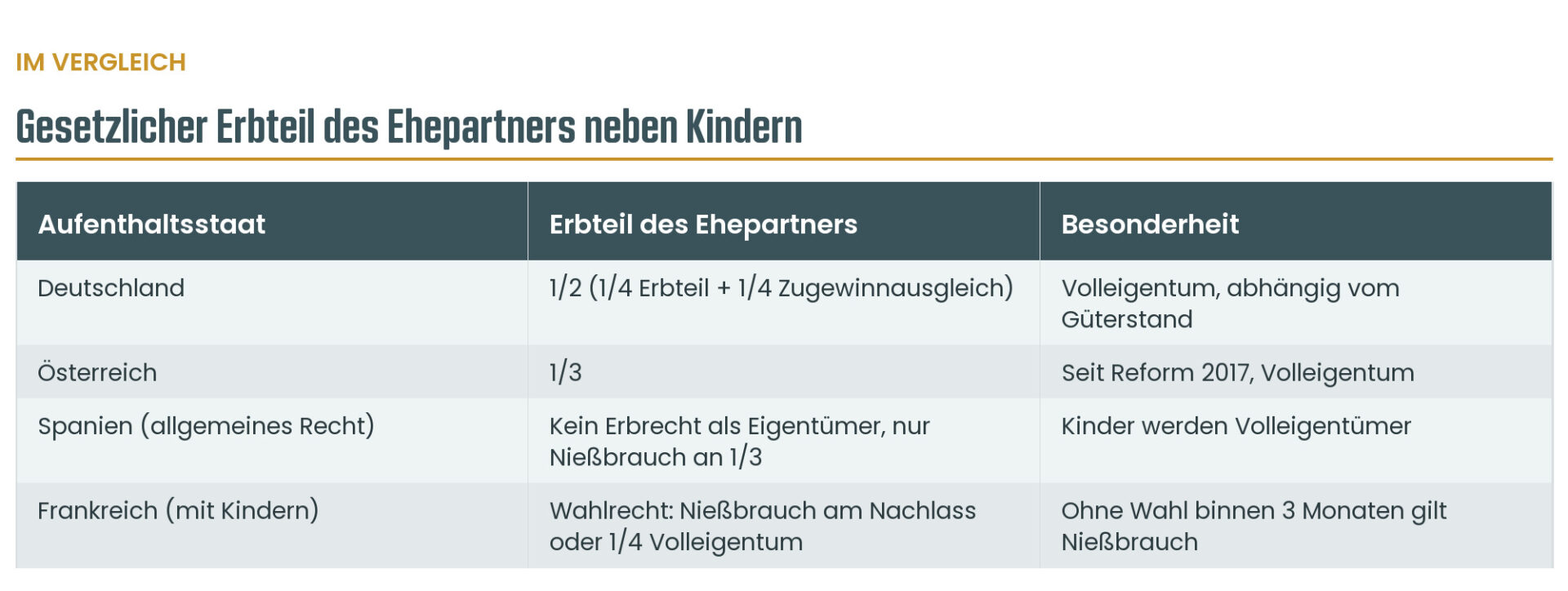
Even this brief excerpt shows that the assumption “my spouse will inherit half in any case” does not hold true, depending on the country of residence – in some legal systems, a spouse does not even become a co-owner of the couple’s property alongside the children, but merely receives a right of use.
Worked Example: Same Estate, Four Different Outcomes
To illustrate the practical impact, consider a purely hypothetical, highly simplified worked example: a testator dies without a will, survived by his wife and two joint children. The estate has a net value of EUR 600,000 (a condominium apartment and bank deposits). The testator was married under the matrimonial property regime of community of accrued gains (Zugewinngemeinschaft) – or the respective country’s default statutory matrimonial property regime. Depending on where he last had his habitual residence, the outcome is as follows:
| Habitual Residence | Wife Receives | Each Child Receives |
|---|---|---|
| Germany | EUR 300,000, full ownership | EUR 150,000, full ownership |
| Austria | EUR 200,000, full ownership | EUR 200,000, full ownership |
| Spain (general law) | No co-ownership, only a usufruct over an estate portion worth around EUR 200,000 | EUR 300,000, full ownership (encumbered by the mother’s usufruct) |
| France (usufruct option, joint children) | Usufruct over the entire estate of EUR 600,000, no full ownership | EUR 300,000, full ownership (encumbered by the mother’s usufruct) |
The difference lies not only in the amount, but in the type of inheritance right involved: under German and Austrian law, the wife immediately becomes a co-owner of the property and may dispose of it freely. Under Spanish and French law, by contrast, she may be allowed to remain living in the couple’s home, yet it legally belongs to the children – with all the practical consequences this entails, for example for a later sale, which would then typically require the children’s consent. This example does not take into account forced heirship claims, preferential legacies, advancements, or differing matrimonial property regimes, and it does not substitute for an individual case assessment; its sole purpose is to illustrate the order of magnitude of the differences.
If the Destination Country Is Not an EU Member State: Renvoi and Further Reference
Matters become particularly complex where the last habitual residence was in a state outside the scope of the EuErbVO – for example, Switzerland, the United Kingdom, the United States, or a non-European country such as Serbia. In these cases, German courts still first examine, under Article 21 EuErbVO, whether the law of that state is applicable. Unlike EU member states, however, such third countries are not bound by the EuErbVO and have their own, differing conflict-of-laws rules. If the destination state’s private international law refers back to German law, or onward to the law of a third state, this must, in principle, be taken into account under Article 34 EuErbVO (the so-called renvoi, comprising both a referral back – Rückverweisung – and a further referral onward – Weiterverweisung), provided the destination state is not itself an EU member state.
As a result, emigrating to a non-EU state can ultimately lead to German law applying after all – or to the law of an entirely different, third state, depending on how the relevant national conflict-of-laws rules are structured. No blanket statement can be made here; the outcome depends on the individual case and the specific destination country, and, in case of doubt, should be clarified in advance rather than being left to be discovered only when the succession actually occurs.
Cross-Border Inheritance Cases in Figures
In practice, this issue affects considerably more people than one might initially assume:
| Metric | Order of Magnitude |
|---|---|
| Succession cases with a cross-border element per year in the EU | approximately 450,000, around 10% of all succession cases in the EU |
| Assets affected per year | estimated at approximately EUR 123 billion |
| German nationals who moved away from Germany (temporarily or permanently) in 2025 | approximately 288,600 |
*(Sources: European Commission estimates on cross-border succession cases; German Federal Statistical Office (Statistisches Bundesamt, Destatis), Migration Statistics 2025, GENESIS-Online table 12711-0011.)*
Today, one in ten succession cases in the EU therefore already has an international element – and, given continuing mobility, this trend is more likely to rise than fall. Anyone emigrating should therefore be aware that, statistically, they are not an exception, but part of a growing norm.
Common Misconceptions About Statutory Succession Abroad
In practice, the same misconceptions come up again and again in client consultations:
- “As a German national, German law always applies to me.” This was true until 2015, but, as a general rule, has no longer been the case since then – what matters is habitual residence, not nationality.
- “Only my property abroad is affected, the rest remains subject to German law.” Under the principle of unity of succession, the foreign law generally applies to the entire estate, not merely to individual assets.
- “Statutory succession is roughly equally fair everywhere anyway.” As the worked example shows, even the legal position of the spouse – full ownership versus a mere usufruct – can differ fundamentally.
- “As long as I still have my German passport, nothing changes.” Nationality can be used as the basis for a choice of law, but without such an explicit declaration, it does not alter the automatic connection to habitual residence.
Two Additional Risks with Assets Abroad: The Time Limit for Disclaiming an Inheritance and Splitting of the Estate in Insolvency
Anyone leaving assets abroad should also keep an eye on the time limit for disclaiming an inheritance (Ausschlagungsfrist): under Section 1944 of the German Civil Code (Bürgerliches Gesetzbuch, BGB), this period is generally six weeks, but is extended to six months if the deceased’s last domicile was exclusively abroad, or if the heir is abroad when the period begins to run. Particularly with assets abroad – such as real estate or a business interest – over-indebtedness may only come to light after this period has expired, where foreign registry or tax information is slower to access than domestic information. In such cases, the only remaining option may be to contest the acceptance of the inheritance under Section 1954 BGB (likewise within six weeks of becoming aware of the grounds), which, however, requires that the over-indebtedness relate to a characteristic material to the value of the estate as a whole – not every single unexpected liability is sufficient.
In addition, where there is over-indebtedness and assets are located in several states, a splitting of the estate (Nachlassspaltung) can occur in the insolvency-law sense: while the EuErbVO, in principle, provides for unity of succession for the estate itself, EU regulations have no binding effect on third countries. Where assets are located in a non-EU state, the jurisdiction and conduct of any insolvency or probate proceedings there are governed by the relevant national law – with the risk of parallel, uncoordinated proceedings running simultaneously in several states.
From Statutory Succession to a Deliberate Decision
The good news is that anyone aware of this automatic connection to habitual residence does not simply have to accept it. The EuErbVO allows an explicit choice of law in a testamentary disposition to determine that the law of one’s own home state should govern the entire estate – regardless of where one lives later on. However, this arrangement requires a will of one’s own and raises its own questions, for instance regarding the form of the disposition and its continued validity after a move. These questions of will drafting are the subject of a separate discussion; at this point, it should merely be noted that the first step consists of becoming aware at all of what applies automatically without any action on one’s own part.
The EuErbVO not only offers the option of securing the law of one’s own home state through a choice of law (Article 22 EuErbVO) – in certain constellations, it can also be deliberately used to shape inheritance-law outcomes such as the German forced heirship regime (Pflichtteilsrecht): anyone who moves their habitual residence to a state whose inheritance law provides no forced heirship rights, or only weaker ones, and does not make a different choice of law there, is, to that extent, also no longer necessarily subject to German forced heirship law. Such planning is legally permissible, but it is not a blank cheque: lifetime transfers of assets can still be caught by the supplementary compulsory portion claim (Pflichtteilsergänzung, under Section 2325 BGB, with a tapering reduction over ten years), and purely artificial arrangements set up solely to circumvent the law risk being legally challenged in an individual case. Such planning should therefore never be undertaken in isolation, but only as part of careful, individual estate planning.
When Prompt Action Is Advisable
- You are shortly to move abroad permanently and do not yet have a will.
- You already live abroad and are not certain which inheritance law applies to you.
- There is a serious illness or some other reason that suggests estate planning should be arranged at short notice.
- Your assets are located in several states, including non-EU states.
- You wish to deliberately choose a different legal system for your estate (choice of law) before your habitual residence changes.
In these cases, the underlying inheritance-law position should be clarified promptly, not merely at some point in the future – a choice of law or a will only takes effect if it is made in good time and in the legally required form.
Conclusion
Anyone who emigrates without making a will leaves the distribution of their estate not to German law, but, as a general rule, to the statutory inheritance law of their new state of residence – with inheritance shares that may differ considerably from German law, and with legal consequences ranging from straightforward full ownership to a mere right of usufruct. Anyone who permanently relocates their habitual residence abroad (or is planning to do so) should therefore first obtain a clear picture of which law would apply automatically in the event of death – before the question arises of whether, and how, a will would be worthwhile.
The Fiala law firm, which focuses on international inheritance law and asset protection, supports clients in assessing their inheritance-law position before and after relocating abroad – from determining the applicable law to the question of whether, and how, a choice of law makes sense. Feel free to contact the firm without obligation to discuss your individual situation in an initial consultation.


